

140
D. Mihajlov et al.
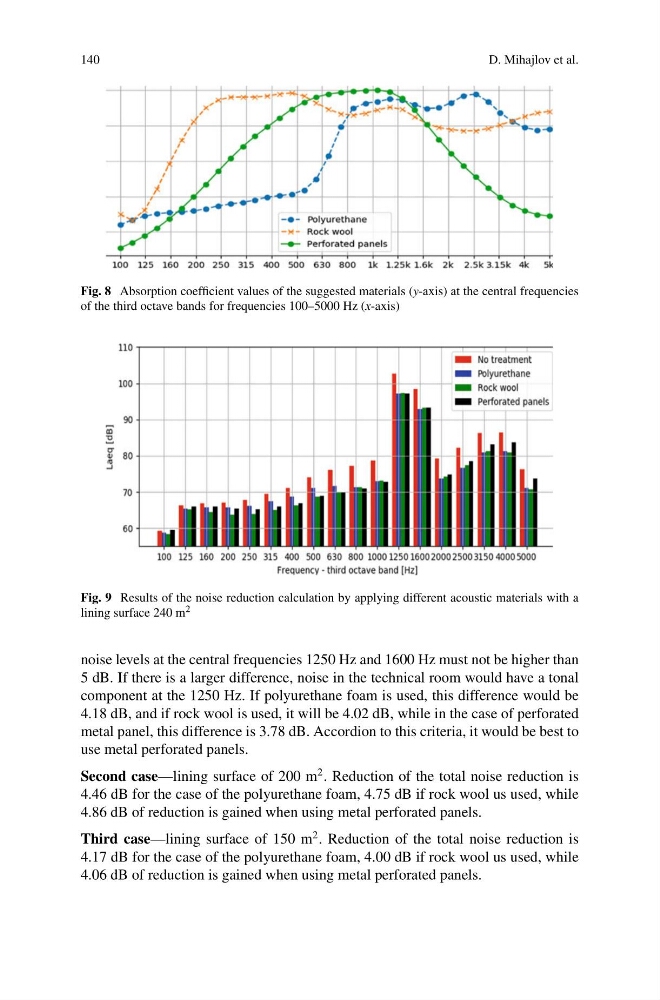
Fig. 8 Absorption coefficient values of the suggested materials (y-axis) at the central frequencies
of the third octave bands for frequencies 100–5000 Hz (x-axis)
Fig. 9 Results of the noise reduction calculation by applying different acoustic materials with a
lining surface 240 m 2
noise levels at the central frequencies 1250 Hz and 1600 Hz must not be higher than
5 dB. If there is a larger difference, noise in the technical room would have a tonal
component at the 1250 Hz. If polyurethane foam is used, this difference would be
4.18 dB, and if rock wool is used, it will be 4.02 dB, while in the case of perforated
metal panel, this difference is 3.78 dB. Accordion to this criteria, it would be best to
use metal perforated panels.
Second case—lining surface of 200 m
2 . Reduction of the total noise reduction is
4.46 dB for the case of the polyurethane foam, 4.75 dB if rock wool us used, while
4.86 dB of reduction is gained when using metal perforated panels.
Third case—lining surface of 150 m
2 . Reduction of the total noise reduction is
4.17 dB for the case of the polyurethane foam, 4.00 dB if rock wool us used, while
4.06 dB of reduction is gained when using metal perforated panels.
D. Mihajlov et al.
Fig. 8 Absorption coefficient values of the suggested materials (y-axis) at the central frequencies
of the third octave bands for frequencies 100–5000 Hz (x-axis)
Fig. 9 Results of the noise reduction calculation by applying different acoustic materials with a
lining surface 240 m 2
noise levels at the central frequencies 1250 Hz and 1600 Hz must not be higher than
5 dB. If there is a larger difference, noise in the technical room would have a tonal
component at the 1250 Hz. If polyurethane foam is used, this difference would be
4.18 dB, and if rock wool is used, it will be 4.02 dB, while in the case of perforated
metal panel, this difference is 3.78 dB. Accordion to this criteria, it would be best to
use metal perforated panels.
Second case—lining surface of 200 m
2 . Reduction of the total noise reduction is
4.46 dB for the case of the polyurethane foam, 4.75 dB if rock wool us used, while
4.86 dB of reduction is gained when using metal perforated panels.
Third case—lining surface of 150 m
2 . Reduction of the total noise reduction is
4.17 dB for the case of the polyurethane foam, 4.00 dB if rock wool us used, while
4.06 dB of reduction is gained when using metal perforated panels.