

136
D. Mihajlov et al.
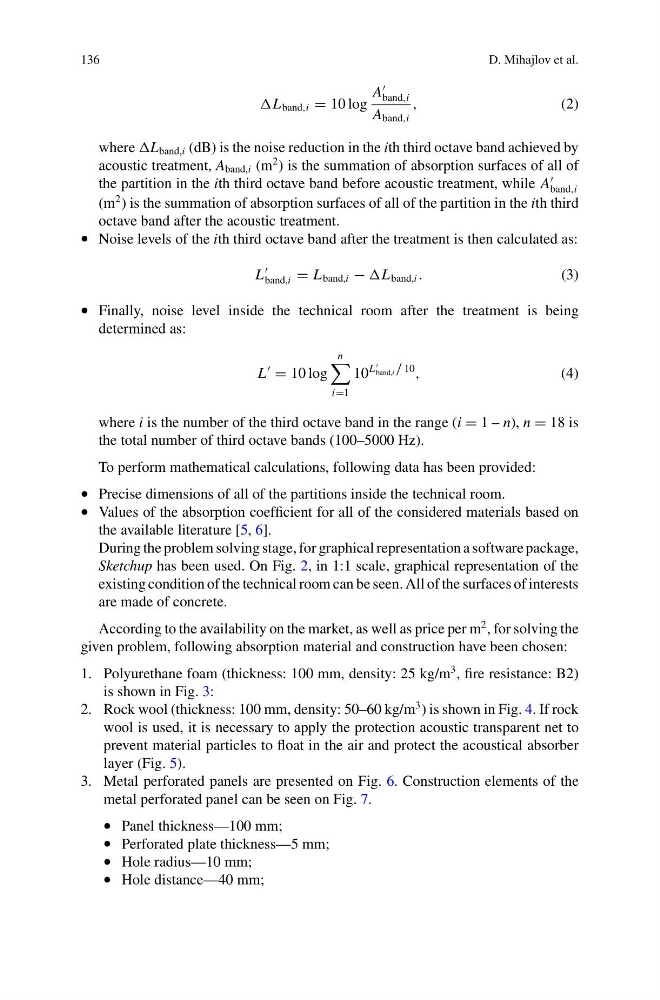
L band,i = 10 log
A
band,i
A band,i
,
(2)
where L band,i (dB) is the noise reduction in the ith third octave band achieved by
acoustic treatment, A band,i (m
2 ) is the summation of absorption surfaces of all of
the partition in the ith third octave band before acoustic treatment, while A
band,i
(m
2 ) is the summation of absorption surfaces of all of the partition in the ith third
octave band after the acoustic treatment.
• Noise levels of the ith third octave band after the treatment is then calculated as:
L
band,i = L band,i − L band,i .
(3)
• Finally, noise level inside the technical room after the treatment is being
determined as:
L
= 10 log
n
i=1
10
L
band,i
10
,
(4)
where i is the number of the third octave band in the range (i = 1 – n), n = 18 is
the total number of third octave bands (100–5000 Hz).
To perform mathematical calculations, following data has been provided:
• Precise dimensions of all of the partitions inside the technical room.
• Values of the absorption coefficient for all of the considered materials based on
the available literature [5, 6].
During the problem solving stage, for graphical representation a software package,
Sketchup has been used. On Fig. 2, in 1:1 scale, graphical representation of the
existing condition of the technical room can be seen. All of the surfaces of interests
are made of concrete.
According to the availability on the market, as well as price per m
2 , for solving the
given problem, following absorption material and construction have been chosen:
1. Polyurethane foam (thickness: 100 mm, density: 25 kg/m
3 , fire resistance: B2)
is shown in Fig. 3:
2. Rock wool (thickness: 100 mm, density: 50–60 kg/m
3 ) is shown in Fig. 4. If rock
wool is used, it is necessary to apply the protection acoustic transparent net to
prevent material particles to float in the air and protect the acoustical absorber
layer (Fig. 5).
3. Metal perforated panels are presented on Fig. 6. Construction elements of the
metal perforated panel can be seen on Fig. 7.
• Panel thickness—100 mm;
• Perforated plate thickness—5 mm;
• Hole radius—10 mm;
• Hole distance—40 mm;
D. Mihajlov et al.
L band,i = 10 log
A
band,i
A band,i
,
(2)
where L band,i (dB) is the noise reduction in the ith third octave band achieved by
acoustic treatment, A band,i (m
2 ) is the summation of absorption surfaces of all of
the partition in the ith third octave band before acoustic treatment, while A
band,i
(m
2 ) is the summation of absorption surfaces of all of the partition in the ith third
octave band after the acoustic treatment.
• Noise levels of the ith third octave band after the treatment is then calculated as:
L
band,i = L band,i − L band,i .
(3)
• Finally, noise level inside the technical room after the treatment is being
determined as:
L
= 10 log
n
i=1
10
L
band,i
10
,
(4)
where i is the number of the third octave band in the range (i = 1 – n), n = 18 is
the total number of third octave bands (100–5000 Hz).
To perform mathematical calculations, following data has been provided:
• Precise dimensions of all of the partitions inside the technical room.
• Values of the absorption coefficient for all of the considered materials based on
the available literature [5, 6].
During the problem solving stage, for graphical representation a software package,
Sketchup has been used. On Fig. 2, in 1:1 scale, graphical representation of the
existing condition of the technical room can be seen. All of the surfaces of interests
are made of concrete.
According to the availability on the market, as well as price per m
2 , for solving the
given problem, following absorption material and construction have been chosen:
1. Polyurethane foam (thickness: 100 mm, density: 25 kg/m
3 , fire resistance: B2)
is shown in Fig. 3:
2. Rock wool (thickness: 100 mm, density: 50–60 kg/m
3 ) is shown in Fig. 4. If rock
wool is used, it is necessary to apply the protection acoustic transparent net to
prevent material particles to float in the air and protect the acoustical absorber
layer (Fig. 5).
3. Metal perforated panels are presented on Fig. 6. Construction elements of the
metal perforated panel can be seen on Fig. 7.
• Panel thickness—100 mm;
• Perforated plate thickness—5 mm;
• Hole radius—10 mm;
• Hole distance—40 mm;