

Development of Methodologies and Means for Noise Protection …
119
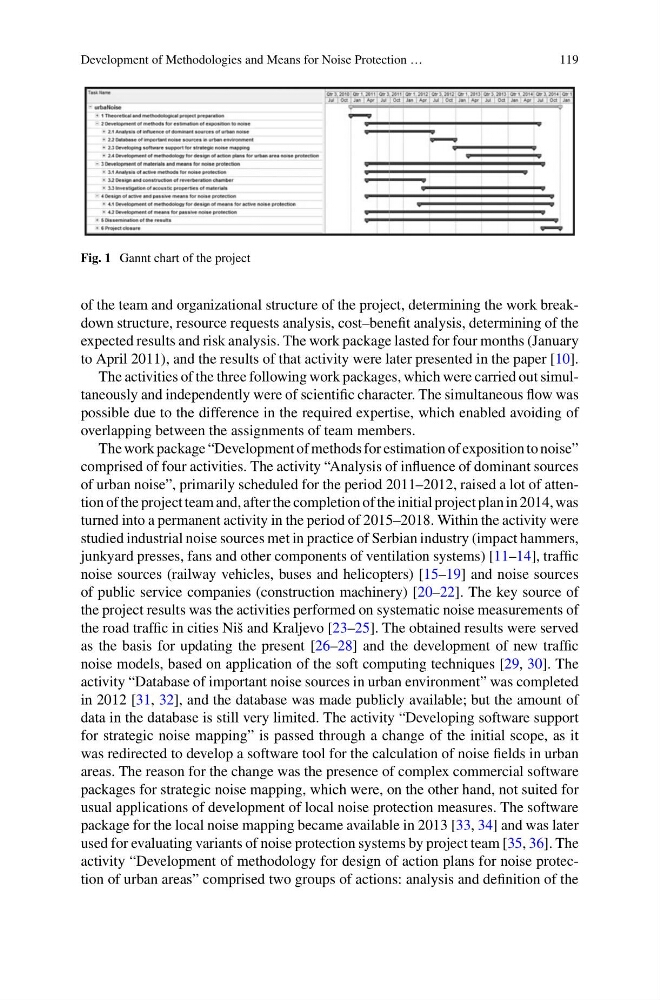
Fig. 1 Gannt chart of the project
of the team and organizational structure of the project, determining the work breakdown structure, resource requests analysis, cost–benefit analysis, determining of the
expected results and risk analysis. The work package lasted for four months (January
to April 2011), and the results of that activity were later presented in the paper [10].
The activities of the three following work packages, which were carried out simultaneously and independently were of scientific character. The simultaneous flow was
possible due to the difference in the required expertise, which enabled avoiding of
overlapping between the assignments of team members.
The work package “Development of methods for estimation of exposition to noise”
comprised of four activities. The activity “Analysis of influence of dominant sources
of urban noise”, primarily scheduled for the period 2011–2012, raised a lot of attention of the project team and, after the completion of the initial project plan in 2014, was
turned into a permanent activity in the period of 2015–2018. Within the activity were
studied industrial noise sources met in practice of Serbian industry (impact hammers,
junkyard presses, fans and other components of ventilation systems) [11–14], traffic
noise sources (railway vehicles, buses and helicopters) [15–19] and noise sources
of public service companies (construction machinery) [20–22]. The key source of
the project results was the activities performed on systematic noise measurements of
the road traffic in cities Niš and Kraljevo [23–25]. The obtained results were served
as the basis for updating the present [26–28] and the development of new traffic
noise models, based on application of the soft computing techniques [29, 30]. The
activity “Database of important noise sources in urban environment” was completed
in 2012 [31, 32], and the database was made publicly available; but the amount of
data in the database is still very limited. The activity “Developing software support
for strategic noise mapping” is passed through a change of the initial scope, as it
was redirected to develop a software tool for the calculation of noise fields in urban
areas. The reason for the change was the presence of complex commercial software
packages for strategic noise mapping, which were, on the other hand, not suited for
usual applications of development of local noise protection measures. The software
package for the local noise mapping became available in 2013 [33, 34] and was later
used for evaluating variants of noise protection systems by project team [35, 36]. The
activity “Development of methodology for design of action plans for noise protection of urban areas” comprised two groups of actions: analysis and definition of the
119
Fig. 1 Gannt chart of the project
of the team and organizational structure of the project, determining the work breakdown structure, resource requests analysis, cost–benefit analysis, determining of the
expected results and risk analysis. The work package lasted for four months (January
to April 2011), and the results of that activity were later presented in the paper [10].
The activities of the three following work packages, which were carried out simultaneously and independently were of scientific character. The simultaneous flow was
possible due to the difference in the required expertise, which enabled avoiding of
overlapping between the assignments of team members.
The work package “Development of methods for estimation of exposition to noise”
comprised of four activities. The activity “Analysis of influence of dominant sources
of urban noise”, primarily scheduled for the period 2011–2012, raised a lot of attention of the project team and, after the completion of the initial project plan in 2014, was
turned into a permanent activity in the period of 2015–2018. Within the activity were
studied industrial noise sources met in practice of Serbian industry (impact hammers,
junkyard presses, fans and other components of ventilation systems) [11–14], traffic
noise sources (railway vehicles, buses and helicopters) [15–19] and noise sources
of public service companies (construction machinery) [20–22]. The key source of
the project results was the activities performed on systematic noise measurements of
the road traffic in cities Niš and Kraljevo [23–25]. The obtained results were served
as the basis for updating the present [26–28] and the development of new traffic
noise models, based on application of the soft computing techniques [29, 30]. The
activity “Database of important noise sources in urban environment” was completed
in 2012 [31, 32], and the database was made publicly available; but the amount of
data in the database is still very limited. The activity “Developing software support
for strategic noise mapping” is passed through a change of the initial scope, as it
was redirected to develop a software tool for the calculation of noise fields in urban
areas. The reason for the change was the presence of complex commercial software
packages for strategic noise mapping, which were, on the other hand, not suited for
usual applications of development of local noise protection measures. The software
package for the local noise mapping became available in 2013 [33, 34] and was later
used for evaluating variants of noise protection systems by project team [35, 36]. The
activity “Development of methodology for design of action plans for noise protection of urban areas” comprised two groups of actions: analysis and definition of the