

65
5. Peptides that fibrillate quickly need to be lyophilized as soon as
HPLC fractions are collected and samples are prepared for
subsequent analytical HPLC and MALDI-TOF analysis.
Lyophilized peptides can be stored for up to a year at −20 °C
with containers tightly sealed. Strongly aggregating peptides
tend to become less soluble over time and their catalytic activity decreases.
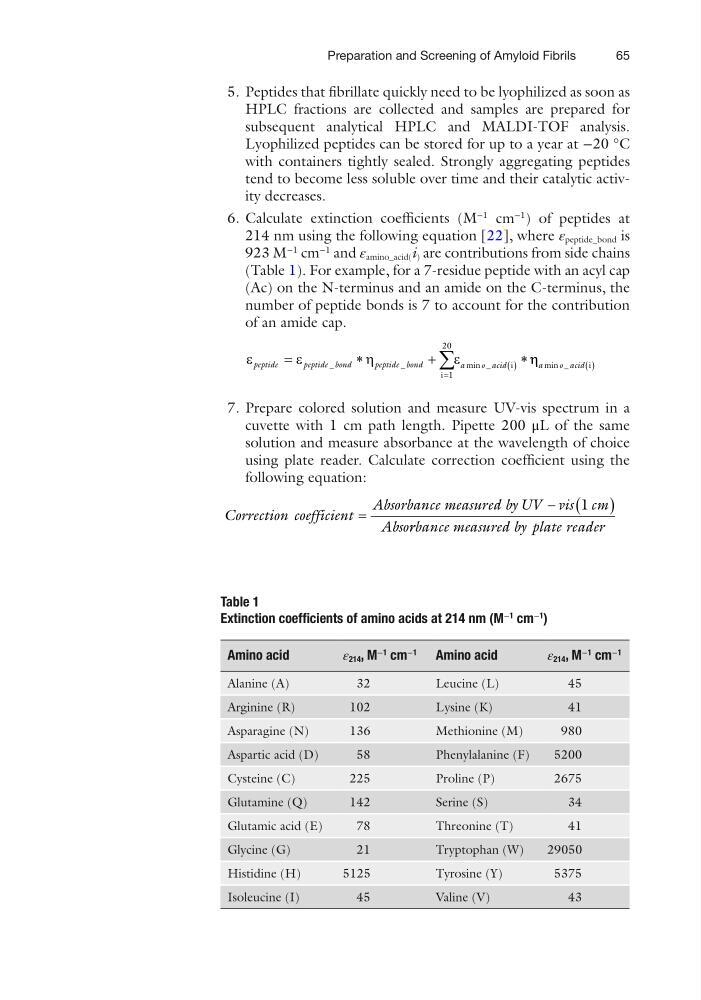
6. Calculate extinction coefficients (M
−1
cm
−1
) of peptides at
214 nm using the following equation [22], where ε peptide_bond is
923 M
−1
cm
−1
and ε amino_acid( i ) are contributions from side chains
(Table 1). For example, for a 7-residue peptide with an acyl cap
(Ac) on the N-terminus and an amide on the C-terminus, the
number of peptide bonds is 7 to account for the contribution
of an amide cap.
e
e
h
e
peptide
p eptide bond
peptide bond
a
o acid
=
*
+
*
=
( )
å
_
_
min _
i
i
1
20
h h a o acid
min _
i
( )
7. Prepare colored solution and measure UV-vis spectrum in a
cuvette with 1 cm path length. Pipette 200 μL of the same
solution and measure absorbance at the wavelength of choice
using plate reader. Calculate correction coefficient using the
following equation:
Correction coefficient
Absorbance measured by UV vis cm
Abso
=
- (
)
1
r rbance measured by plate reader
Table 1
Extinction coefficients of amino acids at 214 nm (M
−1
cm
−1
)
Amino acid
ε 214 , M
−1
cm
−1
Amino acid
ε 214 , M
−1
cm
−1
Alanine (A)
32
Leucine (L)
45
Arginine (R)
102
Lysine (K)
41
Asparagine (N)
136
Methionine (M)
980
Aspartic acid (D)
58
Phenylalanine (F)
5200
Cysteine (C)
225
Proline (P)
2675
Glutamine (Q)
142
Serine (S)
34
Glutamic acid (E)
78
Threonine (T)
41
Glycine (G)
21
Tryptophan (W)
29050
Histidine (H)
5125
Tyrosine (Y)
5375
Isoleucine (I)
45
Valine (V)
43
Preparation and Screening of Amyloid Fibrils
5. Peptides that fibrillate quickly need to be lyophilized as soon as
HPLC fractions are collected and samples are prepared for
subsequent analytical HPLC and MALDI-TOF analysis.
Lyophilized peptides can be stored for up to a year at −20 °C
with containers tightly sealed. Strongly aggregating peptides
tend to become less soluble over time and their catalytic activity decreases.
6. Calculate extinction coefficients (M
−1
cm
−1
) of peptides at
214 nm using the following equation [22], where ε peptide_bond is
923 M
−1
cm
−1
and ε amino_acid( i ) are contributions from side chains
(Table 1). For example, for a 7-residue peptide with an acyl cap
(Ac) on the N-terminus and an amide on the C-terminus, the
number of peptide bonds is 7 to account for the contribution
of an amide cap.
e
e
h
e
peptide
p eptide bond
peptide bond
a
o acid
=
*
+
*
=
( )
å
_
_
min _
i
i
1
20
h h a o acid
min _
i
( )
7. Prepare colored solution and measure UV-vis spectrum in a
cuvette with 1 cm path length. Pipette 200 μL of the same
solution and measure absorbance at the wavelength of choice
using plate reader. Calculate correction coefficient using the
following equation:
Correction coefficient
Absorbance measured by UV vis cm
Abso
=
- (
)
1
r rbance measured by plate reader
Table 1
Extinction coefficients of amino acids at 214 nm (M
−1
cm
−1
)
Amino acid
ε 214 , M
−1
cm
−1
Amino acid
ε 214 , M
−1
cm
−1
Alanine (A)
32
Leucine (L)
45
Arginine (R)
102
Lysine (K)
41
Asparagine (N)
136
Methionine (M)
980
Aspartic acid (D)
58
Phenylalanine (F)
5200
Cysteine (C)
225
Proline (P)
2675
Glutamine (Q)
142
Serine (S)
34
Glutamic acid (E)
78
Threonine (T)
41
Glycine (G)
21
Tryptophan (W)
29050
Histidine (H)
5125
Tyrosine (Y)
5375
Isoleucine (I)
45
Valine (V)
43
Preparation and Screening of Amyloid Fibrils