

63
1. Determine the path length in the 96-well plate for a volume of
200 μL (see Note 7).
2. Prepare two working buffers: (1) 25 mM Hepes-KOH, pH
8—mix 0.5 mL of 1 M Hepes-KOH and 19.5 mL of water in
a 50 mL Falcon tube; (2) 28.4 mM Hepes-KOH, pH 8—mix
0.568 mL of 1 M Hepes-KOH and 19.4 mL of water.
3. Dilute 50 mM CuSO 4 into water to 10 mM and then further
dilute the solution tenfold to make 1 mM stock of CuSO 4 in
water (see Note 8).
4. Prepare 2 mL of 2 mM DMP solution in water: mix 1.825 mL
of water, 125 μL of isopropanol, 50 μL of 80 mM DMP.
5. Prepare a mixture of peptide and Cu
2+
in buffer: mix 40 μL of
1 mM peptide stock in 10 mM HCl and 20 μL of 1 mM Cu
2+
in water, then add 440 μL of 28.4 mM Hepes-KOH buffer,
pH 8 (see Note 9). This will give 500 μL of solution with
40 μM Cu
2+
and 80 μM peptide. For a blank solution, mix
40 μL of 10 mM HCl, 20 μL of 1 mM Cu
2+
in water, and
440 μL of 28.4 mM Hepes-KOH buffer, pH 8.
6. Fill reaction reservoir (trough) with 25 mM Hepes-KOH buffer, pH 8. Using a 12-channel pipette dispense 100 μL of this
buffer into each well to be used of the 96-well plate.
7. Add 50 μL of Cu-peptide solution (40 μM Cu
2+
and 80 μM
peptide) or blank. Each sample should be analyzed at least
three times (use three wells).
8. Set up an experiment on the plate reader to follow the absorbance at 476 nm, taking measurements every 10 s for 5 min.
9. Fill another trough with 2 mM DMP. Using a 12-channel
pipette deliver 50 μL of 2 mM DMP into each well. Gently
pipette up and down four times to mix (see Note 10).
10. Place the 96-well plate into the plate reader and start the measurements (see Note 11).
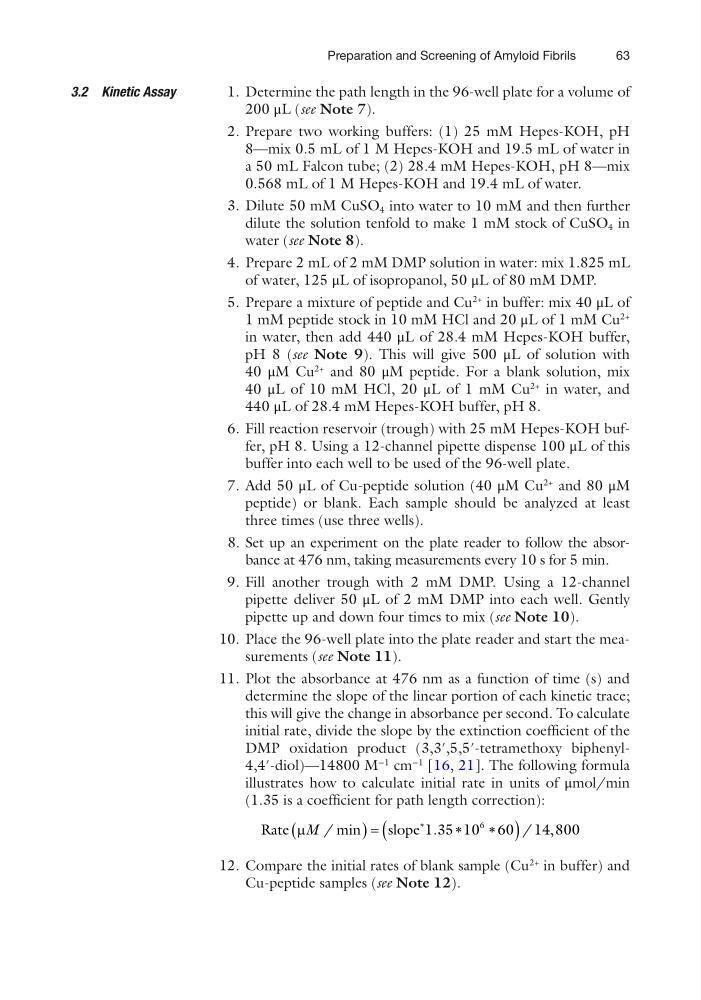
11. Plot the absorbance at 476 nm as a function of time (s) and
determine the slope of the linear portion of each kinetic trace;
this will give the change in absorbance per second. To calculate
initial rate, divide the slope by the extinction coefficient of the
DMP oxidation product (3,3′,5,5′-tetramethoxy biphenyl4,4′-diol)—14800 M
−1
cm
−1
[16, 21]. The following formula
illustrates how to calculate initial rate in units of μmol/min
(1.35 is a coefficient for path length correction):
Rate
slope
mM / min
.
/ ,
(
)=
*
*
(
)
*
1 35 10 60 14 800
6
12. Compare the initial rates of blank sample (Cu
2+
in buffer) and
Cu-peptide samples (see Note 12).
3.2 Kinetic Assay
Preparation and Screening of Amyloid Fibrils
1. Determine the path length in the 96-well plate for a volume of
200 μL (see Note 7).
2. Prepare two working buffers: (1) 25 mM Hepes-KOH, pH
8—mix 0.5 mL of 1 M Hepes-KOH and 19.5 mL of water in
a 50 mL Falcon tube; (2) 28.4 mM Hepes-KOH, pH 8—mix
0.568 mL of 1 M Hepes-KOH and 19.4 mL of water.
3. Dilute 50 mM CuSO 4 into water to 10 mM and then further
dilute the solution tenfold to make 1 mM stock of CuSO 4 in
water (see Note 8).
4. Prepare 2 mL of 2 mM DMP solution in water: mix 1.825 mL
of water, 125 μL of isopropanol, 50 μL of 80 mM DMP.
5. Prepare a mixture of peptide and Cu
2+
in buffer: mix 40 μL of
1 mM peptide stock in 10 mM HCl and 20 μL of 1 mM Cu
2+
in water, then add 440 μL of 28.4 mM Hepes-KOH buffer,
pH 8 (see Note 9). This will give 500 μL of solution with
40 μM Cu
2+
and 80 μM peptide. For a blank solution, mix
40 μL of 10 mM HCl, 20 μL of 1 mM Cu
2+
in water, and
440 μL of 28.4 mM Hepes-KOH buffer, pH 8.
6. Fill reaction reservoir (trough) with 25 mM Hepes-KOH buffer, pH 8. Using a 12-channel pipette dispense 100 μL of this
buffer into each well to be used of the 96-well plate.
7. Add 50 μL of Cu-peptide solution (40 μM Cu
2+
and 80 μM
peptide) or blank. Each sample should be analyzed at least
three times (use three wells).
8. Set up an experiment on the plate reader to follow the absorbance at 476 nm, taking measurements every 10 s for 5 min.
9. Fill another trough with 2 mM DMP. Using a 12-channel
pipette deliver 50 μL of 2 mM DMP into each well. Gently
pipette up and down four times to mix (see Note 10).
10. Place the 96-well plate into the plate reader and start the measurements (see Note 11).
11. Plot the absorbance at 476 nm as a function of time (s) and
determine the slope of the linear portion of each kinetic trace;
this will give the change in absorbance per second. To calculate
initial rate, divide the slope by the extinction coefficient of the
DMP oxidation product (3,3′,5,5′-tetramethoxy biphenyl4,4′-diol)—14800 M
−1
cm
−1
[16, 21]. The following formula
illustrates how to calculate initial rate in units of μmol/min
(1.35 is a coefficient for path length correction):
Rate
slope
mM / min
.
/ ,
(
)=
*
*
(
)
*
1 35 10 60 14 800
6
12. Compare the initial rates of blank sample (Cu
2+
in buffer) and
Cu-peptide samples (see Note 12).
3.2 Kinetic Assay
Preparation and Screening of Amyloid Fibrils