

60
(7- residues or less) de novo designed peptides, catalyze ester
hydrolysis in the presence of Zn
2+
. The most catalytically active
peptide, Ac-IHIHIQI-CONH 2 , was identified by varying hydrophobic core residues and the sequence of hydrophilic portion of
the peptide. This peptide self-assembles into fibrils and binds zinc,
the resulting material catalyzes hydrolysis of p-nitrophenyl esters
with efficiency comparable to that of the natural enzymes by weight
[7]. Peptides that do not form fibrils, but have similar sequences
otherwise, showed significantly lower catalytic activity. The correlation between the propensity to form fibrils and the ability to catalyze chemical reactions suggests that the rigid fibril arrangement of
functional groups in peptide assemblies locks the metal ion in a
coordination environment that promotes catalysis. The strategy of
using peptide self-assembly for design of catalysts can be further
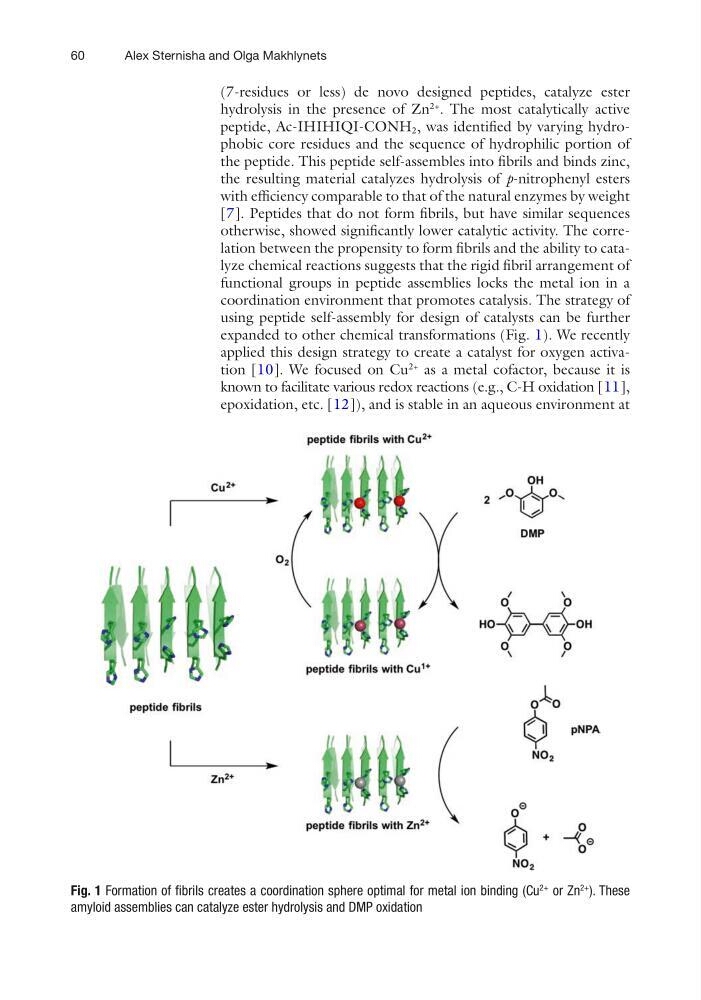
expanded to other chemical transformations (Fig. 1). We recently
applied this design strategy to create a catalyst for oxygen activation [10]. We focused on Cu
2+
as a metal cofactor, because it is
known to facilitate various redox reactions (e.g., C-H oxidation [11],
epoxidation, etc. [12]), and is stable in an aqueous environment at
Fig. 1 Formation of fibrils creates a coordination sphere optimal for metal ion binding (Cu
2+
or Zn
2+
). These
amyloid assemblies can catalyze ester hydrolysis and DMP oxidation
Alex Sternisha and Olga Makhlynets
(7- residues or less) de novo designed peptides, catalyze ester
hydrolysis in the presence of Zn
2+
. The most catalytically active
peptide, Ac-IHIHIQI-CONH 2 , was identified by varying hydrophobic core residues and the sequence of hydrophilic portion of
the peptide. This peptide self-assembles into fibrils and binds zinc,
the resulting material catalyzes hydrolysis of p-nitrophenyl esters
with efficiency comparable to that of the natural enzymes by weight
[7]. Peptides that do not form fibrils, but have similar sequences
otherwise, showed significantly lower catalytic activity. The correlation between the propensity to form fibrils and the ability to catalyze chemical reactions suggests that the rigid fibril arrangement of
functional groups in peptide assemblies locks the metal ion in a
coordination environment that promotes catalysis. The strategy of
using peptide self-assembly for design of catalysts can be further
expanded to other chemical transformations (Fig. 1). We recently
applied this design strategy to create a catalyst for oxygen activation [10]. We focused on Cu
2+
as a metal cofactor, because it is
known to facilitate various redox reactions (e.g., C-H oxidation [11],
epoxidation, etc. [12]), and is stable in an aqueous environment at
Fig. 1 Formation of fibrils creates a coordination sphere optimal for metal ion binding (Cu
2+
or Zn
2+
). These
amyloid assemblies can catalyze ester hydrolysis and DMP oxidation
Alex Sternisha and Olga Makhlynets