

29
absence of the target ligand, and chiefly in state N′ (or N) in its
presence. Finally, fluorophores are incorporated at locations
that consistently report on the N ⇆ N′ conformational change,
independent of the choice of POI.
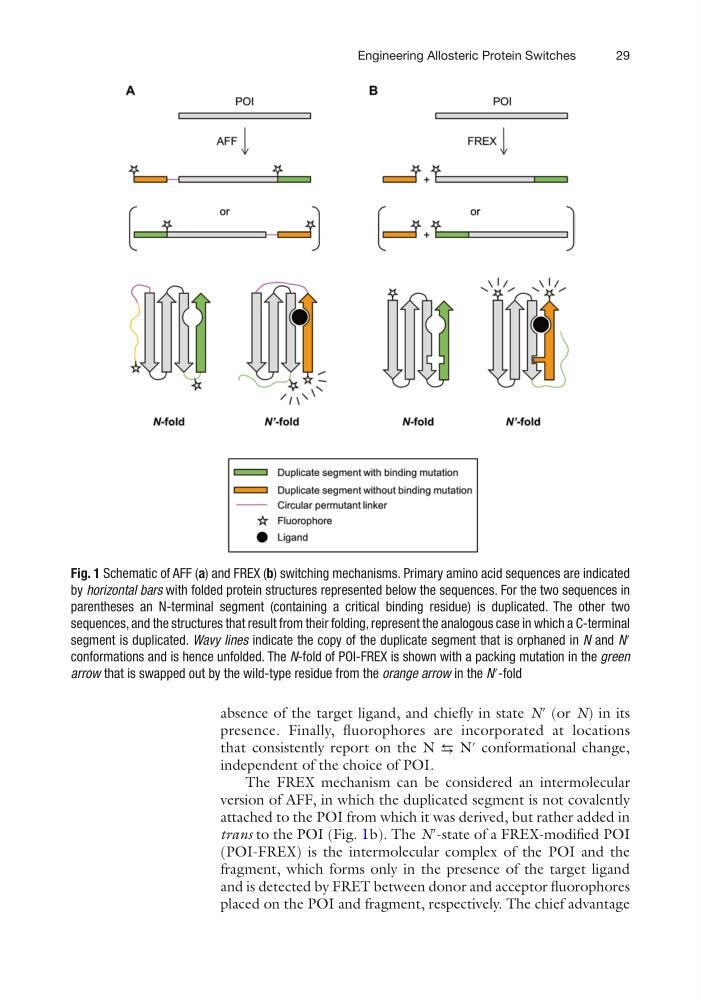
The FREX mechanism can be considered an intermolecular
version of AFF, in which the duplicated segment is not covalently
attached to the POI from which it was derived, but rather added in
trans to the POI (Fig. 1b). The N′-state of a FREX-modified POI
(POI-FREX) is the intermolecular complex of the POI and the
fragment, which forms only in the presence of the target ligand
and is detected by FRET between donor and acceptor fluorophores
placed on the POI and fragment, respectively. The chief advantage
Fig. 1 Schematic of AFF (a) and FREX (b) switching mechanisms. Primary amino acid sequences are indicated
by horizontal bars with folded protein structures represented below the sequences. For the two sequences in
parentheses an N-terminal segment (containing a critical binding residue) is duplicated. The other two
sequences, and the structures that result from their folding, represent the analogous case in which a C-terminal
segment is duplicated. Wavy lines indicate the copy of the duplicate segment that is orphaned in N and N′
conformations and is hence unfolded. The N-fold of POI-FREX is shown with a packing mutation in the green
arrow that is swapped out by the wild-type residue from the orange arrow in the N′-fold
Engineering Allosteric Protein Switches
absence of the target ligand, and chiefly in state N′ (or N) in its
presence. Finally, fluorophores are incorporated at locations
that consistently report on the N ⇆ N′ conformational change,
independent of the choice of POI.
The FREX mechanism can be considered an intermolecular
version of AFF, in which the duplicated segment is not covalently
attached to the POI from which it was derived, but rather added in
trans to the POI (Fig. 1b). The N′-state of a FREX-modified POI
(POI-FREX) is the intermolecular complex of the POI and the
fragment, which forms only in the presence of the target ligand
and is detected by FRET between donor and acceptor fluorophores
placed on the POI and fragment, respectively. The chief advantage
Fig. 1 Schematic of AFF (a) and FREX (b) switching mechanisms. Primary amino acid sequences are indicated
by horizontal bars with folded protein structures represented below the sequences. For the two sequences in
parentheses an N-terminal segment (containing a critical binding residue) is duplicated. The other two
sequences, and the structures that result from their folding, represent the analogous case in which a C-terminal
segment is duplicated. Wavy lines indicate the copy of the duplicate segment that is orphaned in N and N′
conformations and is hence unfolded. The N-fold of POI-FREX is shown with a packing mutation in the green
arrow that is swapped out by the wild-type residue from the orange arrow in the N′-fold
Engineering Allosteric Protein Switches