

332
10. Dephosphorylate the ends of the linearized acceptor plasmid
by incubation with Antarctic phosphatase at 37 °C for 1 h to
reduce self-ligation background.
11. Determine the concentration of each digested DNA fragment
by measuring absorbance at 260 nm using a Nanodrop spectrophotometer (or equivalent instrument). Once again, this
step is key, as multi-insert ligations are very sensitive to the
relative concentration of all fragments being ligated. We have
found that a molar ratio of 2:1:1:1 (where “2” is the acceptor
plasmid) is efficient for 3-insert ligations.
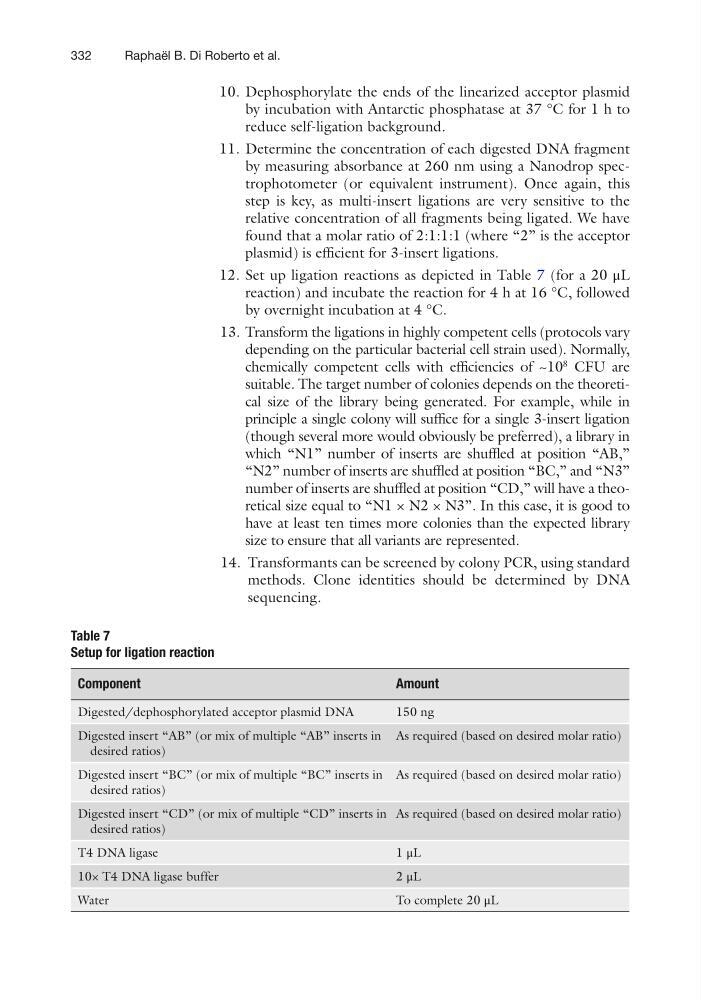
12. Set up ligation reactions as depicted in Table 7 (for a 20 μL
reaction) and incubate the reaction for 4 h at 16 °C, followed
by overnight incubation at 4 °C.
13. Transform the ligations in highly competent cells (protocols vary
depending on the particular bacterial cell strain used). Normally,
chemically competent cells with efficiencies of ~10
8
CFU are
suitable. The target number of colonies depends on the theoretical size of the library being generated. For example, while in
principle a single colony will suffice for a single 3-insert ligation
(though several more would obviously be preferred), a library in
which “N1” number of inserts are shuffled at position “AB,”
“N2” number of inserts are shuffled at position “BC,” and “N3”
number of inserts are shuffled at position “CD,” will have a theoretical size equal to “N1 × N2 × N3”. In this case, it is good to
have at least ten times more colonies than the expected library
size to ensure that all variants are represented.
14. Transformants can be screened by colony PCR, using standard
methods. Clone identities should be determined by DNA
sequencing.
Table 7
Setup for ligation reaction
Component
Amount
Digested/dephosphorylated acceptor plasmid DNA
150 ng
Digested insert “AB” (or mix of multiple “AB” inserts in
desired ratios)
As required (based on desired molar ratio)
Digested insert “BC” (or mix of multiple “BC” inserts in
desired ratios)
As required (based on desired molar ratio)
Digested insert “CD” (or mix of multiple “CD” inserts in
desired ratios)
As required (based on desired molar ratio)
T4 DNA ligase
1 μL
10× T4 DNA ligase buffer
2 μL
Water
To complete 20 μL
Raphaël B. Di Roberto et al.
10. Dephosphorylate the ends of the linearized acceptor plasmid
by incubation with Antarctic phosphatase at 37 °C for 1 h to
reduce self-ligation background.
11. Determine the concentration of each digested DNA fragment
by measuring absorbance at 260 nm using a Nanodrop spectrophotometer (or equivalent instrument). Once again, this
step is key, as multi-insert ligations are very sensitive to the
relative concentration of all fragments being ligated. We have
found that a molar ratio of 2:1:1:1 (where “2” is the acceptor
plasmid) is efficient for 3-insert ligations.
12. Set up ligation reactions as depicted in Table 7 (for a 20 μL
reaction) and incubate the reaction for 4 h at 16 °C, followed
by overnight incubation at 4 °C.
13. Transform the ligations in highly competent cells (protocols vary
depending on the particular bacterial cell strain used). Normally,
chemically competent cells with efficiencies of ~10
8
CFU are
suitable. The target number of colonies depends on the theoretical size of the library being generated. For example, while in
principle a single colony will suffice for a single 3-insert ligation
(though several more would obviously be preferred), a library in
which “N1” number of inserts are shuffled at position “AB,”
“N2” number of inserts are shuffled at position “BC,” and “N3”
number of inserts are shuffled at position “CD,” will have a theoretical size equal to “N1 × N2 × N3”. In this case, it is good to
have at least ten times more colonies than the expected library
size to ensure that all variants are represented.
14. Transformants can be screened by colony PCR, using standard
methods. Clone identities should be determined by DNA
sequencing.
Table 7
Setup for ligation reaction
Component
Amount
Digested/dephosphorylated acceptor plasmid DNA
150 ng
Digested insert “AB” (or mix of multiple “AB” inserts in
desired ratios)
As required (based on desired molar ratio)
Digested insert “BC” (or mix of multiple “BC” inserts in
desired ratios)
As required (based on desired molar ratio)
Digested insert “CD” (or mix of multiple “CD” inserts in
desired ratios)
As required (based on desired molar ratio)
T4 DNA ligase
1 μL
10× T4 DNA ligase buffer
2 μL
Water
To complete 20 μL
Raphaël B. Di Roberto et al.