

327
5 μL of 10× Mutazyme II reaction buffer.
1 μL of 40 mM dNTP mix.
0.5 μL of PCR primer mix (250 ng/μL of each PCR primer).
1 μL of Mutazyme II DNA polymerase (2.5 U/μL).
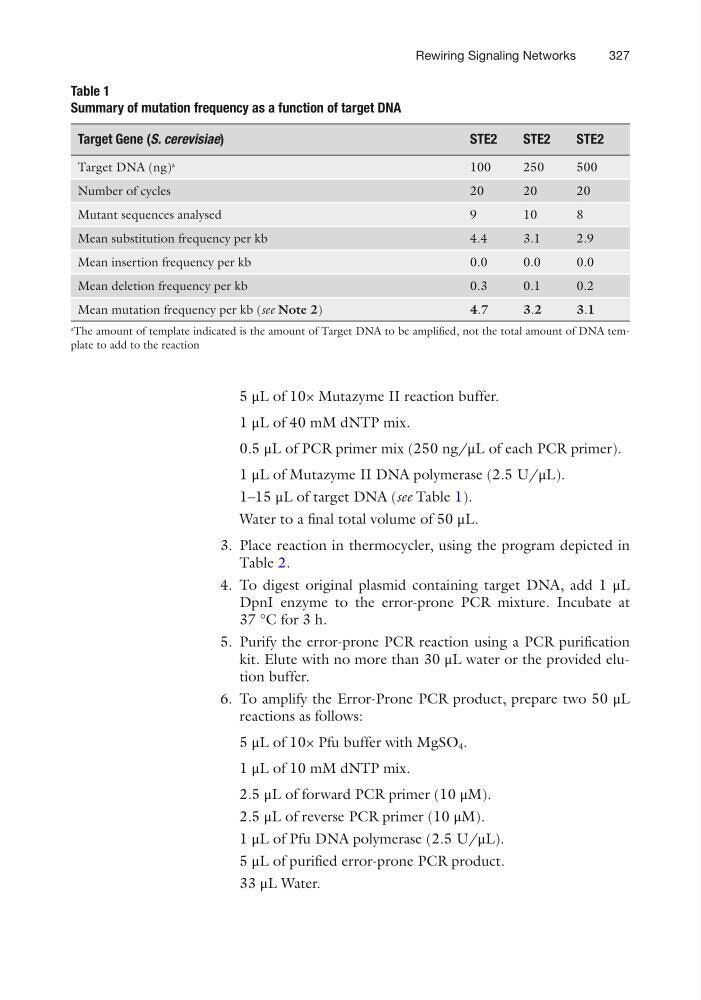
1–15 μL of target DNA (see Table 1).
Water to a final total volume of 50 μL.
3. Place reaction in thermocycler, using the program depicted in
Table 2.
4. To digest original plasmid containing target DNA, add 1 μL
DpnI enzyme to the error-prone PCR mixture. Incubate at
37 °C for 3 h.
5. Purify the error-prone PCR reaction using a PCR purification
kit. Elute with no more than 30 μL water or the provided elution buffer.
6. To amplify the Error-Prone PCR product, prepare two 50 μL
reactions as follows:
5 μL of 10× Pfu buffer with MgSO 4 .
1 μL of 10 mM dNTP mix.
2.5 μL of forward PCR primer (10 μM).
2.5 μL of reverse PCR primer (10 μM).
1 μL of Pfu DNA polymerase (2.5 U/μL).
5 μL of purified error-prone PCR product.
33 μL Water.
Table 1
Summary of mutation frequency as a function of target DNA
Target Gene (S. cerevisiae)
STE2
STE2
STE2
Target DNA (ng)
a
100
250
500
Number of cycles
20
20
20
Mutant sequences analysed
9
10
8
Mean substitution frequency per kb
4.4
3.1
2.9
Mean insertion frequency per kb
0.0
0.0
0.0
Mean deletion frequency per kb
0.3
0.1
0.2
Mean mutation frequency per kb (see Note 2)
4.7
3.2
3.1
a
The amount of template indicated is the amount of Target DNA to be amplified, not the total amount of DNA template to add to the reaction
Rewiring Signaling Networks
5 μL of 10× Mutazyme II reaction buffer.
1 μL of 40 mM dNTP mix.
0.5 μL of PCR primer mix (250 ng/μL of each PCR primer).
1 μL of Mutazyme II DNA polymerase (2.5 U/μL).
1–15 μL of target DNA (see Table 1).
Water to a final total volume of 50 μL.
3. Place reaction in thermocycler, using the program depicted in
Table 2.
4. To digest original plasmid containing target DNA, add 1 μL
DpnI enzyme to the error-prone PCR mixture. Incubate at
37 °C for 3 h.
5. Purify the error-prone PCR reaction using a PCR purification
kit. Elute with no more than 30 μL water or the provided elution buffer.
6. To amplify the Error-Prone PCR product, prepare two 50 μL
reactions as follows:
5 μL of 10× Pfu buffer with MgSO 4 .
1 μL of 10 mM dNTP mix.
2.5 μL of forward PCR primer (10 μM).
2.5 μL of reverse PCR primer (10 μM).
1 μL of Pfu DNA polymerase (2.5 U/μL).
5 μL of purified error-prone PCR product.
33 μL Water.
Table 1
Summary of mutation frequency as a function of target DNA
Target Gene (S. cerevisiae)
STE2
STE2
STE2
Target DNA (ng)
a
100
250
500
Number of cycles
20
20
20
Mutant sequences analysed
9
10
8
Mean substitution frequency per kb
4.4
3.1
2.9
Mean insertion frequency per kb
0.0
0.0
0.0
Mean deletion frequency per kb
0.3
0.1
0.2
Mean mutation frequency per kb (see Note 2)
4.7
3.2
3.1
a
The amount of template indicated is the amount of Target DNA to be amplified, not the total amount of DNA template to add to the reaction
Rewiring Signaling Networks