

272
functional voltage-gated K
+
channel by connecting the voltage sensor
of CiVSP, a phosphatase found in the ascidian Ciona intestinalis, to
the pore of a Kcv, a K
+
channel found in the algae virus PBCV-1
[3]. An exciting perspective is the expansion of signals perceived by
K
+
channels beyond the realm of those already sensed by native
channels. Regulation of K
+
channels by infrared light, magnetic
fields or ultrasounds that freely penetrate mammalian tissues, will
offer the unprecedented possibility to control cellular functions in
freely moving and behaving organisms.
We recently succeeded in engineering BLINK1, a blue light
(475 nm)-gated K
+
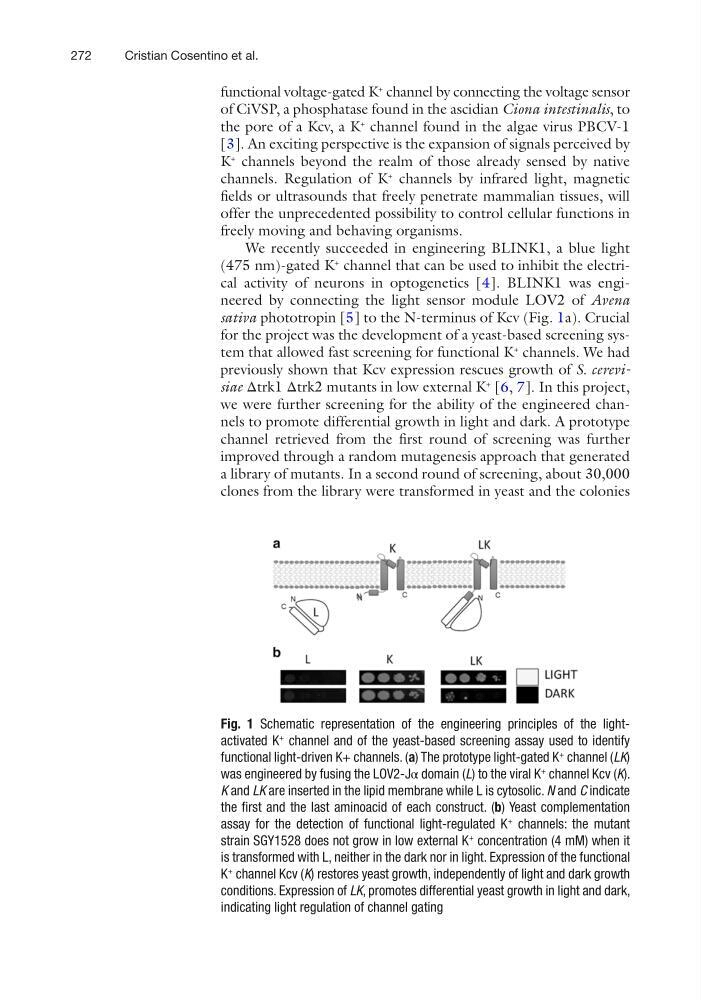
channel that can be used to inhibit the electrical activity of neurons in optogenetics [4]. BLINK1 was engineered by connecting the light sensor module LOV2 of Avena
sativa phototropin [5] to the N-terminus of Kcv (Fig. 1a). Crucial
for the project was the development of a yeast-based screening system that allowed fast screening for functional K
+
channels. We had
previously shown that Kcv expression rescues growth of S. cerevisiae Δtrk1 Δtrk2 mutants in low external K
+
[6, 7]. In this project,
we were further screening for the ability of the engineered channels to promote differential growth in light and dark. A prototype
channel retrieved from the first round of screening was further
improved through a random mutagenesis approach that generated
a library of mutants. In a second round of screening, about 30,000
clones from the library were transformed in yeast and the colonies
Fig. 1 Schematic representation of the engineering principles of the lightactivated K
+
channel and of the yeast-based screening assay used to identify
functional light-driven K+ channels. (a) The prototype light-gated K
+
channel (LK)
was engineered by fusing the LOV2-Jα domain (L) to the viral K
+
channel Kcv (K).
K and LK are inserted in the lipid membrane while L is cytosolic. N and C indicate
the first and the last aminoacid of each construct. (b) Yeast complementation
assay for the detection of functional light-regulated K
+
channels: the mutant
strain SGY1528 does not grow in low external K
+
concentration (4 mM) when it
is transformed with L, neither in the dark nor in light. Expression of the functional
K
+
channel Kcv (K) restores yeast growth, independently of light and dark growth
conditions. Expression of LK, promotes differential yeast growth in light and dark,
indicating light regulation of channel gating
Cristian Cosentino et al.
functional voltage-gated K
+
channel by connecting the voltage sensor
of CiVSP, a phosphatase found in the ascidian Ciona intestinalis, to
the pore of a Kcv, a K
+
channel found in the algae virus PBCV-1
[3]. An exciting perspective is the expansion of signals perceived by
K
+
channels beyond the realm of those already sensed by native
channels. Regulation of K
+
channels by infrared light, magnetic
fields or ultrasounds that freely penetrate mammalian tissues, will
offer the unprecedented possibility to control cellular functions in
freely moving and behaving organisms.
We recently succeeded in engineering BLINK1, a blue light
(475 nm)-gated K
+
channel that can be used to inhibit the electrical activity of neurons in optogenetics [4]. BLINK1 was engineered by connecting the light sensor module LOV2 of Avena
sativa phototropin [5] to the N-terminus of Kcv (Fig. 1a). Crucial
for the project was the development of a yeast-based screening system that allowed fast screening for functional K
+
channels. We had
previously shown that Kcv expression rescues growth of S. cerevisiae Δtrk1 Δtrk2 mutants in low external K
+
[6, 7]. In this project,
we were further screening for the ability of the engineered channels to promote differential growth in light and dark. A prototype
channel retrieved from the first round of screening was further
improved through a random mutagenesis approach that generated
a library of mutants. In a second round of screening, about 30,000
clones from the library were transformed in yeast and the colonies
Fig. 1 Schematic representation of the engineering principles of the lightactivated K
+
channel and of the yeast-based screening assay used to identify
functional light-driven K+ channels. (a) The prototype light-gated K
+
channel (LK)
was engineered by fusing the LOV2-Jα domain (L) to the viral K
+
channel Kcv (K).
K and LK are inserted in the lipid membrane while L is cytosolic. N and C indicate
the first and the last aminoacid of each construct. (b) Yeast complementation
assay for the detection of functional light-regulated K
+
channels: the mutant
strain SGY1528 does not grow in low external K
+
concentration (4 mM) when it
is transformed with L, neither in the dark nor in light. Expression of the functional
K
+
channel Kcv (K) restores yeast growth, independently of light and dark growth
conditions. Expression of LK, promotes differential yeast growth in light and dark,
indicating light regulation of channel gating
Cristian Cosentino et al.