

262
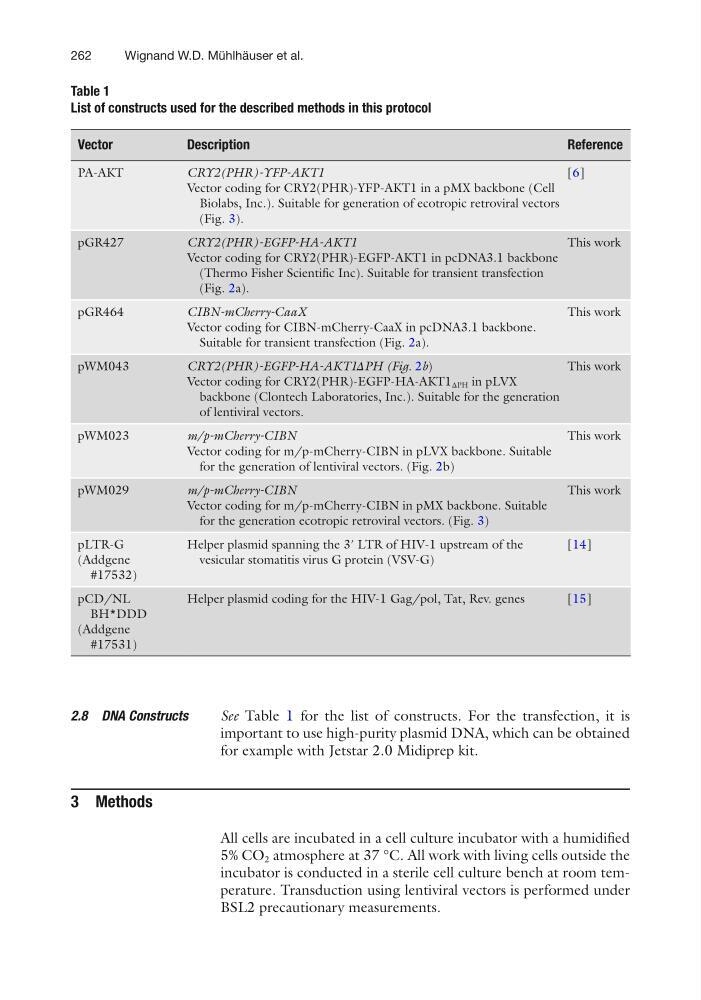
See Table 1 for the list of constructs. For the transfection, it is
important to use high-purity plasmid DNA, which can be obtained
for example with Jetstar 2.0 Midiprep kit.
3 Methods
All cells are incubated in a cell culture incubator with a humidified
5% CO 2 atmosphere at 37 °C. All work with living cells outside the
incubator is conducted in a sterile cell culture bench at room temperature. Transduction using lentiviral vectors is performed under
BSL2 precautionary measurements.
2.8 DNA Constructs
Table 1
List of constructs used for the described methods in this protocol
Vector
Description
Reference
PA-AKT
CRY2(PHR)-YFP-AKT1
Vector coding for CRY2(PHR)-YFP-AKT1 in a pMX backbone (Cell
Biolabs, Inc.). Suitable for generation of ecotropic retroviral vectors
(Fig. 3).
[6]
pGR427
CRY2(PHR)-EGFP-HA-AKT1
Vector coding for CRY2(PHR)-EGFP-AKT1 in pcDNA3.1 backbone
(Thermo Fisher Scientific Inc). Suitable for transient transfection
(Fig. 2a).
This work
pGR464
CIBN-mCherry-CaaX
Vector coding for CIBN-mCherry-CaaX in pcDNA3.1 backbone.
Suitable for transient transfection (Fig. 2a).
This work
pWM043
CRY2(PHR)-EGFP-HA-AKT1ΔPH (Fig. 2b)
Vector coding for CRY2(PHR)-EGFP-HA-AKT1 ΔPH in pLVX
backbone (Clontech Laboratories, Inc.). Suitable for the generation
of lentiviral vectors.
This work
pWM023
m/p-mCherry-CIBN
Vector coding for m/p-mCherry-CIBN in pLVX backbone. Suitable
for the generation of lentiviral vectors. (Fig. 2b)
This work
pWM029
m/p-mCherry-CIBN
Vector coding for m/p-mCherry-CIBN in pMX backbone. Suitable
for the generation ecotropic retroviral vectors. (Fig. 3)
This work
pLTR-G
(Addgene
#17532)
Helper plasmid spanning the 3′ LTR of HIV-1 upstream of the
vesicular stomatitis virus G protein (VSV-G)
[14]
pCD/NL
BH*DDD
(Addgene
#17531)
Helper plasmid coding for the HIV-1 Gag/pol, Tat, Rev. genes
[15]
Wignand W.D. Mühlhäuser et al.
See Table 1 for the list of constructs. For the transfection, it is
important to use high-purity plasmid DNA, which can be obtained
for example with Jetstar 2.0 Midiprep kit.
3 Methods
All cells are incubated in a cell culture incubator with a humidified
5% CO 2 atmosphere at 37 °C. All work with living cells outside the
incubator is conducted in a sterile cell culture bench at room temperature. Transduction using lentiviral vectors is performed under
BSL2 precautionary measurements.
2.8 DNA Constructs
Table 1
List of constructs used for the described methods in this protocol
Vector
Description
Reference
PA-AKT
CRY2(PHR)-YFP-AKT1
Vector coding for CRY2(PHR)-YFP-AKT1 in a pMX backbone (Cell
Biolabs, Inc.). Suitable for generation of ecotropic retroviral vectors
(Fig. 3).
[6]
pGR427
CRY2(PHR)-EGFP-HA-AKT1
Vector coding for CRY2(PHR)-EGFP-AKT1 in pcDNA3.1 backbone
(Thermo Fisher Scientific Inc). Suitable for transient transfection
(Fig. 2a).
This work
pGR464
CIBN-mCherry-CaaX
Vector coding for CIBN-mCherry-CaaX in pcDNA3.1 backbone.
Suitable for transient transfection (Fig. 2a).
This work
pWM043
CRY2(PHR)-EGFP-HA-AKT1ΔPH (Fig. 2b)
Vector coding for CRY2(PHR)-EGFP-HA-AKT1 ΔPH in pLVX
backbone (Clontech Laboratories, Inc.). Suitable for the generation
of lentiviral vectors.
This work
pWM023
m/p-mCherry-CIBN
Vector coding for m/p-mCherry-CIBN in pLVX backbone. Suitable
for the generation of lentiviral vectors. (Fig. 2b)
This work
pWM029
m/p-mCherry-CIBN
Vector coding for m/p-mCherry-CIBN in pMX backbone. Suitable
for the generation ecotropic retroviral vectors. (Fig. 3)
This work
pLTR-G
(Addgene
#17532)
Helper plasmid spanning the 3′ LTR of HIV-1 upstream of the
vesicular stomatitis virus G protein (VSV-G)
[14]
pCD/NL
BH*DDD
(Addgene
#17531)
Helper plasmid coding for the HIV-1 Gag/pol, Tat, Rev. genes
[15]
Wignand W.D. Mühlhäuser et al.