

248
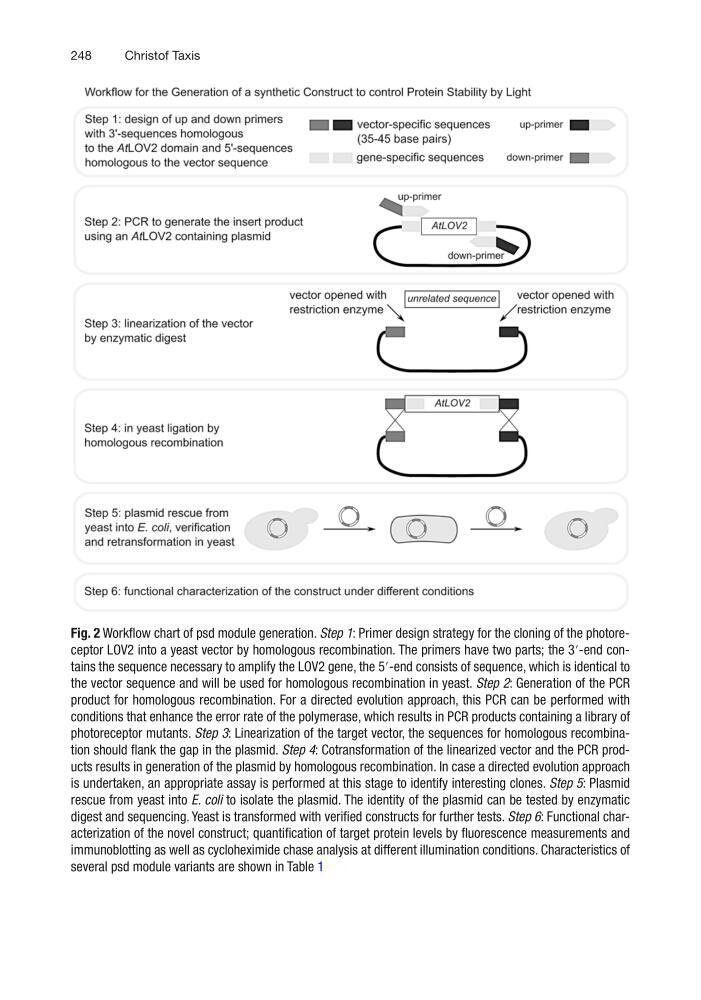
Fig. 2 Workflow chart of psd module generation. Step 1: Primer design strategy for the cloning of the photoreceptor LOV2 into a yeast vector by homologous recombination. The primers have two parts; the 3′-end contains the sequence necessary to amplify the LOV2 gene, the 5′-end consists of sequence, which is identical to
the vector sequence and will be used for homologous recombination in yeast. Step 2: Generation of the PCR
product for homologous recombination. For a directed evolution approach, this PCR can be performed with
conditions that enhance the error rate of the polymerase, which results in PCR products containing a library of
photoreceptor mutants. Step 3: Linearization of the target vector, the sequences for homologous recombination should flank the gap in the plasmid. Step 4: Cotransformation of the linearized vector and the PCR products results in generation of the plasmid by homologous recombination. In case a directed evolution approach
is undertaken, an appropriate assay is performed at this stage to identify interesting clones. Step 5: Plasmid
rescue from yeast into E. coli to isolate the plasmid. The identity of the plasmid can be tested by enzymatic
digest and sequencing. Yeast is transformed with verified constructs for further tests. Step 6: Functional characterization of the novel construct; quantification of target protein levels by fluorescence measurements and
immunoblotting as well as cycloheximide chase analysis at different illumination conditions. Characteristics of
several psd module variants are shown in Table 1
Christof Taxis
Fig. 2 Workflow chart of psd module generation. Step 1: Primer design strategy for the cloning of the photoreceptor LOV2 into a yeast vector by homologous recombination. The primers have two parts; the 3′-end contains the sequence necessary to amplify the LOV2 gene, the 5′-end consists of sequence, which is identical to
the vector sequence and will be used for homologous recombination in yeast. Step 2: Generation of the PCR
product for homologous recombination. For a directed evolution approach, this PCR can be performed with
conditions that enhance the error rate of the polymerase, which results in PCR products containing a library of
photoreceptor mutants. Step 3: Linearization of the target vector, the sequences for homologous recombination should flank the gap in the plasmid. Step 4: Cotransformation of the linearized vector and the PCR products results in generation of the plasmid by homologous recombination. In case a directed evolution approach
is undertaken, an appropriate assay is performed at this stage to identify interesting clones. Step 5: Plasmid
rescue from yeast into E. coli to isolate the plasmid. The identity of the plasmid can be tested by enzymatic
digest and sequencing. Yeast is transformed with verified constructs for further tests. Step 6: Functional characterization of the novel construct; quantification of target protein levels by fluorescence measurements and
immunoblotting as well as cycloheximide chase analysis at different illumination conditions. Characteristics of
several psd module variants are shown in Table 1
Christof Taxis