

199
drug target, but is also increasingly adopted to develop tools for
basic research. Notably, a range of peptide-based, active site directed
inhibitors have been devised for HCV that can serve as AI-domains
and readily be identified from the existing literature [5].
In general terms, proteases are preferably well characterized
both biochemically and structurally. The availability of large protein families is also advantageous as it allows to infer biochemical
and structural information from phylogenetic data. Notably, for
viral proteases whose native function is to process the viral polyprotein, the putative cleavage site can be directly identified from the
genomic sequence requiring little experimental profiling of proteolytic cleavage sites. The availability of biochemical and X-ray
structural data also suggests that it is possible to produce and engineer a particular protease through the recombinant route in E. coli.
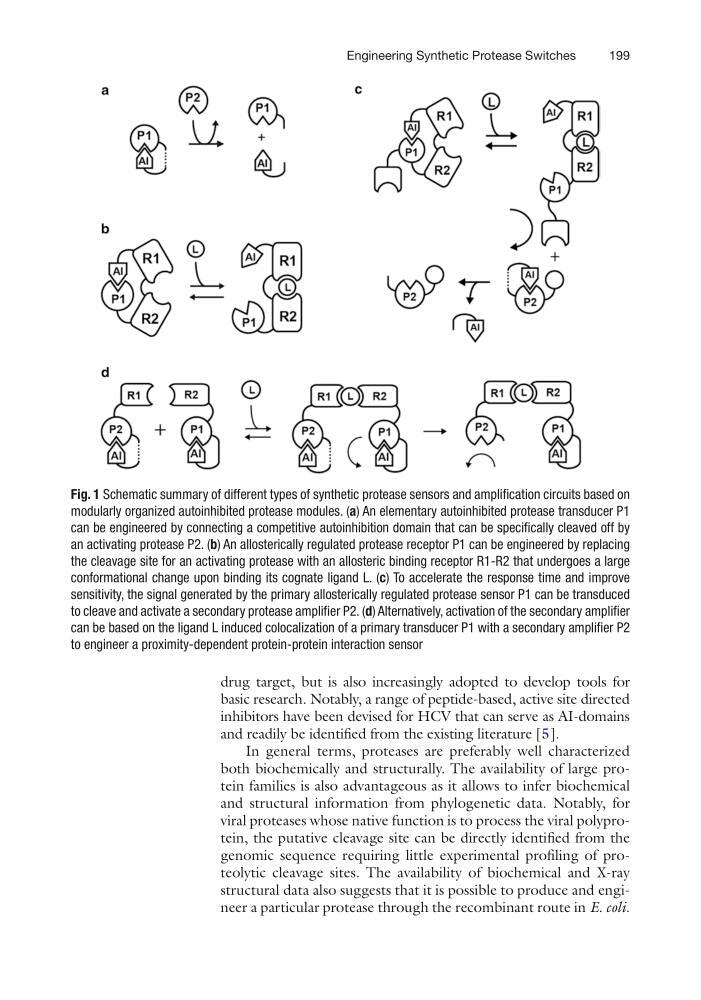
Fig. 1 Schematic summary of different types of synthetic protease sensors and amplification circuits based on
modularly organized autoinhibited protease modules. (a) An elementary autoinhibited protease transducer P1
can be engineered by connecting a competitive autoinhibition domain that can be specifically cleaved off by
an activating protease P2. (b) An allosterically regulated protease receptor P1 can be engineered by replacing
the cleavage site for an activating protease with an allosteric binding receptor R1-R2 that undergoes a large
conformational change upon binding its cognate ligand L. (c) To accelerate the response time and improve
sensitivity, the signal generated by the primary allosterically regulated protease sensor P1 can be transduced
to cleave and activate a secondary protease amplifier P2. (d) Alternatively, activation of the secondary amplifier
can be based on the ligand L induced colocalization of a primary transducer P1 with a secondary amplifier P2
to engineer a proximity-dependent protein-protein interaction sensor
Engineering Synthetic Protease Switches
drug target, but is also increasingly adopted to develop tools for
basic research. Notably, a range of peptide-based, active site directed
inhibitors have been devised for HCV that can serve as AI-domains
and readily be identified from the existing literature [5].
In general terms, proteases are preferably well characterized
both biochemically and structurally. The availability of large protein families is also advantageous as it allows to infer biochemical
and structural information from phylogenetic data. Notably, for
viral proteases whose native function is to process the viral polyprotein, the putative cleavage site can be directly identified from the
genomic sequence requiring little experimental profiling of proteolytic cleavage sites. The availability of biochemical and X-ray
structural data also suggests that it is possible to produce and engineer a particular protease through the recombinant route in E. coli.
Fig. 1 Schematic summary of different types of synthetic protease sensors and amplification circuits based on
modularly organized autoinhibited protease modules. (a) An elementary autoinhibited protease transducer P1
can be engineered by connecting a competitive autoinhibition domain that can be specifically cleaved off by
an activating protease P2. (b) An allosterically regulated protease receptor P1 can be engineered by replacing
the cleavage site for an activating protease with an allosteric binding receptor R1-R2 that undergoes a large
conformational change upon binding its cognate ligand L. (c) To accelerate the response time and improve
sensitivity, the signal generated by the primary allosterically regulated protease sensor P1 can be transduced
to cleave and activate a secondary protease amplifier P2. (d) Alternatively, activation of the secondary amplifier
can be based on the ligand L induced colocalization of a primary transducer P1 with a secondary amplifier P2
to engineer a proximity-dependent protein-protein interaction sensor
Engineering Synthetic Protease Switches