

181
catalytic conversion of substrate to product, the enzyme-based
DNA detection is more sensitive than direct optical readout of
conformational switching sensors such as molecular beacons [14].
Here, we provide detailed protocols for the expression, purification, and bioconjugation of the TEM1-β-lactamase- and BLIPoligonucleotide conjugates, as well as their assembly into an easily
tunable system for oligonucleotide detection in molecular diagnostics and the readout of DNA-based molecular circuits. While the
DNA-directed protein switch described in this chapter is originally
designed to respond to ssDNA, the range of input molecules could
be extended to small molecules and proteins by intelligent redesign
of the input module using conformation-switching aptamers. Since
plasmids for expression of both protein components will be made
accessible via AddGene, we hope that these protocols will enable
the TEM1-β-lactamase/BLIP system to be widely used. In addition, both the design principles and the bioconjugation methods
described here for the TEM1-β-lactamase/BLIP system should be
generally applicable to other enzyme-inhibitor pairs, provided that
they interact with a similar affinity.
2 Materials
1. Plasmid pET29a_TEM1-β-lactamaseE104D_CtermC (encoding periplasmic leader sequence, His-tag, Thrombin cleavage site, TEM1-β-lactamase(E104D), cysteine, Strep-tag)
(see Notes 1 and 2).
2.1 Protein
Expression
and Purification
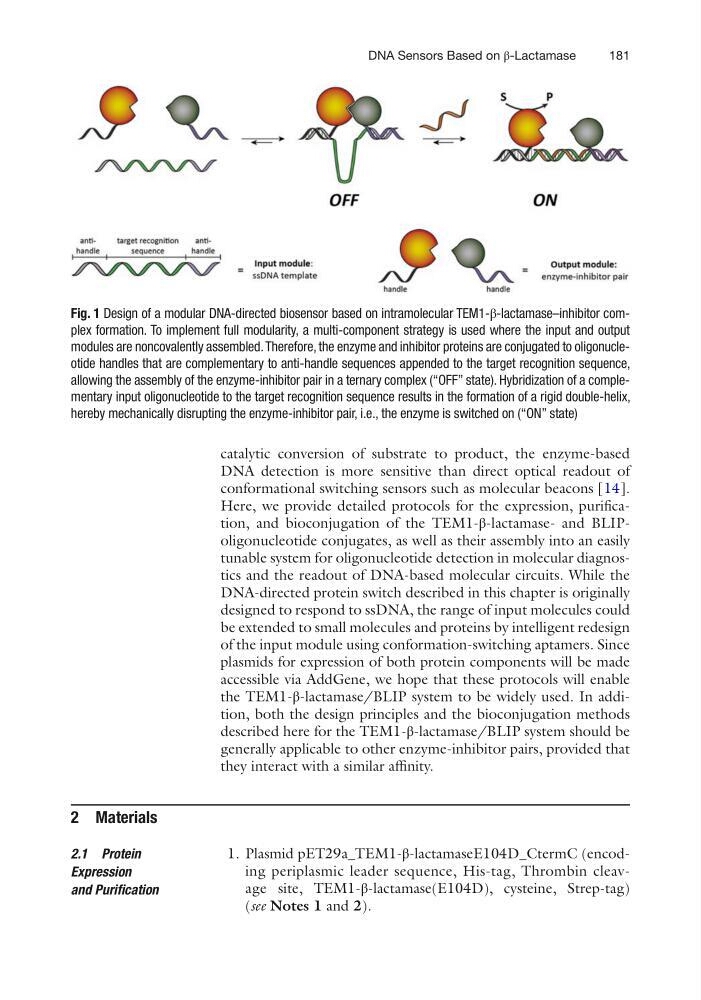
Fig. 1 Design of a modular DNA-directed biosensor based on intramolecular TEM1-β-lactamase–inhibitor complex formation. To implement full modularity, a multi-component strategy is used where the input and output
modules are noncovalently assembled. Therefore, the enzyme and inhibitor proteins are conjugated to oligonucleotide handles that are complementary to anti-handle sequences appended to the target recognition sequence,
allowing the assembly of the enzyme-inhibitor pair in a ternary complex (“OFF” state). Hybridization of a complementary input oligonucleotide to the target recognition sequence results in the formation of a rigid double-helix,
hereby mechanically disrupting the enzyme-inhibitor pair, i.e., the enzyme is switched on (“ON” state)
DNA Sensors Based on β-Lactamase
catalytic conversion of substrate to product, the enzyme-based
DNA detection is more sensitive than direct optical readout of
conformational switching sensors such as molecular beacons [14].
Here, we provide detailed protocols for the expression, purification, and bioconjugation of the TEM1-β-lactamase- and BLIPoligonucleotide conjugates, as well as their assembly into an easily
tunable system for oligonucleotide detection in molecular diagnostics and the readout of DNA-based molecular circuits. While the
DNA-directed protein switch described in this chapter is originally
designed to respond to ssDNA, the range of input molecules could
be extended to small molecules and proteins by intelligent redesign
of the input module using conformation-switching aptamers. Since
plasmids for expression of both protein components will be made
accessible via AddGene, we hope that these protocols will enable
the TEM1-β-lactamase/BLIP system to be widely used. In addition, both the design principles and the bioconjugation methods
described here for the TEM1-β-lactamase/BLIP system should be
generally applicable to other enzyme-inhibitor pairs, provided that
they interact with a similar affinity.
2 Materials
1. Plasmid pET29a_TEM1-β-lactamaseE104D_CtermC (encoding periplasmic leader sequence, His-tag, Thrombin cleavage site, TEM1-β-lactamase(E104D), cysteine, Strep-tag)
(see Notes 1 and 2).
2.1 Protein
Expression
and Purification
Fig. 1 Design of a modular DNA-directed biosensor based on intramolecular TEM1-β-lactamase–inhibitor complex formation. To implement full modularity, a multi-component strategy is used where the input and output
modules are noncovalently assembled. Therefore, the enzyme and inhibitor proteins are conjugated to oligonucleotide handles that are complementary to anti-handle sequences appended to the target recognition sequence,
allowing the assembly of the enzyme-inhibitor pair in a ternary complex (“OFF” state). Hybridization of a complementary input oligonucleotide to the target recognition sequence results in the formation of a rigid double-helix,
hereby mechanically disrupting the enzyme-inhibitor pair, i.e., the enzyme is switched on (“ON” state)
DNA Sensors Based on β-Lactamase