

168
that binding of the peptide or cleavage thereof leads to a change in
parameters like enzyme activity, thus detecting the event [10–12].
However, these systems are typically custom-made and require
substantial empirical optimization. There is therefore a need for
simpler, modularly organized systems that allow the user to study
these processes.
We have developed such a system based on auto-inhibited
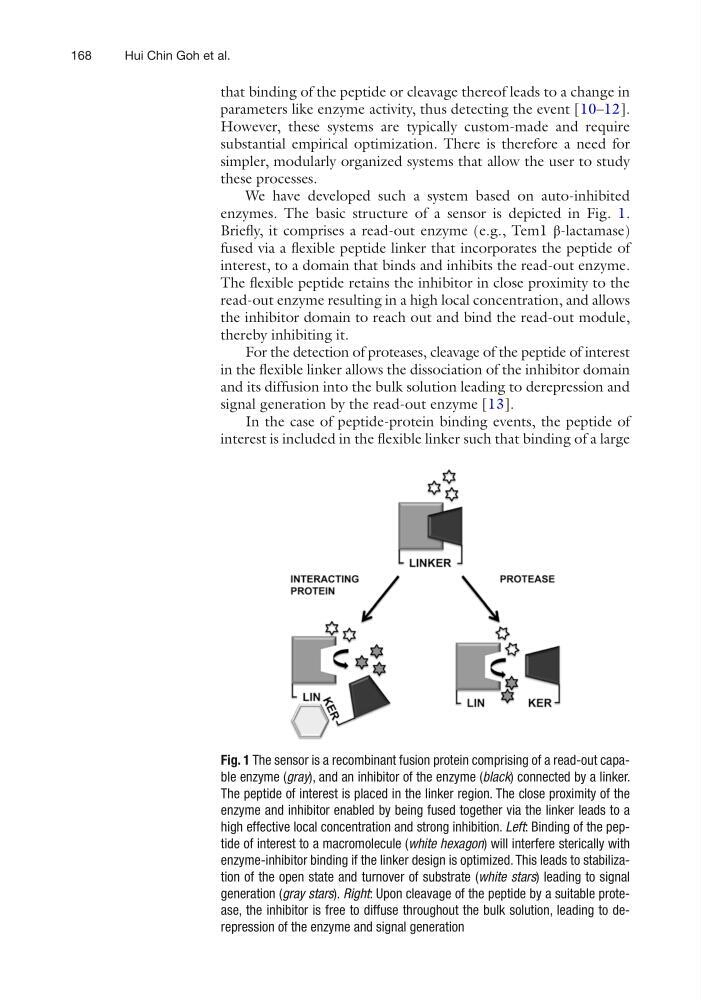
enzymes. The basic structure of a sensor is depicted in Fig. 1.
Briefly, it comprises a read-out enzyme (e.g., Tem1 β-lactamase)
fused via a flexible peptide linker that incorporates the peptide of
interest, to a domain that binds and inhibits the read-out enzyme.
The flexible peptide retains the inhibitor in close proximity to the
read-out enzyme resulting in a high local concentration, and allows
the inhibitor domain to reach out and bind the read-out module,
thereby inhibiting it.
For the detection of proteases, cleavage of the peptide of interest
in the flexible linker allows the dissociation of the inhibitor domain
and its diffusion into the bulk solution leading to derepression and
signal generation by the read-out enzyme [13].
In the case of peptide-protein binding events, the peptide of
interest is included in the flexible linker such that binding of a large
Fig. 1 The sensor is a recombinant fusion protein comprising of a read-out capable enzyme (gray), and an inhibitor of the enzyme (black) connected by a linker.
The peptide of interest is placed in the linker region. The close proximity of the
enzyme and inhibitor enabled by being fused together via the linker leads to a
high effective local concentration and strong inhibition. Left: Binding of the peptide of interest to a macromolecule (white hexagon) will interfere sterically with
enzyme-inhibitor binding if the linker design is optimized. This leads to stabilization of the open state and turnover of substrate (white stars) leading to signal
generation (gray stars). Right: Upon cleavage of the peptide by a suitable protease, the inhibitor is free to diffuse throughout the bulk solution, leading to derepression of the enzyme and signal generation
Hui Chin Goh et al.
that binding of the peptide or cleavage thereof leads to a change in
parameters like enzyme activity, thus detecting the event [10–12].
However, these systems are typically custom-made and require
substantial empirical optimization. There is therefore a need for
simpler, modularly organized systems that allow the user to study
these processes.
We have developed such a system based on auto-inhibited
enzymes. The basic structure of a sensor is depicted in Fig. 1.
Briefly, it comprises a read-out enzyme (e.g., Tem1 β-lactamase)
fused via a flexible peptide linker that incorporates the peptide of
interest, to a domain that binds and inhibits the read-out enzyme.
The flexible peptide retains the inhibitor in close proximity to the
read-out enzyme resulting in a high local concentration, and allows
the inhibitor domain to reach out and bind the read-out module,
thereby inhibiting it.
For the detection of proteases, cleavage of the peptide of interest
in the flexible linker allows the dissociation of the inhibitor domain
and its diffusion into the bulk solution leading to derepression and
signal generation by the read-out enzyme [13].
In the case of peptide-protein binding events, the peptide of
interest is included in the flexible linker such that binding of a large
Fig. 1 The sensor is a recombinant fusion protein comprising of a read-out capable enzyme (gray), and an inhibitor of the enzyme (black) connected by a linker.
The peptide of interest is placed in the linker region. The close proximity of the
enzyme and inhibitor enabled by being fused together via the linker leads to a
high effective local concentration and strong inhibition. Left: Binding of the peptide of interest to a macromolecule (white hexagon) will interfere sterically with
enzyme-inhibitor binding if the linker design is optimized. This leads to stabilization of the open state and turnover of substrate (white stars) leading to signal
generation (gray stars). Right: Upon cleavage of the peptide by a suitable protease, the inhibitor is free to diffuse throughout the bulk solution, leading to derepression of the enzyme and signal generation
Hui Chin Goh et al.