

120
The method is based on the multiple (two half) reactions
catalyzed by firefly luciferase (Fluc). Fluc is frequently applied as a
reporter enzyme in biological assays because of its sensitivity,
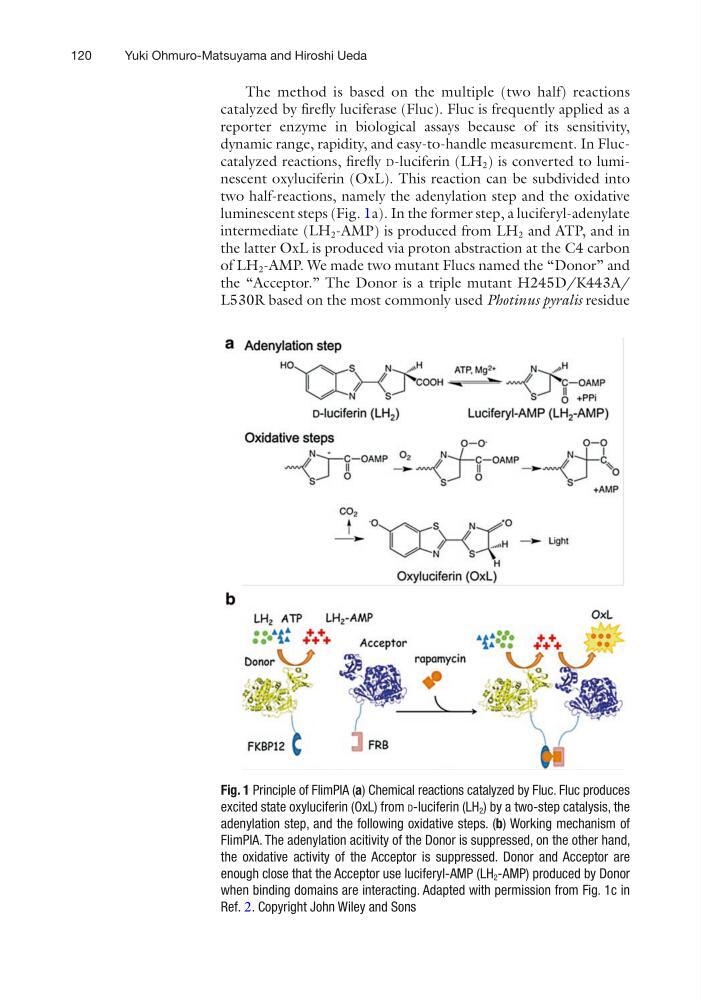
dynamic range, rapidity, and easy-to-handle measurement. In Fluccatalyzed reactions, firefly d-luciferin (LH 2 ) is converted to luminescent oxyluciferin (OxL). This reaction can be subdivided into
two half-reactions, namely the adenylation step and the oxidative
luminescent steps (Fig. 1a). In the former step, a luciferyl- adenylate
intermediate (LH 2 -AMP) is produced from LH 2 and ATP, and in
the latter OxL is produced via proton abstraction at the C4 carbon
of LH 2 -AMP. We made two mutant Flucs named the “Donor” and
the “Acceptor.” The Donor is a triple mutant H245D/K443A/
L530R based on the most commonly used Photinus pyralis residue
Fig. 1 Principle of FlimPIA (a) Chemical reactions catalyzed by Fluc. Fluc produces
excited state oxyluciferin (OxL) from d-luciferin (LH 2 ) by a two-step catalysis, the
adenylation step, and the following oxidative steps. (b) Working mechanism of
FlimPIA. The adenylation acitivity of the Donor is suppressed, on the other hand,
the oxidative activity of the Acceptor is suppressed. Donor and Acceptor are
enough close that the Acceptor use luciferyl-AMP (LH 2 -AMP) produced by Donor
when binding domains are interacting. Adapted with permission from Fig. 1c in
Ref. 2. Copyright John Wiley and Sons
Yuki Ohmuro-Matsuyama and Hiroshi Ueda
The method is based on the multiple (two half) reactions
catalyzed by firefly luciferase (Fluc). Fluc is frequently applied as a
reporter enzyme in biological assays because of its sensitivity,
dynamic range, rapidity, and easy-to-handle measurement. In Fluccatalyzed reactions, firefly d-luciferin (LH 2 ) is converted to luminescent oxyluciferin (OxL). This reaction can be subdivided into
two half-reactions, namely the adenylation step and the oxidative
luminescent steps (Fig. 1a). In the former step, a luciferyl- adenylate
intermediate (LH 2 -AMP) is produced from LH 2 and ATP, and in
the latter OxL is produced via proton abstraction at the C4 carbon
of LH 2 -AMP. We made two mutant Flucs named the “Donor” and
the “Acceptor.” The Donor is a triple mutant H245D/K443A/
L530R based on the most commonly used Photinus pyralis residue
Fig. 1 Principle of FlimPIA (a) Chemical reactions catalyzed by Fluc. Fluc produces
excited state oxyluciferin (OxL) from d-luciferin (LH 2 ) by a two-step catalysis, the
adenylation step, and the following oxidative steps. (b) Working mechanism of
FlimPIA. The adenylation acitivity of the Donor is suppressed, on the other hand,
the oxidative activity of the Acceptor is suppressed. Donor and Acceptor are
enough close that the Acceptor use luciferyl-AMP (LH 2 -AMP) produced by Donor
when binding domains are interacting. Adapted with permission from Fig. 1c in
Ref. 2. Copyright John Wiley and Sons
Yuki Ohmuro-Matsuyama and Hiroshi Ueda