

96
5. After one round of purification with the desalting columns, the
protein mixture should be re-concentrated and buffer
exchanged using centrifugal protein concentrators, which will
remove trace TCEP and further remove unreacted and free
dye.
6. The protein should then undergo a final desalting step to
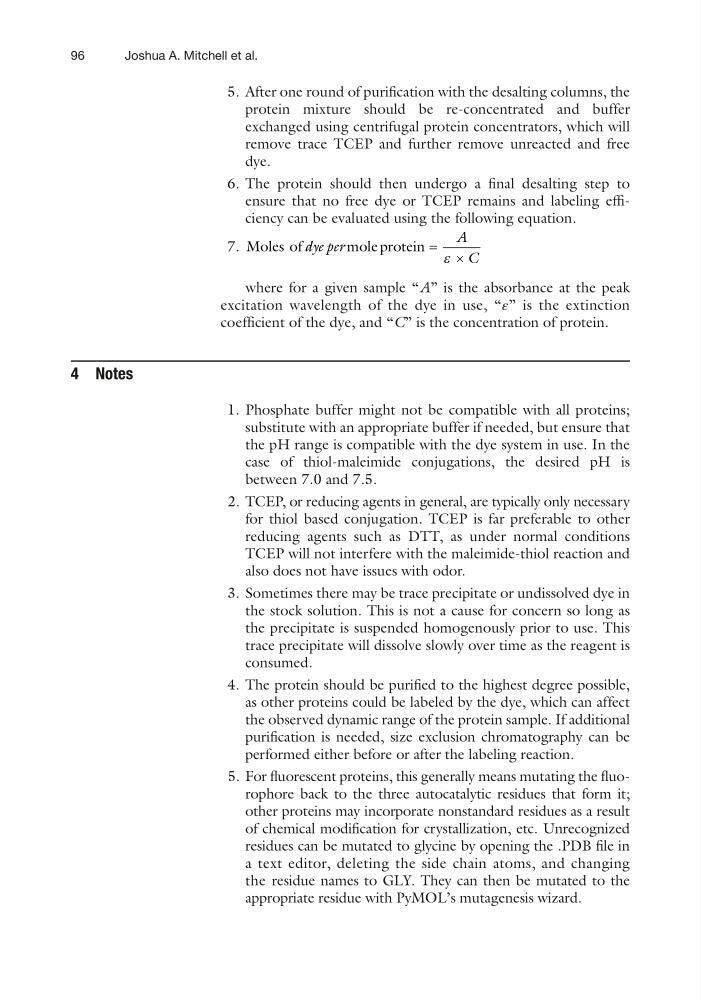
ensure that no free dye or TCEP remains and labeling efficiency can be evaluated using the following equation.
7. Moles of
mole protein
dye per
A
C
= ´
e
where for a given sample “A” is the absorbance at the peak
excitation wavelength of the dye in use, “ε” is the extinction
coefficient of the dye, and “C” is the concentration of protein.
4 Notes
1. Phosphate buffer might not be compatible with all proteins;
substitute with an appropriate buffer if needed, but ensure that
the pH range is compatible with the dye system in use. In the
case of thiol-maleimide conjugations, the desired pH is
between 7.0 and 7.5.
2. TCEP, or reducing agents in general, are typically only necessary
for thiol based conjugation. TCEP is far preferable to other
reducing agents such as DTT, as under normal conditions
TCEP will not interfere with the maleimide-thiol reaction and
also does not have issues with odor.
3. Sometimes there may be trace precipitate or undissolved dye in
the stock solution. This is not a cause for concern so long as
the precipitate is suspended homogenously prior to use. This
trace precipitate will dissolve slowly over time as the reagent is
consumed.
4. The protein should be purified to the highest degree possible,
as other proteins could be labeled by the dye, which can affect
the observed dynamic range of the protein sample. If additional
purification is needed, size exclusion chromatography can be
performed either before or after the labeling reaction.
5. For fluorescent proteins, this generally means mutating the fluorophore back to the three autocatalytic residues that form it;
other proteins may incorporate nonstandard residues as a result
of chemical modification for crystallization, etc. Unrecognized
residues can be mutated to glycine by opening the .PDB file in
a text editor, deleting the side chain atoms, and changing
the residue names to GLY. They can then be mutated to the
appropriate residue with PyMOL’s mutagenesis wizard.
Joshua A. Mitchell et al.
5. After one round of purification with the desalting columns, the
protein mixture should be re-concentrated and buffer
exchanged using centrifugal protein concentrators, which will
remove trace TCEP and further remove unreacted and free
dye.
6. The protein should then undergo a final desalting step to
ensure that no free dye or TCEP remains and labeling efficiency can be evaluated using the following equation.
7. Moles of
mole protein
dye per
A
C
= ´
e
where for a given sample “A” is the absorbance at the peak
excitation wavelength of the dye in use, “ε” is the extinction
coefficient of the dye, and “C” is the concentration of protein.
4 Notes
1. Phosphate buffer might not be compatible with all proteins;
substitute with an appropriate buffer if needed, but ensure that
the pH range is compatible with the dye system in use. In the
case of thiol-maleimide conjugations, the desired pH is
between 7.0 and 7.5.
2. TCEP, or reducing agents in general, are typically only necessary
for thiol based conjugation. TCEP is far preferable to other
reducing agents such as DTT, as under normal conditions
TCEP will not interfere with the maleimide-thiol reaction and
also does not have issues with odor.
3. Sometimes there may be trace precipitate or undissolved dye in
the stock solution. This is not a cause for concern so long as
the precipitate is suspended homogenously prior to use. This
trace precipitate will dissolve slowly over time as the reagent is
consumed.
4. The protein should be purified to the highest degree possible,
as other proteins could be labeled by the dye, which can affect
the observed dynamic range of the protein sample. If additional
purification is needed, size exclusion chromatography can be
performed either before or after the labeling reaction.
5. For fluorescent proteins, this generally means mutating the fluorophore back to the three autocatalytic residues that form it;
other proteins may incorporate nonstandard residues as a result
of chemical modification for crystallization, etc. Unrecognized
residues can be mutated to glycine by opening the .PDB file in
a text editor, deleting the side chain atoms, and changing
the residue names to GLY. They can then be mutated to the
appropriate residue with PyMOL’s mutagenesis wizard.
Joshua A. Mitchell et al.