

74
H. Zhu et al.
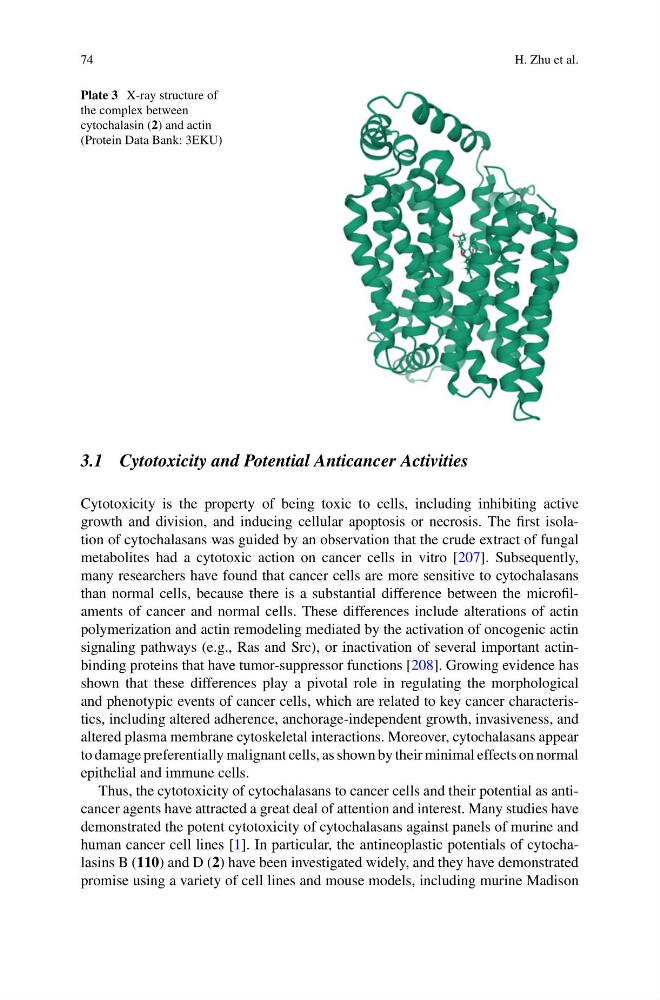
Plate 3 X-ray structure of
the complex between
cytochalasin (2) and actin
(Protein Data Bank: 3EKU)
3.1 Cytotoxicity and Potential Anticancer Activities
Cytotoxicity is the property of being toxic to cells, including inhibiting active
growth and division, and inducing cellular apoptosis or necrosis. The first isolation of cytochalasans was guided by an observation that the crude extract of fungal
metabolites had a cytotoxic action on cancer cells in vitro [207]. Subsequently,
many researchers have found that cancer cells are more sensitive to cytochalasans
than normal cells, because there is a substantial difference between the microfilaments of cancer and normal cells. These differences include alterations of actin
polymerization and actin remodeling mediated by the activation of oncogenic actin
signaling pathways (e.g., Ras and Src), or inactivation of several important actinbinding proteins that have tumor-suppressor functions [208]. Growing evidence has
shown that these differences play a pivotal role in regulating the morphological
and phenotypic events of cancer cells, which are related to key cancer characteristics, including altered adherence, anchorage-independent growth, invasiveness, and
altered plasma membrane cytoskeletal interactions. Moreover, cytochalasans appear
to damage preferentially malignant cells, as shown by their minimal effects on normal
epithelial and immune cells.
Thus, the cytotoxicity of cytochalasans to cancer cells and their potential as anticancer agents have attracted a great deal of attention and interest. Many studies have
demonstrated the potent cytotoxicity of cytochalasans against panels of murine and
human cancer cell lines [1]. In particular, the antineoplastic potentials of cytochalasins B (110) and D (2) have been investigated widely, and they have demonstrated
promise using a variety of cell lines and mouse models, including murine Madison
H. Zhu et al.
Plate 3 X-ray structure of
the complex between
cytochalasin (2) and actin
(Protein Data Bank: 3EKU)
3.1 Cytotoxicity and Potential Anticancer Activities
Cytotoxicity is the property of being toxic to cells, including inhibiting active
growth and division, and inducing cellular apoptosis or necrosis. The first isolation of cytochalasans was guided by an observation that the crude extract of fungal
metabolites had a cytotoxic action on cancer cells in vitro [207]. Subsequently,
many researchers have found that cancer cells are more sensitive to cytochalasans
than normal cells, because there is a substantial difference between the microfilaments of cancer and normal cells. These differences include alterations of actin
polymerization and actin remodeling mediated by the activation of oncogenic actin
signaling pathways (e.g., Ras and Src), or inactivation of several important actinbinding proteins that have tumor-suppressor functions [208]. Growing evidence has
shown that these differences play a pivotal role in regulating the morphological
and phenotypic events of cancer cells, which are related to key cancer characteristics, including altered adherence, anchorage-independent growth, invasiveness, and
altered plasma membrane cytoskeletal interactions. Moreover, cytochalasans appear
to damage preferentially malignant cells, as shown by their minimal effects on normal
epithelial and immune cells.
Thus, the cytotoxicity of cytochalasans to cancer cells and their potential as anticancer agents have attracted a great deal of attention and interest. Many studies have
demonstrated the potent cytotoxicity of cytochalasans against panels of murine and
human cancer cell lines [1]. In particular, the antineoplastic potentials of cytochalasins B (110) and D (2) have been investigated widely, and they have demonstrated
promise using a variety of cell lines and mouse models, including murine Madison