

70
H. Zhu et al.
O
O
OH
OH
O
OH
OH
HN
O
O
O
HO
O
OH
O
OH
NH
O
O
O
OH
HN
O
O
O
OH
O
O
O
OH
O
O
468 (asperflavipine A)
467 (asperflavipine B)
O O
OH
HN
O O
O
O
OH
HN
469 (dimericchalasine A)
Fig. 19 (continued)
centers, was elucidated unequivocally by extensive NMR spectroscopic and X-ray
diffraction data analysis.
Asperchalasine A (455) induced G1-phase cell cycle arrest in cancerous cells, but
showed almost no negative effects on normal cells. Unsurprisingly, it has attracted
considerable interest in terms of its organic synthesis and biosynthesis [2, 3, 198,
199] (for details, see Sect. 5).
Continuing research has led to the isolation of two novel heterotrimers, epicochalasines A (461) and B (462) [196], from the same fungus (Aspergillus flavipes), using
an OSMAC strategy with the liquid culture broth. Both compounds, containing an
aspochalasin and two epicoccine units, exhibit a hendecacyclic 5/6/11/5/6/5/6/5/6/6/5
caged ring system, but their fusion patterns differ, resulting in two different carbon
skeletons. Their absolute configurations were determined by both X-ray crystallographic and calculated ECD spectroscopic data analysis. Their biogenetic pathways
were proposed to start from aspochalasin D (346), and to involve a Diels–Alder
reaction and [3 + 2] cycloaddition as the key steps.
Further studies on Aspergillus flavipes isolated from a soil sample led to the
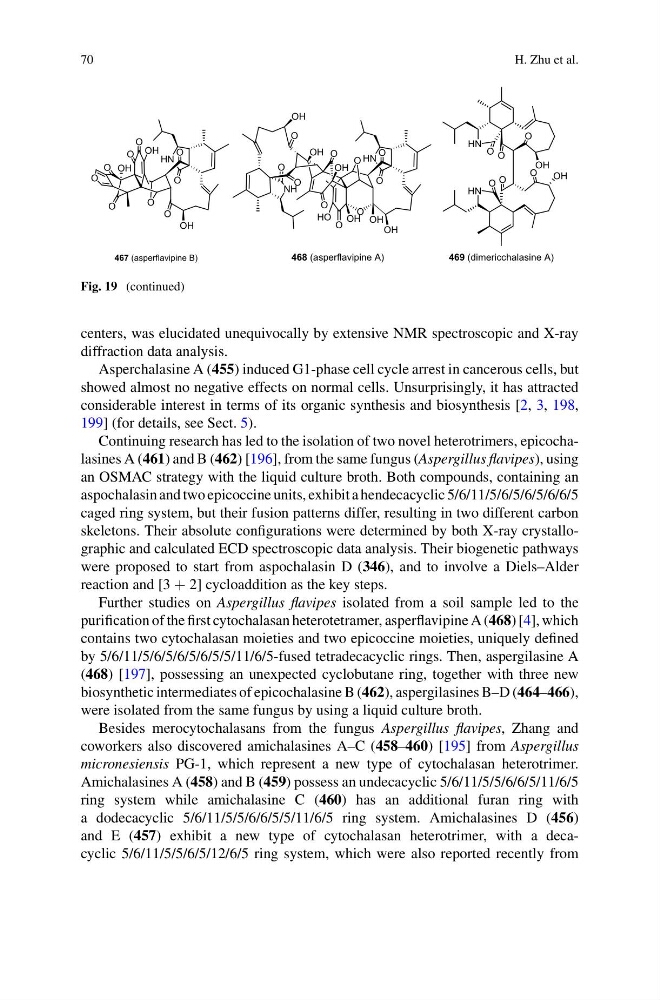
purification of the first cytochalasan heterotetramer, asperflavipine A (468) [4], which
contains two cytochalasan moieties and two epicoccine moieties, uniquely defined
by 5/6/11/5/6/5/6/5/6/5/5/11/6/5-fused tetradecacyclic rings. Then, aspergilasine A
(468) [197], possessing an unexpected cyclobutane ring, together with three new
biosynthetic intermediates of epicochalasine B (462), aspergilasines B–D (464–466),
were isolated from the same fungus by using a liquid culture broth.
Besides merocytochalasans from the fungus Aspergillus flavipes, Zhang and
coworkers also discovered amichalasines A–C (458–460) [195] from Aspergillus
micronesiensis PG-1, which represent a new type of cytochalasan heterotrimer.
Amichalasines A (458) and B (459) possess an undecacyclic 5/6/11/5/5/6/6/5/11/6/5
ring system while amichalasine C (460) has an additional furan ring with
a dodecacyclic 5/6/11/5/5/6/6/5/5/11/6/5 ring system. Amichalasines D (456)
and E (457) exhibit a new type of cytochalasan heterotrimer, with a decacyclic 5/6/11/5/5/6/5/12/6/5 ring system, which were also reported recently from
H. Zhu et al.
O
O
OH
OH
O
OH
OH
HN
O
O
O
HO
O
OH
O
OH
NH
O
O
O
OH
HN
O
O
O
OH
O
O
O
OH
O
O
468 (asperflavipine A)
467 (asperflavipine B)
O O
OH
HN
O O
O
O
OH
HN
469 (dimericchalasine A)
Fig. 19 (continued)
centers, was elucidated unequivocally by extensive NMR spectroscopic and X-ray
diffraction data analysis.
Asperchalasine A (455) induced G1-phase cell cycle arrest in cancerous cells, but
showed almost no negative effects on normal cells. Unsurprisingly, it has attracted
considerable interest in terms of its organic synthesis and biosynthesis [2, 3, 198,
199] (for details, see Sect. 5).
Continuing research has led to the isolation of two novel heterotrimers, epicochalasines A (461) and B (462) [196], from the same fungus (Aspergillus flavipes), using
an OSMAC strategy with the liquid culture broth. Both compounds, containing an
aspochalasin and two epicoccine units, exhibit a hendecacyclic 5/6/11/5/6/5/6/5/6/6/5
caged ring system, but their fusion patterns differ, resulting in two different carbon
skeletons. Their absolute configurations were determined by both X-ray crystallographic and calculated ECD spectroscopic data analysis. Their biogenetic pathways
were proposed to start from aspochalasin D (346), and to involve a Diels–Alder
reaction and [3 + 2] cycloaddition as the key steps.
Further studies on Aspergillus flavipes isolated from a soil sample led to the
purification of the first cytochalasan heterotetramer, asperflavipine A (468) [4], which
contains two cytochalasan moieties and two epicoccine moieties, uniquely defined
by 5/6/11/5/6/5/6/5/6/5/5/11/6/5-fused tetradecacyclic rings. Then, aspergilasine A
(468) [197], possessing an unexpected cyclobutane ring, together with three new
biosynthetic intermediates of epicochalasine B (462), aspergilasines B–D (464–466),
were isolated from the same fungus by using a liquid culture broth.
Besides merocytochalasans from the fungus Aspergillus flavipes, Zhang and
coworkers also discovered amichalasines A–C (458–460) [195] from Aspergillus
micronesiensis PG-1, which represent a new type of cytochalasan heterotrimer.
Amichalasines A (458) and B (459) possess an undecacyclic 5/6/11/5/5/6/6/5/11/6/5
ring system while amichalasine C (460) has an additional furan ring with
a dodecacyclic 5/6/11/5/5/6/6/5/5/11/6/5 ring system. Amichalasines D (456)
and E (457) exhibit a new type of cytochalasan heterotrimer, with a decacyclic 5/6/11/5/5/6/5/12/6/5 ring system, which were also reported recently from