

Progress in the Chemistry of Cytochalasans
65
additional methyl or hydroxymethyl group at C-16 of ring C. Methylation at C-16
was also observed in amiaspochalasin A (425) [169] and 16α-methylaspochalasin
J (429) [177]. Moreover, amiaspochalasin A (425) is the only derivative in this
general class with no methyl group at C-13, while amiaspochalasins B (431) and C
(432) possess an unusual [5.6.6.8] ring system [169]. Trichalasin E (422) [169] was
isolated from the plant endophytic fungus Trichoderma gamsii, and represents the
first cytochalasan with an unusual hydroperoxy group.
Flavichalasine O (433) [187] was proposed as the first example of a cytochalasan possessing a nitrogen-oxygen heterocycle in the macrocyclic ring moiety.
However, more evidence is necessary for the confirmation of the structure postulated, as its NMR data resemble closely those of the co-isolated lactone-aspochalasin,
flavichalasine N (424).
2.4.3 seco-Aspochalasins
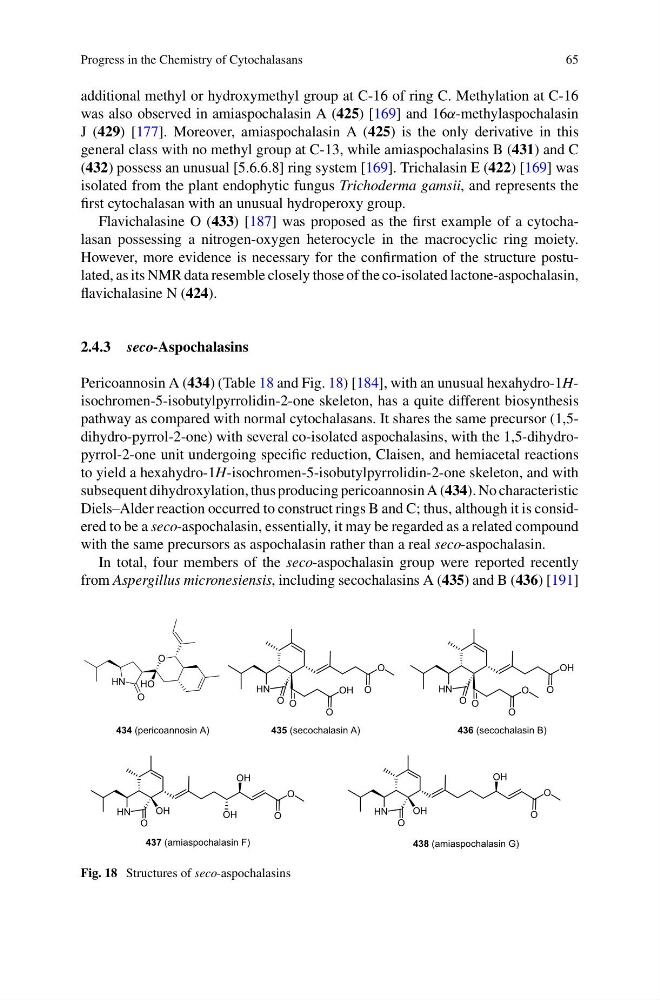
Pericoannosin A (434) (Table 18 and Fig. 18) [184], with an unusual hexahydro-1Hisochromen-5-isobutylpyrrolidin-2-one skeleton, has a quite different biosynthesis
pathway as compared with normal cytochalasans. It shares the same precursor (1,5dihydro-pyrrol-2-one) with several co-isolated aspochalasins, with the 1,5-dihydropyrrol-2-one unit undergoing specific reduction, Claisen, and hemiacetal reactions
to yield a hexahydro-1H-isochromen-5-isobutylpyrrolidin-2-one skeleton, and with
subsequent dihydroxylation, thus producing pericoannosin A (434). No characteristic
Diels–Alder reaction occurred to construct rings B and C; thus, although it is considered to be a seco-aspochalasin, essentially, it may be regarded as a related compound
with the same precursors as aspochalasin rather than a real seco-aspochalasin.
In total, four members of the seco-aspochalasin group were reported recently
from Aspergillus micronesiensis, including secochalasins A (435) and B (436) [191]
HN
O
O
HO
434 (pericoannosin A)
OH
O
O
OH
OH
HN
O
OH
O
O
OH
HN
O
437 (amiaspochalasin F)
438 (amiaspochalasin G)
HN
O O
O
O
HN
O O
O
O
OH
O
OH
O
435 (secochalasin A)
436 (secochalasin B)
Fig. 18 Structures of seco-aspochalasins
65
additional methyl or hydroxymethyl group at C-16 of ring C. Methylation at C-16
was also observed in amiaspochalasin A (425) [169] and 16α-methylaspochalasin
J (429) [177]. Moreover, amiaspochalasin A (425) is the only derivative in this
general class with no methyl group at C-13, while amiaspochalasins B (431) and C
(432) possess an unusual [5.6.6.8] ring system [169]. Trichalasin E (422) [169] was
isolated from the plant endophytic fungus Trichoderma gamsii, and represents the
first cytochalasan with an unusual hydroperoxy group.
Flavichalasine O (433) [187] was proposed as the first example of a cytochalasan possessing a nitrogen-oxygen heterocycle in the macrocyclic ring moiety.
However, more evidence is necessary for the confirmation of the structure postulated, as its NMR data resemble closely those of the co-isolated lactone-aspochalasin,
flavichalasine N (424).
2.4.3 seco-Aspochalasins
Pericoannosin A (434) (Table 18 and Fig. 18) [184], with an unusual hexahydro-1Hisochromen-5-isobutylpyrrolidin-2-one skeleton, has a quite different biosynthesis
pathway as compared with normal cytochalasans. It shares the same precursor (1,5dihydro-pyrrol-2-one) with several co-isolated aspochalasins, with the 1,5-dihydropyrrol-2-one unit undergoing specific reduction, Claisen, and hemiacetal reactions
to yield a hexahydro-1H-isochromen-5-isobutylpyrrolidin-2-one skeleton, and with
subsequent dihydroxylation, thus producing pericoannosin A (434). No characteristic
Diels–Alder reaction occurred to construct rings B and C; thus, although it is considered to be a seco-aspochalasin, essentially, it may be regarded as a related compound
with the same precursors as aspochalasin rather than a real seco-aspochalasin.
In total, four members of the seco-aspochalasin group were reported recently
from Aspergillus micronesiensis, including secochalasins A (435) and B (436) [191]
HN
O
O
HO
434 (pericoannosin A)
OH
O
O
OH
OH
HN
O
OH
O
O
OH
HN
O
437 (amiaspochalasin F)
438 (amiaspochalasin G)
HN
O O
O
O
HN
O O
O
O
OH
O
OH
O
435 (secochalasin A)
436 (secochalasin B)
Fig. 18 Structures of seco-aspochalasins