

34
H. Zhu et al.
HN
O O
HO
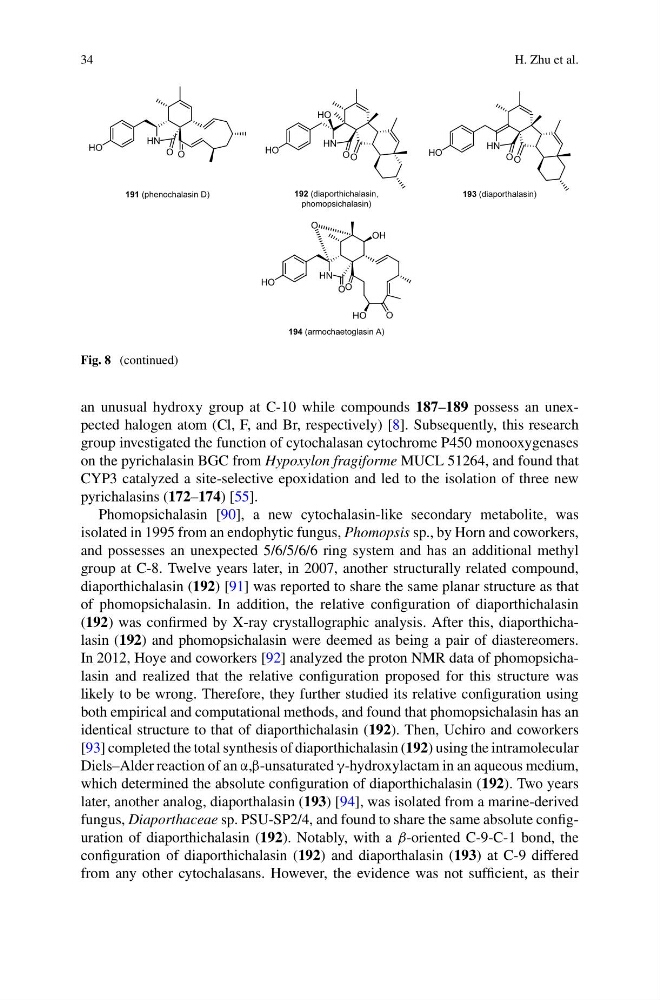
191 (phenochalasin D)
HN
O
HO
O
HO
192 (diaporthichalasin,
phomopsichalasin)
193 (diaporthalasin)
HN
O
HO
O
HN
O
O
O
HO
OH
O
194 (armochaetoglasin A)
HO
Fig. 8 (continued)
an unusual hydroxy group at C-10 while compounds 187–189 possess an unexpected halogen atom (Cl, F, and Br, respectively) [8]. Subsequently, this research
group investigated the function of cytochalasan cytochrome P450 monooxygenases
on the pyrichalasin BGC from Hypoxylon fragiforme MUCL 51264, and found that
CYP3 catalyzed a site-selective epoxidation and led to the isolation of three new
pyrichalasins (172–174) [55].
Phomopsichalasin [90], a new cytochalasin-like secondary metabolite, was
isolated in 1995 from an endophytic fungus, Phomopsis sp., by Horn and coworkers,
and possesses an unexpected 5/6/5/6/6 ring system and has an additional methyl
group at C-8. Twelve years later, in 2007, another structurally related compound,
diaporthichalasin (192) [91] was reported to share the same planar structure as that
of phomopsichalasin. In addition, the relative configuration of diaporthichalasin
(192) was confirmed by X-ray crystallographic analysis. After this, diaporthichalasin (192) and phomopsichalasin were deemed as being a pair of diastereomers.
In 2012, Hoye and coworkers [92] analyzed the proton NMR data of phomopsichalasin and realized that the relative configuration proposed for this structure was
likely to be wrong. Therefore, they further studied its relative configuration using
both empirical and computational methods, and found that phomopsichalasin has an
identical structure to that of diaporthichalasin (192). Then, Uchiro and coworkers
[93] completed the total synthesis of diaporthichalasin (192) using the intramolecular
Diels–Alder reaction of an α,β-unsaturated γ-hydroxylactam in an aqueous medium,
which determined the absolute configuration of diaporthichalasin (192). Two years
later, another analog, diaporthalasin (193) [94], was isolated from a marine-derived
fungus, Diaporthaceae sp. PSU-SP2/4, and found to share the same absolute configuration of diaporthichalasin (192). Notably, with a β-oriented C-9-C-1 bond, the
configuration of diaporthichalasin (192) and diaporthalasin (193) at C-9 differed
from any other cytochalasans. However, the evidence was not sufficient, as their
H. Zhu et al.
HN
O O
HO
191 (phenochalasin D)
HN
O
HO
O
HO
192 (diaporthichalasin,
phomopsichalasin)
193 (diaporthalasin)
HN
O
HO
O
HN
O
O
O
HO
OH
O
194 (armochaetoglasin A)
HO
Fig. 8 (continued)
an unusual hydroxy group at C-10 while compounds 187–189 possess an unexpected halogen atom (Cl, F, and Br, respectively) [8]. Subsequently, this research
group investigated the function of cytochalasan cytochrome P450 monooxygenases
on the pyrichalasin BGC from Hypoxylon fragiforme MUCL 51264, and found that
CYP3 catalyzed a site-selective epoxidation and led to the isolation of three new
pyrichalasins (172–174) [55].
Phomopsichalasin [90], a new cytochalasin-like secondary metabolite, was
isolated in 1995 from an endophytic fungus, Phomopsis sp., by Horn and coworkers,
and possesses an unexpected 5/6/5/6/6 ring system and has an additional methyl
group at C-8. Twelve years later, in 2007, another structurally related compound,
diaporthichalasin (192) [91] was reported to share the same planar structure as that
of phomopsichalasin. In addition, the relative configuration of diaporthichalasin
(192) was confirmed by X-ray crystallographic analysis. After this, diaporthichalasin (192) and phomopsichalasin were deemed as being a pair of diastereomers.
In 2012, Hoye and coworkers [92] analyzed the proton NMR data of phomopsichalasin and realized that the relative configuration proposed for this structure was
likely to be wrong. Therefore, they further studied its relative configuration using
both empirical and computational methods, and found that phomopsichalasin has an
identical structure to that of diaporthichalasin (192). Then, Uchiro and coworkers
[93] completed the total synthesis of diaporthichalasin (192) using the intramolecular
Diels–Alder reaction of an α,β-unsaturated γ-hydroxylactam in an aqueous medium,
which determined the absolute configuration of diaporthichalasin (192). Two years
later, another analog, diaporthalasin (193) [94], was isolated from a marine-derived
fungus, Diaporthaceae sp. PSU-SP2/4, and found to share the same absolute configuration of diaporthichalasin (192). Notably, with a β-oriented C-9-C-1 bond, the
configuration of diaporthichalasin (192) and diaporthalasin (193) at C-9 differed
from any other cytochalasans. However, the evidence was not sufficient, as their