

Human Endogenous Natural Products
323
host and the microbes. Specifically, some metabolites are synthesized by the microbes
and are biotransformed by the host such as trimethylamine oxide [14], while other
metabolites are synthesized by the host and biotransformed by the microbes, as
exemplified by unconjugated secondary bile acids [14]. The remaining metabolites
are generated endogenously and are biotransformed at least once by both the host
and its commensal microbes, such as conjugated secondary bile acids [14]. There
are also some miscellaneous metabolites for which their categorizations are troublesome, such as spermidine and tyramine, which are produced by both the host and its
commensal microbes [4].
Many microbiota-related metabolites are bioactive. By affecting differentiation,
migration, proliferation, apoptosis, and other processes of the host cell, they have
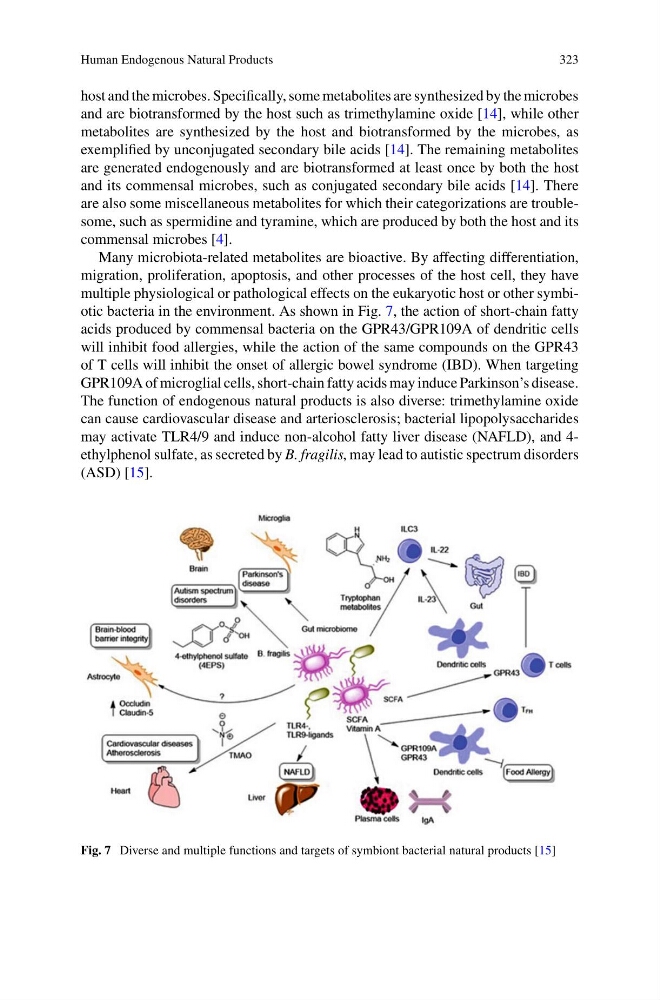
multiple physiological or pathological effects on the eukaryotic host or other symbiotic bacteria in the environment. As shown in Fig. 7, the action of short-chain fatty
acids produced by commensal bacteria on the GPR43/GPR109A of dendritic cells
will inhibit food allergies, while the action of the same compounds on the GPR43
of T cells will inhibit the onset of allergic bowel syndrome (IBD). When targeting
GPR109A of microglial cells, short-chain fatty acids may induce Parkinson’s disease.
The function of endogenous natural products is also diverse: trimethylamine oxide
can cause cardiovascular disease and arteriosclerosis; bacterial lipopolysaccharides
may activate TLR4/9 and induce non-alcohol fatty liver disease (NAFLD), and 4ethylphenol sulfate, as secreted by B. fragilis, may lead to autistic spectrum disorders
(ASD) [15].
Fig. 7 Diverse and multiple functions and targets of symbiont bacterial natural products [15]
323
host and the microbes. Specifically, some metabolites are synthesized by the microbes
and are biotransformed by the host such as trimethylamine oxide [14], while other
metabolites are synthesized by the host and biotransformed by the microbes, as
exemplified by unconjugated secondary bile acids [14]. The remaining metabolites
are generated endogenously and are biotransformed at least once by both the host
and its commensal microbes, such as conjugated secondary bile acids [14]. There
are also some miscellaneous metabolites for which their categorizations are troublesome, such as spermidine and tyramine, which are produced by both the host and its
commensal microbes [4].
Many microbiota-related metabolites are bioactive. By affecting differentiation,
migration, proliferation, apoptosis, and other processes of the host cell, they have
multiple physiological or pathological effects on the eukaryotic host or other symbiotic bacteria in the environment. As shown in Fig. 7, the action of short-chain fatty
acids produced by commensal bacteria on the GPR43/GPR109A of dendritic cells
will inhibit food allergies, while the action of the same compounds on the GPR43
of T cells will inhibit the onset of allergic bowel syndrome (IBD). When targeting
GPR109A of microglial cells, short-chain fatty acids may induce Parkinson’s disease.
The function of endogenous natural products is also diverse: trimethylamine oxide
can cause cardiovascular disease and arteriosclerosis; bacterial lipopolysaccharides
may activate TLR4/9 and induce non-alcohol fatty liver disease (NAFLD), and 4ethylphenol sulfate, as secreted by B. fragilis, may lead to autistic spectrum disorders
(ASD) [15].
Fig. 7 Diverse and multiple functions and targets of symbiont bacterial natural products [15]