

290
J. C. Pardo-Novoa and C. M. Cerda-García-Rojas
OR
O
1
2
3
4
5
6
7
8
9
10
11
12
13
14
15
O
O
O
O
O
214 R = H
215 R = Ac
7
1
2
6
1
2
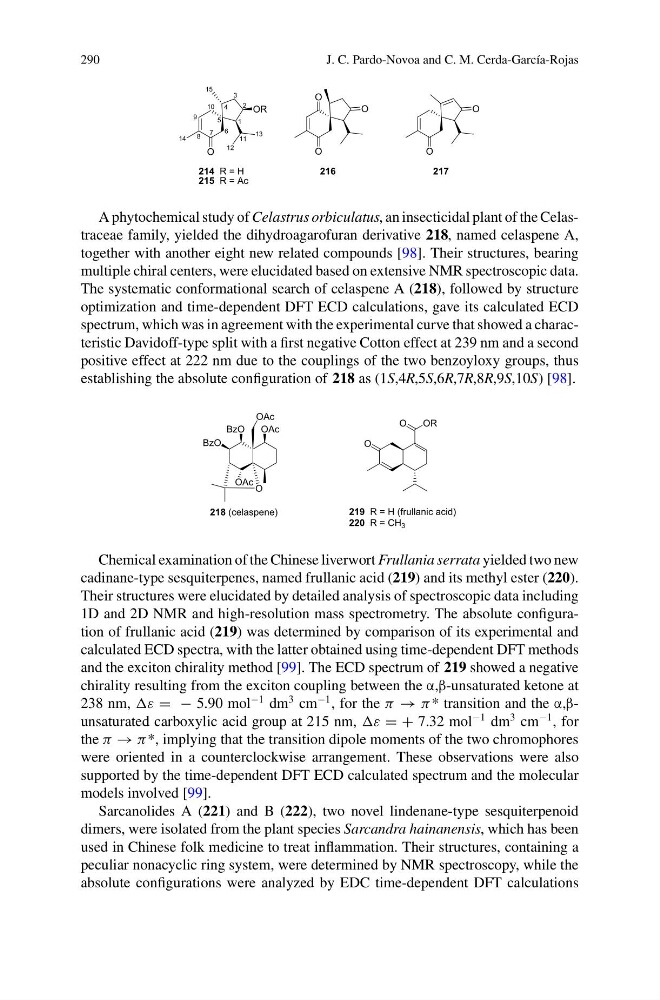
A phytochemical study of Celastrus orbiculatus, an insecticidal plant of the Celastraceae family, yielded the dihydroagarofuran derivative 218, named celaspene A,
together with another eight new related compounds [98]. Their structures, bearing
multiple chiral centers, were elucidated based on extensive NMR spectroscopic data.
The systematic conformational search of celaspene A (218), followed by structure
optimization and time-dependent DFT ECD calculations, gave its calculated ECD
spectrum, which was in agreement with the experimental curve that showed a characteristic Davidoff-type split with a first negative Cotton effect at 239 nm and a second
positive effect at 222 nm due to the couplings of the two benzoyloxy groups, thus
establishing the absolute configuration of 218 as (1S,4R,5S,6R,7R,8R,9S,10S) [98].
218 (celaspene)
OAc
BzO
BzO
O
OAc
OAc
O
OR
O
219 R = H (frullanic acid)
220 R = CH 3
Chemical examination of the Chinese liverwort Frullania serrata yielded two new
cadinane-type sesquiterpenes, named frullanic acid (219) and its methyl ester (220).
Their structures were elucidated by detailed analysis of spectroscopic data including
1D and 2D NMR and high-resolution mass spectrometry. The absolute configuration of frullanic acid (219) was determined by comparison of its experimental and
calculated ECD spectra, with the latter obtained using time-dependent DFT methods
and the exciton chirality method [99]. The ECD spectrum of 219 showed a negative
chirality resulting from the exciton coupling between the α,β-unsaturated ketone at
238 nm, ε = − 5.90 mol
−1 dm
3 cm
−1 , for the π → π * transition and the α,βunsaturated carboxylic acid group at 215 nm, ε = + 7.32 mol
−1 dm
3 cm
−1 , for
the π → π *, implying that the transition dipole moments of the two chromophores
were oriented in a counterclockwise arrangement. These observations were also
supported by the time-dependent DFT ECD calculated spectrum and the molecular
models involved [99].
Sarcanolides A (221) and B (222), two novel lindenane-type sesquiterpenoid
dimers, were isolated from the plant species Sarcandra hainanensis, which has been
used in Chinese folk medicine to treat inflammation. Their structures, containing a
peculiar nonacyclic ring system, were determined by NMR spectroscopy, while the
absolute configurations were analyzed by EDC time-dependent DFT calculations
J. C. Pardo-Novoa and C. M. Cerda-García-Rojas
OR
O
1
2
3
4
5
6
7
8
9
10
11
12
13
14
15
O
O
O
O
O
214 R = H
215 R = Ac
7
1
2
6
1
2
A phytochemical study of Celastrus orbiculatus, an insecticidal plant of the Celastraceae family, yielded the dihydroagarofuran derivative 218, named celaspene A,
together with another eight new related compounds [98]. Their structures, bearing
multiple chiral centers, were elucidated based on extensive NMR spectroscopic data.
The systematic conformational search of celaspene A (218), followed by structure
optimization and time-dependent DFT ECD calculations, gave its calculated ECD
spectrum, which was in agreement with the experimental curve that showed a characteristic Davidoff-type split with a first negative Cotton effect at 239 nm and a second
positive effect at 222 nm due to the couplings of the two benzoyloxy groups, thus
establishing the absolute configuration of 218 as (1S,4R,5S,6R,7R,8R,9S,10S) [98].
218 (celaspene)
OAc
BzO
BzO
O
OAc
OAc
O
OR
O
219 R = H (frullanic acid)
220 R = CH 3
Chemical examination of the Chinese liverwort Frullania serrata yielded two new
cadinane-type sesquiterpenes, named frullanic acid (219) and its methyl ester (220).
Their structures were elucidated by detailed analysis of spectroscopic data including
1D and 2D NMR and high-resolution mass spectrometry. The absolute configuration of frullanic acid (219) was determined by comparison of its experimental and
calculated ECD spectra, with the latter obtained using time-dependent DFT methods
and the exciton chirality method [99]. The ECD spectrum of 219 showed a negative
chirality resulting from the exciton coupling between the α,β-unsaturated ketone at
238 nm, ε = − 5.90 mol
−1 dm
3 cm
−1 , for the π → π * transition and the α,βunsaturated carboxylic acid group at 215 nm, ε = + 7.32 mol
−1 dm
3 cm
−1 , for
the π → π *, implying that the transition dipole moments of the two chromophores
were oriented in a counterclockwise arrangement. These observations were also
supported by the time-dependent DFT ECD calculated spectrum and the molecular
models involved [99].
Sarcanolides A (221) and B (222), two novel lindenane-type sesquiterpenoid
dimers, were isolated from the plant species Sarcandra hainanensis, which has been
used in Chinese folk medicine to treat inflammation. Their structures, containing a
peculiar nonacyclic ring system, were determined by NMR spectroscopy, while the
absolute configurations were analyzed by EDC time-dependent DFT calculations