

Progress in the Chemistry of Cytochalasans
23
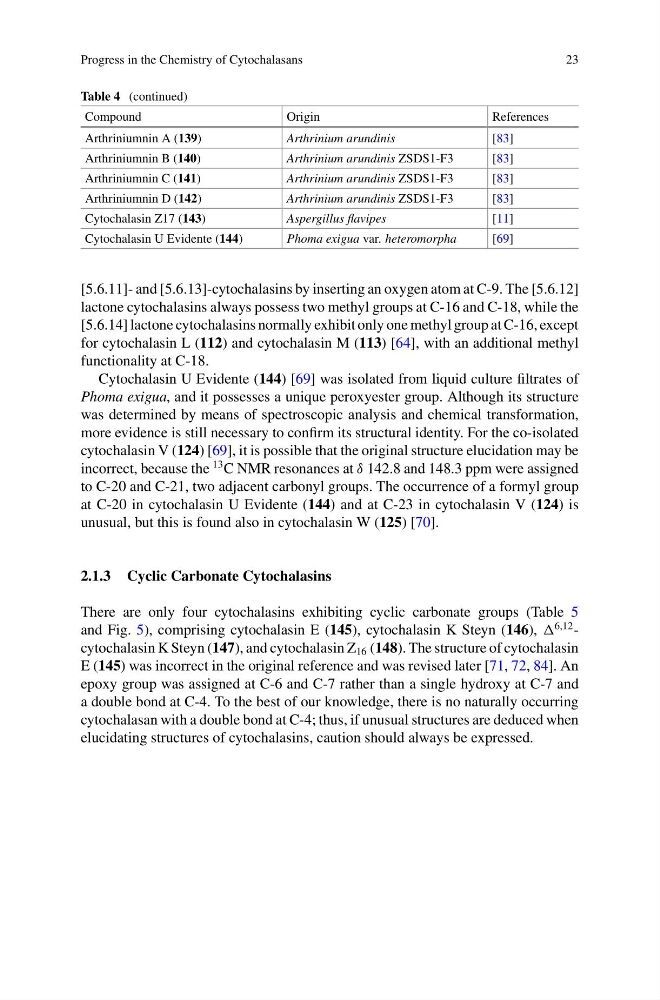
Table 4 (continued)
Compound
Origin
References
Arthriniumnin A (139)
Arthrinium arundinis
[83]
Arthriniumnin B (140)
Arthrinium arundinis ZSDS1-F3
[83]
Arthriniumnin C (141)
Arthrinium arundinis ZSDS1-F3
[83]
Arthriniumnin D (142)
Arthrinium arundinis ZSDS1-F3
[83]
Cytochalasin Z17 (143)
Aspergillus flavipes
[11]
Cytochalasin U Evidente (144)
Phoma exigua var. heteromorpha
[69]
[5.6.11]- and [5.6.13]-cytochalasins by inserting an oxygen atom at C-9. The [5.6.12]
lactone cytochalasins always possess two methyl groups at C-16 and C-18, while the
[5.6.14] lactone cytochalasins normally exhibit only one methyl group at C-16, except
for cytochalasin L (112) and cytochalasin M (113) [64], with an additional methyl
functionality at C-18.
Cytochalasin U Evidente (144) [69] was isolated from liquid culture filtrates of
Phoma exigua, and it possesses a unique peroxyester group. Although its structure
was determined by means of spectroscopic analysis and chemical transformation,
more evidence is still necessary to confirm its structural identity. For the co-isolated
cytochalasin V (124) [69], it is possible that the original structure elucidation may be
incorrect, because the
13 C NMR resonances at δ 142.8 and 148.3 ppm were assigned
to C-20 and C-21, two adjacent carbonyl groups. The occurrence of a formyl group
at C-20 in cytochalasin U Evidente (144) and at C-23 in cytochalasin V (124) is
unusual, but this is found also in cytochalasin W (125) [70].
2.1.3 Cyclic Carbonate Cytochalasins
There are only four cytochalasins exhibiting cyclic carbonate groups (Table 5
and Fig. 5), comprising cytochalasin E (145), cytochalasin K Steyn (146),
6,12 -
cytochalasin K Steyn (147), and cytochalasin Z 16 (148). The structure of cytochalasin
E (145) was incorrect in the original reference and was revised later [71, 72, 84]. An
epoxy group was assigned at C-6 and C-7 rather than a single hydroxy at C-7 and
a double bond at C-4. To the best of our knowledge, there is no naturally occurring
cytochalasan with a double bond at C-4; thus, if unusual structures are deduced when
elucidating structures of cytochalasins, caution should always be expressed.
23
Table 4 (continued)
Compound
Origin
References
Arthriniumnin A (139)
Arthrinium arundinis
[83]
Arthriniumnin B (140)
Arthrinium arundinis ZSDS1-F3
[83]
Arthriniumnin C (141)
Arthrinium arundinis ZSDS1-F3
[83]
Arthriniumnin D (142)
Arthrinium arundinis ZSDS1-F3
[83]
Cytochalasin Z17 (143)
Aspergillus flavipes
[11]
Cytochalasin U Evidente (144)
Phoma exigua var. heteromorpha
[69]
[5.6.11]- and [5.6.13]-cytochalasins by inserting an oxygen atom at C-9. The [5.6.12]
lactone cytochalasins always possess two methyl groups at C-16 and C-18, while the
[5.6.14] lactone cytochalasins normally exhibit only one methyl group at C-16, except
for cytochalasin L (112) and cytochalasin M (113) [64], with an additional methyl
functionality at C-18.
Cytochalasin U Evidente (144) [69] was isolated from liquid culture filtrates of
Phoma exigua, and it possesses a unique peroxyester group. Although its structure
was determined by means of spectroscopic analysis and chemical transformation,
more evidence is still necessary to confirm its structural identity. For the co-isolated
cytochalasin V (124) [69], it is possible that the original structure elucidation may be
incorrect, because the
13 C NMR resonances at δ 142.8 and 148.3 ppm were assigned
to C-20 and C-21, two adjacent carbonyl groups. The occurrence of a formyl group
at C-20 in cytochalasin U Evidente (144) and at C-23 in cytochalasin V (124) is
unusual, but this is found also in cytochalasin W (125) [70].
2.1.3 Cyclic Carbonate Cytochalasins
There are only four cytochalasins exhibiting cyclic carbonate groups (Table 5
and Fig. 5), comprising cytochalasin E (145), cytochalasin K Steyn (146),
6,12 -
cytochalasin K Steyn (147), and cytochalasin Z 16 (148). The structure of cytochalasin
E (145) was incorrect in the original reference and was revised later [71, 72, 84]. An
epoxy group was assigned at C-6 and C-7 rather than a single hydroxy at C-7 and
a double bond at C-4. To the best of our knowledge, there is no naturally occurring
cytochalasan with a double bond at C-4; thus, if unusual structures are deduced when
elucidating structures of cytochalasins, caution should always be expressed.