

Progress in the Chemistry of Cytochalasans
21
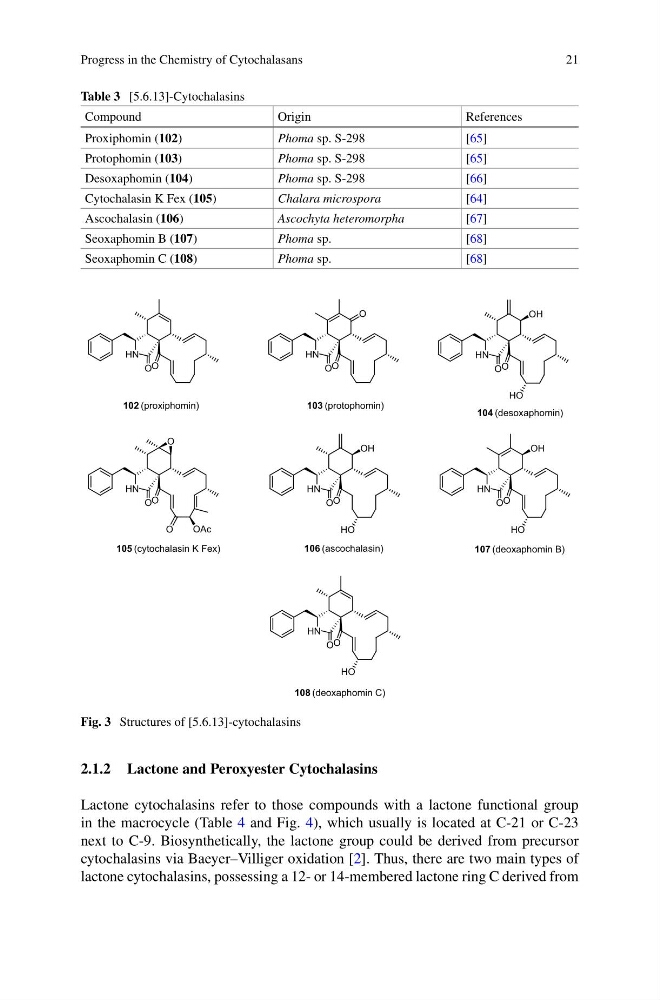
Table 3 [5.6.13]-Cytochalasins
Compound
Origin
References
Proxiphomin (102)
Phoma sp. S-298
[65]
Protophomin (103)
Phoma sp. S-298
[65]
Desoxaphomin (104)
Phoma sp. S-298
[66]
Cytochalasin K Fex (105)
Chalara microspora
[64]
Ascochalasin (106)
Ascochyta heteromorpha
[67]
Seoxaphomin B (107)
Phoma sp.
[68]
Seoxaphomin C (108)
Phoma sp.
[68]
102 (proxiphomin)
103 (protophomin)
104 (desoxaphomin)
HN
O
O
OAc
O
O
105 (cytochalasin K Fex)
HN
O
O
HN
O
O
O
HN
O
O
OH
HO
HN
O
O
OH
HO
106 (ascochalasin)
107 (deoxaphomin B)
108 (deoxaphomin C)
HN
O
O
OH
HO
HN
O
O
HO
Fig. 3 Structures of [5.6.13]-cytochalasins
2.1.2 Lactone and Peroxyester Cytochalasins
Lactone cytochalasins refer to those compounds with a lactone functional group
in the macrocycle (Table 4 and Fig. 4), which usually is located at C-21 or C-23
next to C-9. Biosynthetically, the lactone group could be derived from precursor
cytochalasins via Baeyer–Villiger oxidation [2]. Thus, there are two main types of
lactone cytochalasins, possessing a 12- or 14-membered lactone ring C derived from
21
Table 3 [5.6.13]-Cytochalasins
Compound
Origin
References
Proxiphomin (102)
Phoma sp. S-298
[65]
Protophomin (103)
Phoma sp. S-298
[65]
Desoxaphomin (104)
Phoma sp. S-298
[66]
Cytochalasin K Fex (105)
Chalara microspora
[64]
Ascochalasin (106)
Ascochyta heteromorpha
[67]
Seoxaphomin B (107)
Phoma sp.
[68]
Seoxaphomin C (108)
Phoma sp.
[68]
102 (proxiphomin)
103 (protophomin)
104 (desoxaphomin)
HN
O
O
OAc
O
O
105 (cytochalasin K Fex)
HN
O
O
HN
O
O
O
HN
O
O
OH
HO
HN
O
O
OH
HO
106 (ascochalasin)
107 (deoxaphomin B)
108 (deoxaphomin C)
HN
O
O
OH
HO
HN
O
O
HO
Fig. 3 Structures of [5.6.13]-cytochalasins
2.1.2 Lactone and Peroxyester Cytochalasins
Lactone cytochalasins refer to those compounds with a lactone functional group
in the macrocycle (Table 4 and Fig. 4), which usually is located at C-21 or C-23
next to C-9. Biosynthetically, the lactone group could be derived from precursor
cytochalasins via Baeyer–Villiger oxidation [2]. Thus, there are two main types of
lactone cytochalasins, possessing a 12- or 14-membered lactone ring C derived from