

260
J. C. Pardo-Novoa and C. M. Cerda-García-Rojas
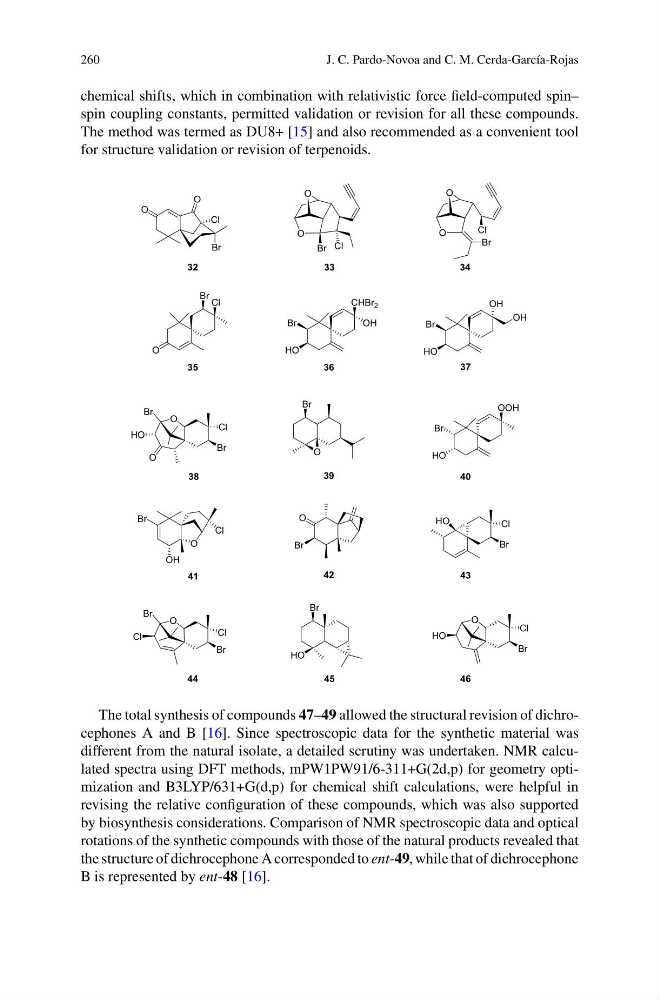
chemical shifts, which in combination with relativistic force field-computed spin–
spin coupling constants, permitted validation or revision for all these compounds.
The method was termed as DU8+ [15] and also recommended as a convenient tool
for structure validation or revision of terpenoids.
O
O
Br
Cl
O
O
Cl
Br
O
O
Cl
Br
O
Cl
Br
HO
CHBr 2
OH
Br
HO
OH
Br
OH
O
Br
Cl
HO
Br
O
Br
O
OOH
Br
HO
O
Cl
OH
Br
O
Br
Cl
HO
Br
O
Br
Cl
Cl
Br
O
Br
Cl
HO
Br
HO
4
3
3
3
2
3
6
3
5
3
37
38
39
40
41
42
43
6
4
5
4
4
4
The total synthesis of compounds 47–49 allowed the structural revision of dichrocephones A and B [16]. Since spectroscopic data for the synthetic material was
different from the natural isolate, a detailed scrutiny was undertaken. NMR calculated spectra using DFT methods, mPW1PW91/6-311+G(2d,p) for geometry optimization and B3LYP/631+G(d,p) for chemical shift calculations, were helpful in
revising the relative configuration of these compounds, which was also supported
by biosynthesis considerations. Comparison of NMR spectroscopic data and optical
rotations of the synthetic compounds with those of the natural products revealed that
the structure of dichrocephone A corresponded to ent-49, while that of dichrocephone
B is represented by ent-48 [16].
J. C. Pardo-Novoa and C. M. Cerda-García-Rojas
chemical shifts, which in combination with relativistic force field-computed spin–
spin coupling constants, permitted validation or revision for all these compounds.
The method was termed as DU8+ [15] and also recommended as a convenient tool
for structure validation or revision of terpenoids.
O
O
Br
Cl
O
O
Cl
Br
O
O
Cl
Br
O
Cl
Br
HO
CHBr 2
OH
Br
HO
OH
Br
OH
O
Br
Cl
HO
Br
O
Br
O
OOH
Br
HO
O
Cl
OH
Br
O
Br
Cl
HO
Br
O
Br
Cl
Cl
Br
O
Br
Cl
HO
Br
HO
4
3
3
3
2
3
6
3
5
3
37
38
39
40
41
42
43
6
4
5
4
4
4
The total synthesis of compounds 47–49 allowed the structural revision of dichrocephones A and B [16]. Since spectroscopic data for the synthetic material was
different from the natural isolate, a detailed scrutiny was undertaken. NMR calculated spectra using DFT methods, mPW1PW91/6-311+G(2d,p) for geometry optimization and B3LYP/631+G(d,p) for chemical shift calculations, were helpful in
revising the relative configuration of these compounds, which was also supported
by biosynthesis considerations. Comparison of NMR spectroscopic data and optical
rotations of the synthetic compounds with those of the natural products revealed that
the structure of dichrocephone A corresponded to ent-49, while that of dichrocephone
B is represented by ent-48 [16].