

258
J. C. Pardo-Novoa and C. M. Cerda-García-Rojas
O
OH
HO
O
HO
OH
O
OH
OH
O
OH
OH
O
OH
OH
5
1
4
1
16
17
18
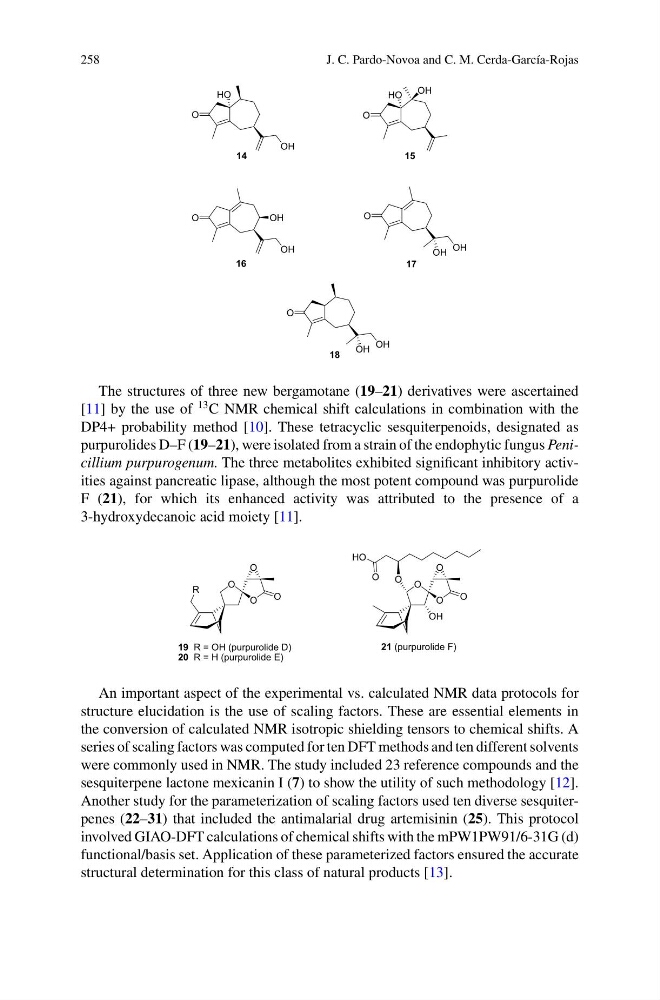
The structures of three new bergamotane (19–21) derivatives were ascertained
[11] by the use of
13 C NMR chemical shift calculations in combination with the
DP4+ probability method [10]. These tetracyclic sesquiterpenoids, designated as
purpurolides D–F (19–21), were isolated from a strain of the endophytic fungus Penicillium purpurogenum. The three metabolites exhibited significant inhibitory activities against pancreatic lipase, although the most potent compound was purpurolide
F (21), for which its enhanced activity was attributed to the presence of a
3-hydroxydecanoic acid moiety [11].
O
O
O
O
R
O
O
O
O
O
HO
O
OH
19 R = OH (purpurolide D)
20 R = H (purpurolide E)
21 (purpurolide F)
An important aspect of the experimental vs. calculated NMR data protocols for
structure elucidation is the use of scaling factors. These are essential elements in
the conversion of calculated NMR isotropic shielding tensors to chemical shifts. A
series of scaling factors was computed for ten DFT methods and ten different solvents
were commonly used in NMR. The study included 23 reference compounds and the
sesquiterpene lactone mexicanin I (7) to show the utility of such methodology [12].
Another study for the parameterization of scaling factors used ten diverse sesquiterpenes (22–31) that included the antimalarial drug artemisinin (25). This protocol
involved GIAO-DFT calculations of chemical shifts with the mPW1PW91/6-31G (d)
functional/basis set. Application of these parameterized factors ensured the accurate
structural determination for this class of natural products [13].
J. C. Pardo-Novoa and C. M. Cerda-García-Rojas
O
OH
HO
O
HO
OH
O
OH
OH
O
OH
OH
O
OH
OH
5
1
4
1
16
17
18
The structures of three new bergamotane (19–21) derivatives were ascertained
[11] by the use of
13 C NMR chemical shift calculations in combination with the
DP4+ probability method [10]. These tetracyclic sesquiterpenoids, designated as
purpurolides D–F (19–21), were isolated from a strain of the endophytic fungus Penicillium purpurogenum. The three metabolites exhibited significant inhibitory activities against pancreatic lipase, although the most potent compound was purpurolide
F (21), for which its enhanced activity was attributed to the presence of a
3-hydroxydecanoic acid moiety [11].
O
O
O
O
R
O
O
O
O
O
HO
O
OH
19 R = OH (purpurolide D)
20 R = H (purpurolide E)
21 (purpurolide F)
An important aspect of the experimental vs. calculated NMR data protocols for
structure elucidation is the use of scaling factors. These are essential elements in
the conversion of calculated NMR isotropic shielding tensors to chemical shifts. A
series of scaling factors was computed for ten DFT methods and ten different solvents
were commonly used in NMR. The study included 23 reference compounds and the
sesquiterpene lactone mexicanin I (7) to show the utility of such methodology [12].
Another study for the parameterization of scaling factors used ten diverse sesquiterpenes (22–31) that included the antimalarial drug artemisinin (25). This protocol
involved GIAO-DFT calculations of chemical shifts with the mPW1PW91/6-31G (d)
functional/basis set. Application of these parameterized factors ensured the accurate
structural determination for this class of natural products [13].