

256
J. C. Pardo-Novoa and C. M. Cerda-García-Rojas
HO
OH
O
O
O
HO
OH
HO
1 (presilphiperfolane-7,8-diol)
2
O
O
O
HO
OH
HO
3
O
O
O
HO
OH
HO
4
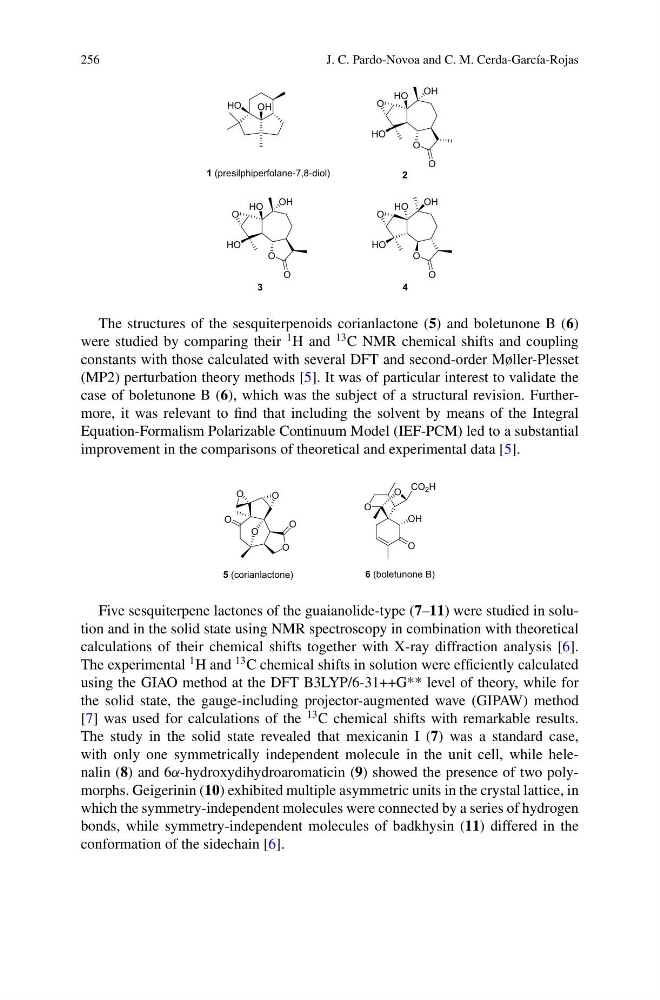
The structures of the sesquiterpenoids corianlactone (5) and boletunone B (6)
were studied by comparing their
1 H and
13 C NMR chemical shifts and coupling
constants with those calculated with several DFT and second-order Møller-Plesset
(MP2) perturbation theory methods [5]. It was of particular interest to validate the
case of boletunone B (6), which was the subject of a structural revision. Furthermore, it was relevant to find that including the solvent by means of the Integral
Equation-Formalism Polarizable Continuum Model (IEF-PCM) led to a substantial
improvement in the comparisons of theoretical and experimental data [5].
O
O
O
O
O
O
5 (corianlactone)
O
O
CO 2 H
O
OH
6 (boletunone B)
Five sesquiterpene lactones of the guaianolide-type (7–11) were studied in solution and in the solid state using NMR spectroscopy in combination with theoretical
calculations of their chemical shifts together with X-ray diffraction analysis [6].
The experimental
1 H and
13 C chemical shifts in solution were efficiently calculated
using the GIAO method at the DFT B3LYP/6-31++G** level of theory, while for
the solid state, the gauge-including projector-augmented wave (GIPAW) method
[7] was used for calculations of the
13 C chemical shifts with remarkable results.
The study in the solid state revealed that mexicanin I (7) was a standard case,
with only one symmetrically independent molecule in the unit cell, while helenalin (8) and 6α-hydroxydihydroaromaticin (9) showed the presence of two polymorphs. Geigerinin (10) exhibited multiple asymmetric units in the crystal lattice, in
which the symmetry-independent molecules were connected by a series of hydrogen
bonds, while symmetry-independent molecules of badkhysin (11) differed in the
conformation of the sidechain [6].
J. C. Pardo-Novoa and C. M. Cerda-García-Rojas
HO
OH
O
O
O
HO
OH
HO
1 (presilphiperfolane-7,8-diol)
2
O
O
O
HO
OH
HO
3
O
O
O
HO
OH
HO
4
The structures of the sesquiterpenoids corianlactone (5) and boletunone B (6)
were studied by comparing their
1 H and
13 C NMR chemical shifts and coupling
constants with those calculated with several DFT and second-order Møller-Plesset
(MP2) perturbation theory methods [5]. It was of particular interest to validate the
case of boletunone B (6), which was the subject of a structural revision. Furthermore, it was relevant to find that including the solvent by means of the Integral
Equation-Formalism Polarizable Continuum Model (IEF-PCM) led to a substantial
improvement in the comparisons of theoretical and experimental data [5].
O
O
O
O
O
O
5 (corianlactone)
O
O
CO 2 H
O
OH
6 (boletunone B)
Five sesquiterpene lactones of the guaianolide-type (7–11) were studied in solution and in the solid state using NMR spectroscopy in combination with theoretical
calculations of their chemical shifts together with X-ray diffraction analysis [6].
The experimental
1 H and
13 C chemical shifts in solution were efficiently calculated
using the GIAO method at the DFT B3LYP/6-31++G** level of theory, while for
the solid state, the gauge-including projector-augmented wave (GIPAW) method
[7] was used for calculations of the
13 C chemical shifts with remarkable results.
The study in the solid state revealed that mexicanin I (7) was a standard case,
with only one symmetrically independent molecule in the unit cell, while helenalin (8) and 6α-hydroxydihydroaromaticin (9) showed the presence of two polymorphs. Geigerinin (10) exhibited multiple asymmetric units in the crystal lattice, in
which the symmetry-independent molecules were connected by a series of hydrogen
bonds, while symmetry-independent molecules of badkhysin (11) differed in the
conformation of the sidechain [6].