

18
H. Zhu et al.
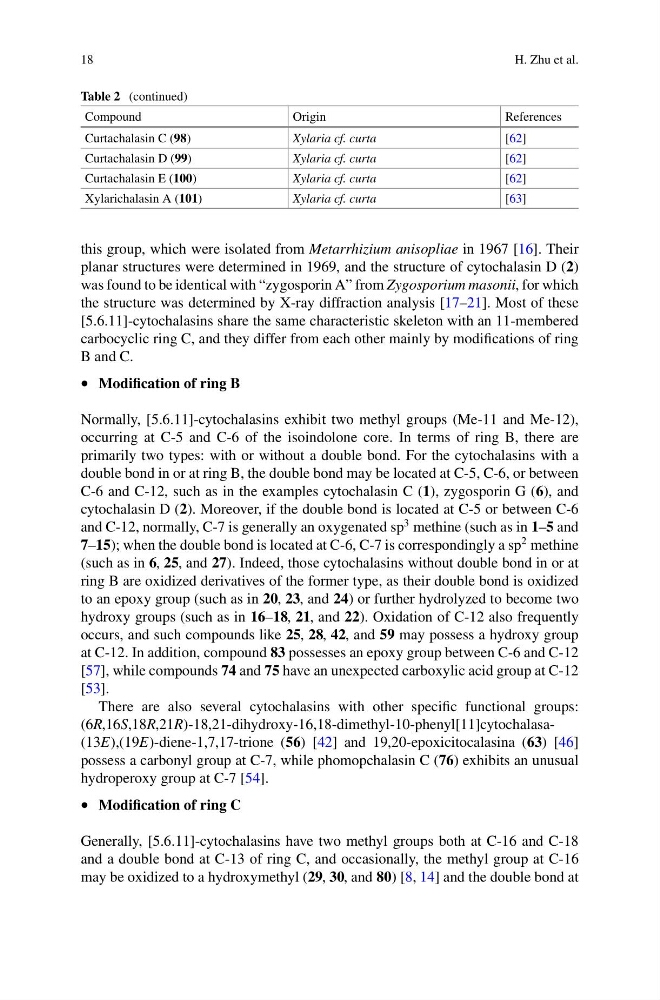
Table 2 (continued)
Compound
Origin
References
Curtachalasin C (98)
Xylaria cf. curta
[62]
Curtachalasin D (99)
Xylaria cf. curta
[62]
Curtachalasin E (100)
Xylaria cf. curta
[62]
Xylarichalasin A (101)
Xylaria cf. curta
[63]
this group, which were isolated from Metarrhizium anisopliae in 1967 [16]. Their
planar structures were determined in 1969, and the structure of cytochalasin D (2)
was found to be identical with “zygosporin A” from Zygosporium masonii, for which
the structure was determined by X-ray diffraction analysis [17–21]. Most of these
[5.6.11]-cytochalasins share the same characteristic skeleton with an 11-membered
carbocyclic ring C, and they differ from each other mainly by modifications of ring
B and C.
• Modification of ring B
Normally, [5.6.11]-cytochalasins exhibit two methyl groups (Me-11 and Me-12),
occurring at C-5 and C-6 of the isoindolone core. In terms of ring B, there are
primarily two types: with or without a double bond. For the cytochalasins with a
double bond in or at ring B, the double bond may be located at C-5, C-6, or between
C-6 and C-12, such as in the examples cytochalasin C (1), zygosporin G (6), and
cytochalasin D (2). Moreover, if the double bond is located at C-5 or between C-6
and C-12, normally, C-7 is generally an oxygenated sp
3 methine (such as in 1–5 and
7–15); when the double bond is located at C-6, C-7 is correspondingly a sp
2 methine
(such as in 6, 25, and 27). Indeed, those cytochalasins without double bond in or at
ring B are oxidized derivatives of the former type, as their double bond is oxidized
to an epoxy group (such as in 20, 23, and 24) or further hydrolyzed to become two
hydroxy groups (such as in 16–18, 21, and 22). Oxidation of C-12 also frequently
occurs, and such compounds like 25, 28, 42, and 59 may possess a hydroxy group
at C-12. In addition, compound 83 possesses an epoxy group between C-6 and C-12
[57], while compounds 74 and 75 have an unexpected carboxylic acid group at C-12
[53].
There are also several cytochalasins with other specific functional groups:
(6R,16S,18R,21R)-18,21-dihydroxy-16,18-dimethyl-10-phenyl[11]cytochalasa(13E),(19E)-diene-1,7,17-trione (56) [42] and 19,20-epoxicitocalasina (63) [46]
possess a carbonyl group at C-7, while phomopchalasin C (76) exhibits an unusual
hydroperoxy group at C-7 [54].
• Modification of ring C
Generally, [5.6.11]-cytochalasins have two methyl groups both at C-16 and C-18
and a double bond at C-13 of ring C, and occasionally, the methyl group at C-16
may be oxidized to a hydroxymethyl (29, 30, and 80) [8, 14] and the double bond at
H. Zhu et al.
Table 2 (continued)
Compound
Origin
References
Curtachalasin C (98)
Xylaria cf. curta
[62]
Curtachalasin D (99)
Xylaria cf. curta
[62]
Curtachalasin E (100)
Xylaria cf. curta
[62]
Xylarichalasin A (101)
Xylaria cf. curta
[63]
this group, which were isolated from Metarrhizium anisopliae in 1967 [16]. Their
planar structures were determined in 1969, and the structure of cytochalasin D (2)
was found to be identical with “zygosporin A” from Zygosporium masonii, for which
the structure was determined by X-ray diffraction analysis [17–21]. Most of these
[5.6.11]-cytochalasins share the same characteristic skeleton with an 11-membered
carbocyclic ring C, and they differ from each other mainly by modifications of ring
B and C.
• Modification of ring B
Normally, [5.6.11]-cytochalasins exhibit two methyl groups (Me-11 and Me-12),
occurring at C-5 and C-6 of the isoindolone core. In terms of ring B, there are
primarily two types: with or without a double bond. For the cytochalasins with a
double bond in or at ring B, the double bond may be located at C-5, C-6, or between
C-6 and C-12, such as in the examples cytochalasin C (1), zygosporin G (6), and
cytochalasin D (2). Moreover, if the double bond is located at C-5 or between C-6
and C-12, normally, C-7 is generally an oxygenated sp
3 methine (such as in 1–5 and
7–15); when the double bond is located at C-6, C-7 is correspondingly a sp
2 methine
(such as in 6, 25, and 27). Indeed, those cytochalasins without double bond in or at
ring B are oxidized derivatives of the former type, as their double bond is oxidized
to an epoxy group (such as in 20, 23, and 24) or further hydrolyzed to become two
hydroxy groups (such as in 16–18, 21, and 22). Oxidation of C-12 also frequently
occurs, and such compounds like 25, 28, 42, and 59 may possess a hydroxy group
at C-12. In addition, compound 83 possesses an epoxy group between C-6 and C-12
[57], while compounds 74 and 75 have an unexpected carboxylic acid group at C-12
[53].
There are also several cytochalasins with other specific functional groups:
(6R,16S,18R,21R)-18,21-dihydroxy-16,18-dimethyl-10-phenyl[11]cytochalasa(13E),(19E)-diene-1,7,17-trione (56) [42] and 19,20-epoxicitocalasina (63) [46]
possess a carbonyl group at C-7, while phomopchalasin C (76) exhibits an unusual
hydroperoxy group at C-7 [54].
• Modification of ring C
Generally, [5.6.11]-cytochalasins have two methyl groups both at C-16 and C-18
and a double bond at C-13 of ring C, and occasionally, the methyl group at C-16
may be oxidized to a hydroxymethyl (29, 30, and 80) [8, 14] and the double bond at