

Bioactive Compounds from Medicinal Plants in Myanmar
221
O
R
1
R
2
OH
O
O
R
3
HO
OH
O
CO
433 (12-hydroxyoleanolic lactone)
429 (decussatine) R
1 = R
2 = OMe, R
3 = H
430 (methylbellidifolin) R
1 = OH, R
2 = H, R
3 = OMe
431 (3,5-dimethoxy-1-hydroxyxanthone) R
1 = R
2 = H, R
3 = OMe
432 (bellidifolin) R
1 = R
3 = OH, R
2 = H
HO
O
OH
382 (oleanolic acid)
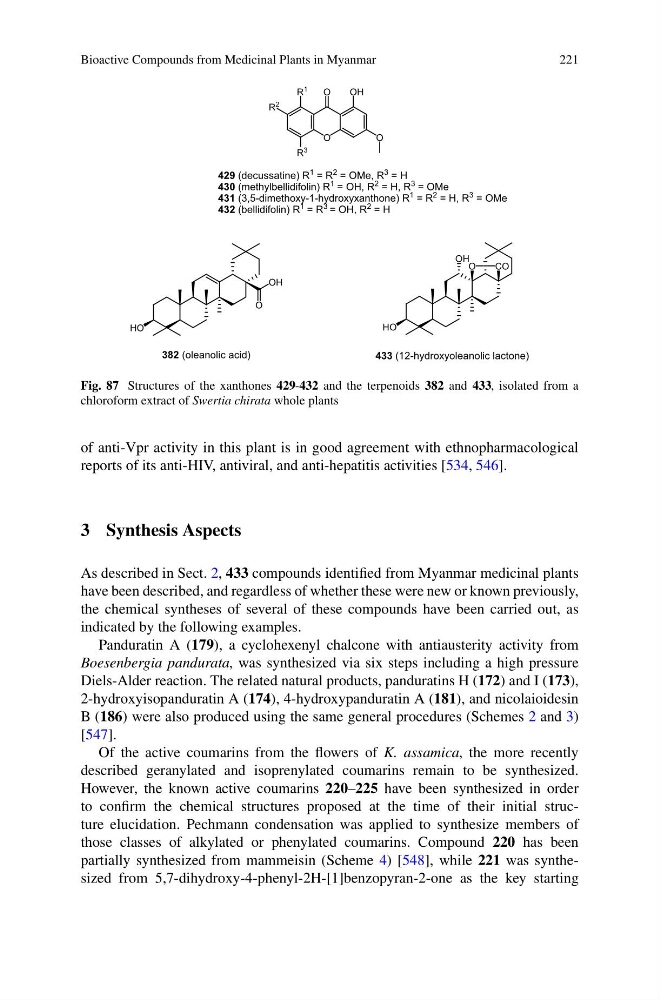
Fig. 87 Structures of the xanthones 429-432 and the terpenoids 382 and 433, isolated from a
chloroform extract of Swertia chirata whole plants
of anti-Vpr activity in this plant is in good agreement with ethnopharmacological
reports of its anti-HIV, antiviral, and anti-hepatitis activities [534, 546].
3 Synthesis Aspects
As described in Sect. 2, 433 compounds identified from Myanmar medicinal plants
have been described, and regardless of whether these were new or known previously,
the chemical syntheses of several of these compounds have been carried out, as
indicated by the following examples.
Panduratin A (179), a cyclohexenyl chalcone with antiausterity activity from
Boesenbergia pandurata, was synthesized via six steps including a high pressure
Diels-Alder reaction. The related natural products, panduratins H (172) and I (173),
2-hydroxyisopanduratin A (174), 4-hydroxypanduratin A (181), and nicolaioidesin
B (186) were also produced using the same general procedures (Schemes 2 and 3)
[547].
Of the active coumarins from the flowers of K. assamica, the more recently
described geranylated and isoprenylated coumarins remain to be synthesized.
However, the known active coumarins 220–225 have been synthesized in order
to confirm the chemical structures proposed at the time of their initial structure elucidation. Pechmann condensation was applied to synthesize members of
those classes of alkylated or phenylated coumarins. Compound 220 has been
partially synthesized from mammeisin (Scheme 4) [548], while 221 was synthesized from 5,7-dihydroxy-4-phenyl-2H-[1]benzopyran-2-one as the key starting
221
O
R
1
R
2
OH
O
O
R
3
HO
OH
O
CO
433 (12-hydroxyoleanolic lactone)
429 (decussatine) R
1 = R
2 = OMe, R
3 = H
430 (methylbellidifolin) R
1 = OH, R
2 = H, R
3 = OMe
431 (3,5-dimethoxy-1-hydroxyxanthone) R
1 = R
2 = H, R
3 = OMe
432 (bellidifolin) R
1 = R
3 = OH, R
2 = H
HO
O
OH
382 (oleanolic acid)
Fig. 87 Structures of the xanthones 429-432 and the terpenoids 382 and 433, isolated from a
chloroform extract of Swertia chirata whole plants
of anti-Vpr activity in this plant is in good agreement with ethnopharmacological
reports of its anti-HIV, antiviral, and anti-hepatitis activities [534, 546].
3 Synthesis Aspects
As described in Sect. 2, 433 compounds identified from Myanmar medicinal plants
have been described, and regardless of whether these were new or known previously,
the chemical syntheses of several of these compounds have been carried out, as
indicated by the following examples.
Panduratin A (179), a cyclohexenyl chalcone with antiausterity activity from
Boesenbergia pandurata, was synthesized via six steps including a high pressure
Diels-Alder reaction. The related natural products, panduratins H (172) and I (173),
2-hydroxyisopanduratin A (174), 4-hydroxypanduratin A (181), and nicolaioidesin
B (186) were also produced using the same general procedures (Schemes 2 and 3)
[547].
Of the active coumarins from the flowers of K. assamica, the more recently
described geranylated and isoprenylated coumarins remain to be synthesized.
However, the known active coumarins 220–225 have been synthesized in order
to confirm the chemical structures proposed at the time of their initial structure elucidation. Pechmann condensation was applied to synthesize members of
those classes of alkylated or phenylated coumarins. Compound 220 has been
partially synthesized from mammeisin (Scheme 4) [548], while 221 was synthesized from 5,7-dihydroxy-4-phenyl-2H-[1]benzopyran-2-one as the key starting