

Bioactive Compounds from Medicinal Plants in Myanmar
185
Among these isolates, compounds 240, 254, and 260–262 exhibited the most
potent NO production inhibitory activities (IC 50 (μM): 8.08, 7.28, 8.82, 6.73,
7.01) against LPS-activated BV-2 cells, followed by 250, 251, 257 (IC 50 /μM: 9.03,
10.7, 12.8) and 243–246 [IC 50 /μM: 22.3, 21.6, 33.5, 23.1], respectively [277]. The
inhibitory effects of compounds 240, 250, 254, and 260–262 were greater than that
of the positive control, l-NMMA (IC 50 9.50 μM). However, cytotoxicity was found
from compounds 236–238 at 10 μM. Since activated microglial cells produce excessive inflammatory substances, such as NO, cytokines, and prostaglandins, NO derived
from inducible nitric oxide synthase in LPS-activated microglia is an important mediator of inflammation and neuronal cell death [300]. Thus, Limonia acidissima and
its active constituents may be good lead compounds for the development of novel
neuroprotective agents.
2.14 Soymida febrifuga (Roxb.) A. Juss.
Soymida febrifuga belongs to the family Meliaceae. It is distributed widely in tropical
areas of Asia, inclusive of India, Sri Lanka, and Myanmar. In Myanmar, the plant is
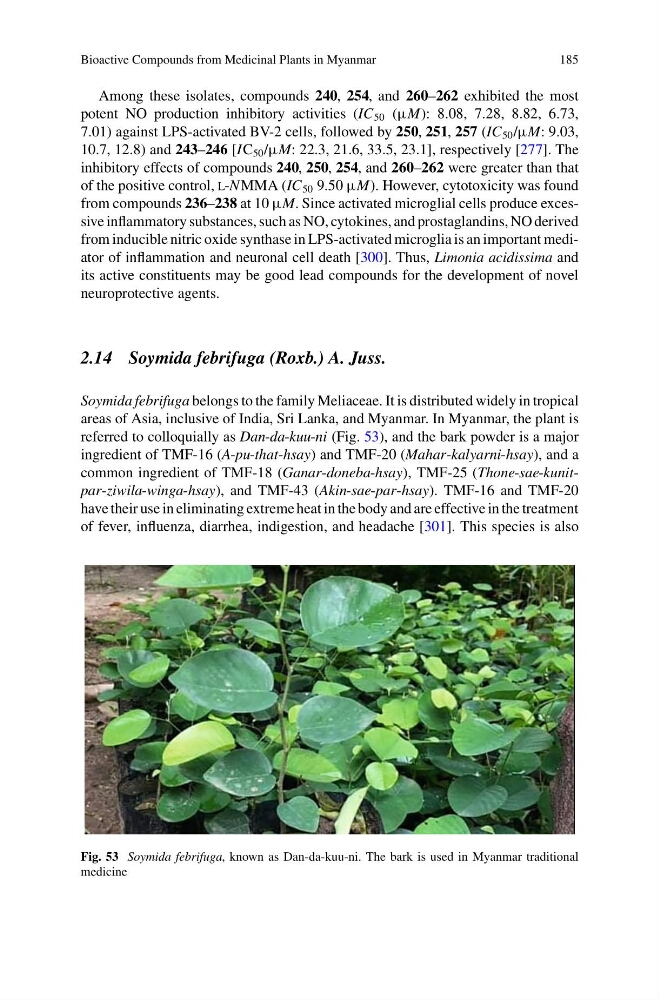
referred to colloquially as Dan-da-kuu-ni (Fig. 53), and the bark powder is a major
ingredient of TMF-16 (A-pu-that-hsay) and TMF-20 (Mahar-kalyarni-hsay), and a
common ingredient of TMF-18 (Ganar-doneba-hsay), TMF-25 (Thone-sae-kunitpar-ziwila-winga-hsay), and TMF-43 (Akin-sae-par-hsay). TMF-16 and TMF-20
have their use in eliminating extreme heat in the body and are effective in the treatment
of fever, influenza, diarrhea, indigestion, and headache [301]. This species is also
Fig. 53 Soymida febrifuga, known as Dan-da-kuu-ni. The bark is used in Myanmar traditional
medicine
185
Among these isolates, compounds 240, 254, and 260–262 exhibited the most
potent NO production inhibitory activities (IC 50 (μM): 8.08, 7.28, 8.82, 6.73,
7.01) against LPS-activated BV-2 cells, followed by 250, 251, 257 (IC 50 /μM: 9.03,
10.7, 12.8) and 243–246 [IC 50 /μM: 22.3, 21.6, 33.5, 23.1], respectively [277]. The
inhibitory effects of compounds 240, 250, 254, and 260–262 were greater than that
of the positive control, l-NMMA (IC 50 9.50 μM). However, cytotoxicity was found
from compounds 236–238 at 10 μM. Since activated microglial cells produce excessive inflammatory substances, such as NO, cytokines, and prostaglandins, NO derived
from inducible nitric oxide synthase in LPS-activated microglia is an important mediator of inflammation and neuronal cell death [300]. Thus, Limonia acidissima and
its active constituents may be good lead compounds for the development of novel
neuroprotective agents.
2.14 Soymida febrifuga (Roxb.) A. Juss.
Soymida febrifuga belongs to the family Meliaceae. It is distributed widely in tropical
areas of Asia, inclusive of India, Sri Lanka, and Myanmar. In Myanmar, the plant is
referred to colloquially as Dan-da-kuu-ni (Fig. 53), and the bark powder is a major
ingredient of TMF-16 (A-pu-that-hsay) and TMF-20 (Mahar-kalyarni-hsay), and a
common ingredient of TMF-18 (Ganar-doneba-hsay), TMF-25 (Thone-sae-kunitpar-ziwila-winga-hsay), and TMF-43 (Akin-sae-par-hsay). TMF-16 and TMF-20
have their use in eliminating extreme heat in the body and are effective in the treatment
of fever, influenza, diarrhea, indigestion, and headache [301]. This species is also
Fig. 53 Soymida febrifuga, known as Dan-da-kuu-ni. The bark is used in Myanmar traditional
medicine