

Bioactive Compounds from Medicinal Plants in Myanmar
177
of the coumarin derivatives 204–206 were typically less than 1.0 and the values for
207 were 4.70 and 5.02 for the D6 and W2 clones, respectively, these coumarin
derivatives have been proposed as being weak antimalarial agents.
In turn, when the flowers of K. assamica in Myanmar were studied in 2008 [238,
239], the CHCl 3 -soluble fraction showed anti-austerity activity, with a PC 100 value
of 1 μg/cm
3 against PANC-1 human pancreatic cancer cells in vitro. Subsequently,
a series of chromatographic separations on this active extract resulted in the isolation of nine new coumarins, kayeassamins A–I (211–219) [238, 239] (Fig. 44),
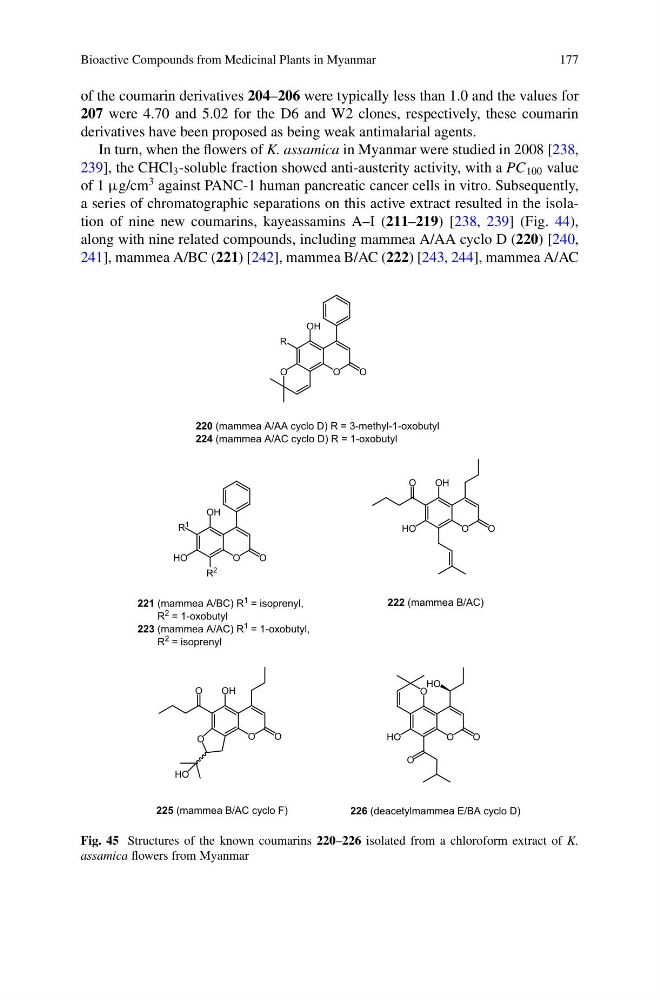
along with nine related compounds, including mammea A/AA cyclo D (220) [240,
241], mammea A/BC (221) [242], mammea B/AC (222) [243, 244], mammea A/AC
O
R
O
O
OH
220 (mammea A/AA cyclo D) R = 3-methyl-1-oxobutyl
224 (mammea A/AC cyclo D) R = 1-oxobutyl
O
R
1
O
HO
R
2
OH
221 (mammea A/BC) R
1 = isoprenyl,
R
2 = 1-oxobutyl
223 (mammea A/AC) R
1 = 1-oxobutyl,
R
2 = isoprenyl
O
HO
HO
O
O
O
226 (deacetylmammea E/BA cyclo D)
O
HO
OH
O
O
222 (mammea B/AC)
O
OH
O
O
225 (mammea B/AC cyclo F)
O
HO
Fig. 45 Structures of the known coumarins 220–226 isolated from a chloroform extract of K.
assamica flowers from Myanmar
177
of the coumarin derivatives 204–206 were typically less than 1.0 and the values for
207 were 4.70 and 5.02 for the D6 and W2 clones, respectively, these coumarin
derivatives have been proposed as being weak antimalarial agents.
In turn, when the flowers of K. assamica in Myanmar were studied in 2008 [238,
239], the CHCl 3 -soluble fraction showed anti-austerity activity, with a PC 100 value
of 1 μg/cm
3 against PANC-1 human pancreatic cancer cells in vitro. Subsequently,
a series of chromatographic separations on this active extract resulted in the isolation of nine new coumarins, kayeassamins A–I (211–219) [238, 239] (Fig. 44),
along with nine related compounds, including mammea A/AA cyclo D (220) [240,
241], mammea A/BC (221) [242], mammea B/AC (222) [243, 244], mammea A/AC
O
R
O
O
OH
220 (mammea A/AA cyclo D) R = 3-methyl-1-oxobutyl
224 (mammea A/AC cyclo D) R = 1-oxobutyl
O
R
1
O
HO
R
2
OH
221 (mammea A/BC) R
1 = isoprenyl,
R
2 = 1-oxobutyl
223 (mammea A/AC) R
1 = 1-oxobutyl,
R
2 = isoprenyl
O
HO
HO
O
O
O
226 (deacetylmammea E/BA cyclo D)
O
HO
OH
O
O
222 (mammea B/AC)
O
OH
O
O
225 (mammea B/AC cyclo F)
O
HO
Fig. 45 Structures of the known coumarins 220–226 isolated from a chloroform extract of K.
assamica flowers from Myanmar