

Bioactive Compounds from Medicinal Plants in Myanmar
145
O
O
R
3
R
2
O
O
O
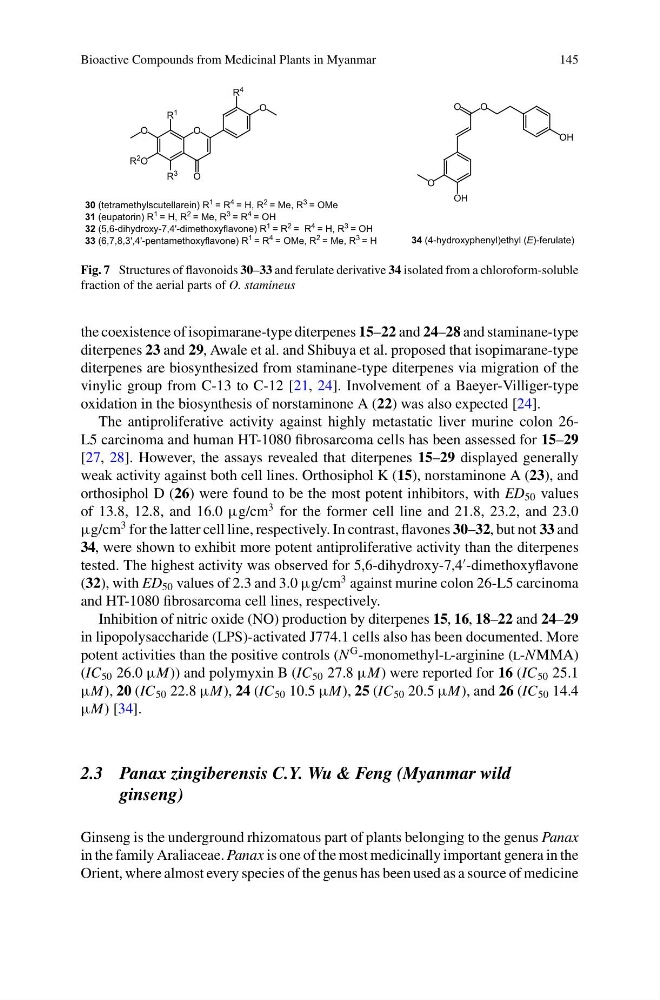
30 (tetramethylscutellarein) R
1 = R
4 = H, R
2 = Me, R
3 = OMe
31 (eupatorin) R
1 = H, R
2 = Me, R
3 = R
4 = OH
32 (5,6-dihydroxy-7,4'-dimethoxyflavone) R
1 = R
2 = R
4 = H, R
3 = OH
33 (6,7,8,3',4'-pentamethoxyflavone) R
1 = R
4 = OMe, R
2 = Me, R
3 = H
R
4
R
1
OH
O
O
O
OH
34 (4-hydroxyphenyl)ethyl (E)-ferulate)
Fig. 7 Structures of flavonoids 30–33 and ferulate derivative 34 isolated from a chloroform-soluble
fraction of the aerial parts of O. stamineus
the coexistence of isopimarane-type diterpenes 15–22 and 24–28 and staminane-type
diterpenes 23 and 29, Awale et al. and Shibuya et al. proposed that isopimarane-type
diterpenes are biosynthesized from staminane-type diterpenes via migration of the
vinylic group from C-13 to C-12 [21, 24]. Involvement of a Baeyer-Villiger-type
oxidation in the biosynthesis of norstaminone A (22) was also expected [24].
The antiproliferative activity against highly metastatic liver murine colon 26L5 carcinoma and human HT-1080 fibrosarcoma cells has been assessed for 15–29
[27, 28]. However, the assays revealed that diterpenes 15–29 displayed generally
weak activity against both cell lines. Orthosiphol K (15), norstaminone A (23), and
orthosiphol D (26) were found to be the most potent inhibitors, with ED 50 values
of 13.8, 12.8, and 16.0 μg/cm
3 for the former cell line and 21.8, 23.2, and 23.0
μg/cm
3 for the latter cell line, respectively. In contrast, flavones 30–32, but not 33 and
34, were shown to exhibit more potent antiproliferative activity than the diterpenes
tested. The highest activity was observed for 5,6-dihydroxy-7,4
-dimethoxyflavone
(32), with ED 50 values of 2.3 and 3.0 μg/cm
3 against murine colon 26-L5 carcinoma
and HT-1080 fibrosarcoma cell lines, respectively.
Inhibition of nitric oxide (NO) production by diterpenes 15, 16, 18–22 and 24–29
in lipopolysaccharide (LPS)-activated J774.1 cells also has been documented. More
potent activities than the positive controls (N
G -monomethyl-l-arginine (l-NMMA)
(IC 50 26.0 μM)) and polymyxin B (IC 50 27.8 μM) were reported for 16 (IC 50 25.1
μM), 20 (IC 50 22.8 μM), 24 (IC 50 10.5 μM), 25 (IC 50 20.5 μM), and 26 (IC 50 14.4
μM) [34].
2.3 Panax zingiberensis C.Y. Wu & Feng (Myanmar wild
ginseng)
Ginseng is the underground rhizomatous part of plants belonging to the genus Panax
in the family Araliaceae. Panax is one of the most medicinally important genera in the
Orient, where almost every species of the genus has been used as a source of medicine
145
O
O
R
3
R
2
O
O
O
30 (tetramethylscutellarein) R
1 = R
4 = H, R
2 = Me, R
3 = OMe
31 (eupatorin) R
1 = H, R
2 = Me, R
3 = R
4 = OH
32 (5,6-dihydroxy-7,4'-dimethoxyflavone) R
1 = R
2 = R
4 = H, R
3 = OH
33 (6,7,8,3',4'-pentamethoxyflavone) R
1 = R
4 = OMe, R
2 = Me, R
3 = H
R
4
R
1
OH
O
O
O
OH
34 (4-hydroxyphenyl)ethyl (E)-ferulate)
Fig. 7 Structures of flavonoids 30–33 and ferulate derivative 34 isolated from a chloroform-soluble
fraction of the aerial parts of O. stamineus
the coexistence of isopimarane-type diterpenes 15–22 and 24–28 and staminane-type
diterpenes 23 and 29, Awale et al. and Shibuya et al. proposed that isopimarane-type
diterpenes are biosynthesized from staminane-type diterpenes via migration of the
vinylic group from C-13 to C-12 [21, 24]. Involvement of a Baeyer-Villiger-type
oxidation in the biosynthesis of norstaminone A (22) was also expected [24].
The antiproliferative activity against highly metastatic liver murine colon 26L5 carcinoma and human HT-1080 fibrosarcoma cells has been assessed for 15–29
[27, 28]. However, the assays revealed that diterpenes 15–29 displayed generally
weak activity against both cell lines. Orthosiphol K (15), norstaminone A (23), and
orthosiphol D (26) were found to be the most potent inhibitors, with ED 50 values
of 13.8, 12.8, and 16.0 μg/cm
3 for the former cell line and 21.8, 23.2, and 23.0
μg/cm
3 for the latter cell line, respectively. In contrast, flavones 30–32, but not 33 and
34, were shown to exhibit more potent antiproliferative activity than the diterpenes
tested. The highest activity was observed for 5,6-dihydroxy-7,4
-dimethoxyflavone
(32), with ED 50 values of 2.3 and 3.0 μg/cm
3 against murine colon 26-L5 carcinoma
and HT-1080 fibrosarcoma cell lines, respectively.
Inhibition of nitric oxide (NO) production by diterpenes 15, 16, 18–22 and 24–29
in lipopolysaccharide (LPS)-activated J774.1 cells also has been documented. More
potent activities than the positive controls (N
G -monomethyl-l-arginine (l-NMMA)
(IC 50 26.0 μM)) and polymyxin B (IC 50 27.8 μM) were reported for 16 (IC 50 25.1
μM), 20 (IC 50 22.8 μM), 24 (IC 50 10.5 μM), 25 (IC 50 20.5 μM), and 26 (IC 50 14.4
μM) [34].
2.3 Panax zingiberensis C.Y. Wu & Feng (Myanmar wild
ginseng)
Ginseng is the underground rhizomatous part of plants belonging to the genus Panax
in the family Araliaceae. Panax is one of the most medicinally important genera in the
Orient, where almost every species of the genus has been used as a source of medicine