

Progress in the Chemistry of Cytochalasans
107
HN
O
O
OH
HN
O
OH
HO
HN
O
OH
HO
408 (periconiasin D)
409 (periconiasin E)
410 (periconiasin F)
HN
O O
HO
404 (periconiasin A)
HN
O O
O
406 (periconiasin C)
HN
O O
HO
405 (periconiasin B)
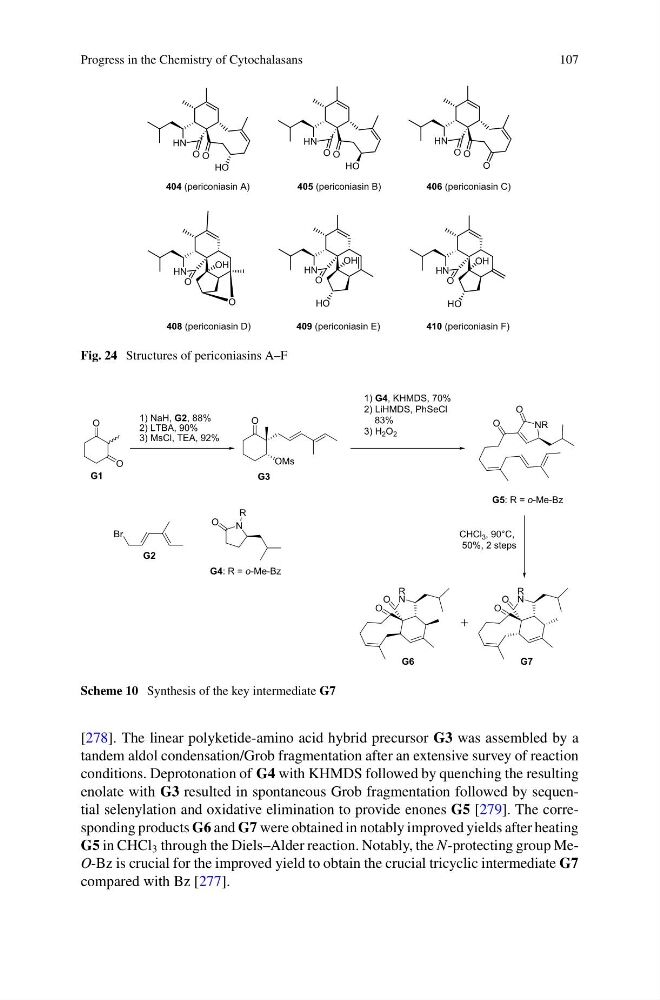
Fig. 24 Structures of periconiasins A–F
O
O
1) NaH, G2, 88%
2) LTBA, 90%
3) MsCl, TEA, 92%
O
OMs
1) G4, KHMDS, 70%
2) LiHMDS, PhSeCl
83%
3) H 2 O 2
NR
O
O
G5: R = o-Me-Bz
CHCl 3 , 90°C,
50%, 2 steps
R
N
O
O
+
R
N
O
O
G4: R = o-Me-Bz
Br
N
O
R
G1
G3
G2
7
G
6
G
Scheme 10 Synthesis of the key intermediate G7
[278]. The linear polyketide-amino acid hybrid precursor G3 was assembled by a
tandem aldol condensation/Grob fragmentation after an extensive survey of reaction
conditions. Deprotonation of G4 with KHMDS followed by quenching the resulting
enolate with G3 resulted in spontaneous Grob fragmentation followed by sequential selenylation and oxidative elimination to provide enones G5 [279]. The corresponding products G6 and G7 were obtained in notably improved yields after heating
G5 in CHCl 3 through the Diels–Alder reaction. Notably, the N-protecting group MeO-Bz is crucial for the improved yield to obtain the crucial tricyclic intermediate G7
compared with Bz [277].
107
HN
O
O
OH
HN
O
OH
HO
HN
O
OH
HO
408 (periconiasin D)
409 (periconiasin E)
410 (periconiasin F)
HN
O O
HO
404 (periconiasin A)
HN
O O
O
406 (periconiasin C)
HN
O O
HO
405 (periconiasin B)
Fig. 24 Structures of periconiasins A–F
O
O
1) NaH, G2, 88%
2) LTBA, 90%
3) MsCl, TEA, 92%
O
OMs
1) G4, KHMDS, 70%
2) LiHMDS, PhSeCl
83%
3) H 2 O 2
NR
O
O
G5: R = o-Me-Bz
CHCl 3 , 90°C,
50%, 2 steps
R
N
O
O
+
R
N
O
O
G4: R = o-Me-Bz
Br
N
O
R
G1
G3
G2
7
G
6
G
Scheme 10 Synthesis of the key intermediate G7
[278]. The linear polyketide-amino acid hybrid precursor G3 was assembled by a
tandem aldol condensation/Grob fragmentation after an extensive survey of reaction
conditions. Deprotonation of G4 with KHMDS followed by quenching the resulting
enolate with G3 resulted in spontaneous Grob fragmentation followed by sequential selenylation and oxidative elimination to provide enones G5 [279]. The corresponding products G6 and G7 were obtained in notably improved yields after heating
G5 in CHCl 3 through the Diels–Alder reaction. Notably, the N-protecting group MeO-Bz is crucial for the improved yield to obtain the crucial tricyclic intermediate G7
compared with Bz [277].