

100
H. Zhu et al.
O
O
HO
HN
O O
OH
O
NH
O
O
O
HO
O
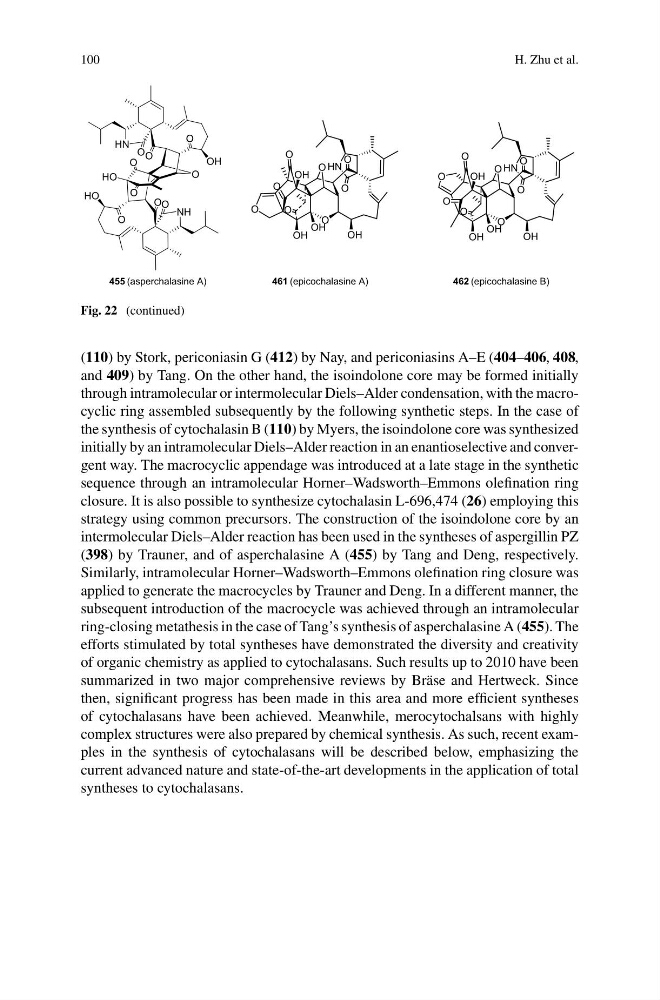
455 (asperchalasine A)
O
O
O
OH
OH
OH
O
O
OH
HN
O
O
O
461 (epicochalasine A)
O
O
OH
OH
OH
O
O
OH
HN
O
O
O
O
462 (epicochalasine B)
Fig. 22 (continued)
(110) by Stork, periconiasin G (412) by Nay, and periconiasins A–E (404–406, 408,
and 409) by Tang. On the other hand, the isoindolone core may be formed initially
through intramolecular or intermolecular Diels–Alder condensation, with the macrocyclic ring assembled subsequently by the following synthetic steps. In the case of
the synthesis of cytochalasin B (110) by Myers, the isoindolone core was synthesized
initially by an intramolecular Diels–Alder reaction in an enantioselective and convergent way. The macrocyclic appendage was introduced at a late stage in the synthetic
sequence through an intramolecular Horner–Wadsworth–Emmons olefination ring
closure. It is also possible to synthesize cytochalasin L-696,474 (26) employing this
strategy using common precursors. The construction of the isoindolone core by an
intermolecular Diels–Alder reaction has been used in the syntheses of aspergillin PZ
(398) by Trauner, and of asperchalasine A (455) by Tang and Deng, respectively.
Similarly, intramolecular Horner–Wadsworth–Emmons olefination ring closure was
applied to generate the macrocycles by Trauner and Deng. In a different manner, the
subsequent introduction of the macrocycle was achieved through an intramolecular
ring-closing metathesis in the case of Tang’s synthesis of asperchalasine A (455). The
efforts stimulated by total syntheses have demonstrated the diversity and creativity
of organic chemistry as applied to cytochalasans. Such results up to 2010 have been
summarized in two major comprehensive reviews by Bräse and Hertweck. Since
then, significant progress has been made in this area and more efficient syntheses
of cytochalasans have been achieved. Meanwhile, merocytochalsans with highly
complex structures were also prepared by chemical synthesis. As such, recent examples in the synthesis of cytochalasans will be described below, emphasizing the
current advanced nature and state-of-the-art developments in the application of total
syntheses to cytochalasans.
H. Zhu et al.
O
O
HO
HN
O O
OH
O
NH
O
O
O
HO
O
455 (asperchalasine A)
O
O
O
OH
OH
OH
O
O
OH
HN
O
O
O
461 (epicochalasine A)
O
O
OH
OH
OH
O
O
OH
HN
O
O
O
O
462 (epicochalasine B)
Fig. 22 (continued)
(110) by Stork, periconiasin G (412) by Nay, and periconiasins A–E (404–406, 408,
and 409) by Tang. On the other hand, the isoindolone core may be formed initially
through intramolecular or intermolecular Diels–Alder condensation, with the macrocyclic ring assembled subsequently by the following synthetic steps. In the case of
the synthesis of cytochalasin B (110) by Myers, the isoindolone core was synthesized
initially by an intramolecular Diels–Alder reaction in an enantioselective and convergent way. The macrocyclic appendage was introduced at a late stage in the synthetic
sequence through an intramolecular Horner–Wadsworth–Emmons olefination ring
closure. It is also possible to synthesize cytochalasin L-696,474 (26) employing this
strategy using common precursors. The construction of the isoindolone core by an
intermolecular Diels–Alder reaction has been used in the syntheses of aspergillin PZ
(398) by Trauner, and of asperchalasine A (455) by Tang and Deng, respectively.
Similarly, intramolecular Horner–Wadsworth–Emmons olefination ring closure was
applied to generate the macrocycles by Trauner and Deng. In a different manner, the
subsequent introduction of the macrocycle was achieved through an intramolecular
ring-closing metathesis in the case of Tang’s synthesis of asperchalasine A (455). The
efforts stimulated by total syntheses have demonstrated the diversity and creativity
of organic chemistry as applied to cytochalasans. Such results up to 2010 have been
summarized in two major comprehensive reviews by Bräse and Hertweck. Since
then, significant progress has been made in this area and more efficient syntheses
of cytochalasans have been achieved. Meanwhile, merocytochalsans with highly
complex structures were also prepared by chemical synthesis. As such, recent examples in the synthesis of cytochalasans will be described below, emphasizing the
current advanced nature and state-of-the-art developments in the application of total
syntheses to cytochalasans.