

54 Planar double chain linkages
(a)
(b)
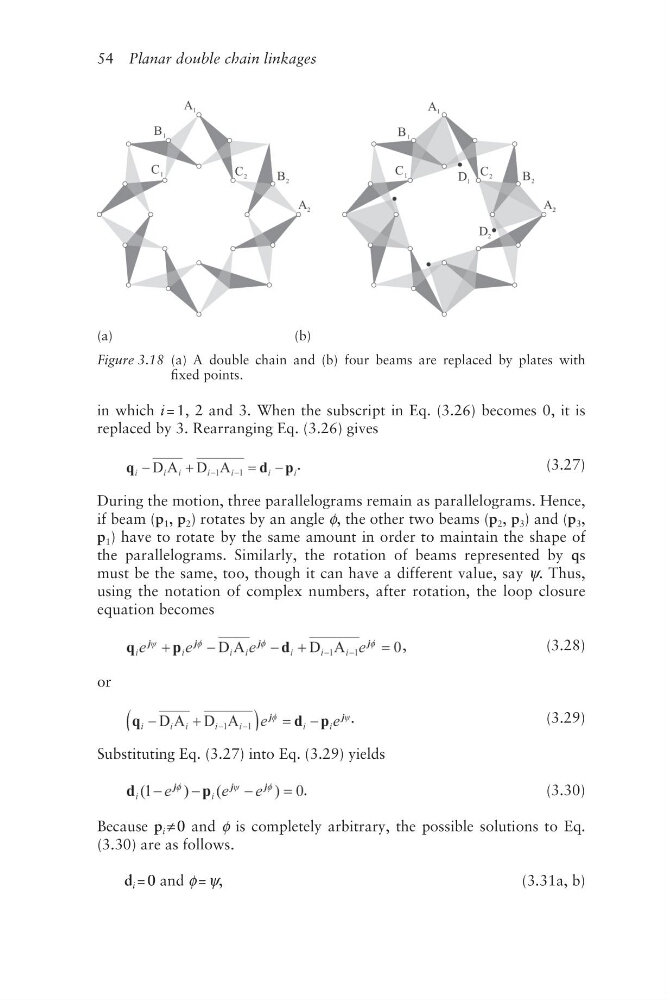
Figure 3.18 (a) A double chain and (b) four beams are replaced by plates with
fixed points.
in which i = 1, 2 and 3. When the subscript in Eq. (3.26) becomes 0, it is
replaced by 3. Rearranging Eq. (3.26) gives
.
(3.27)
During the motion, three parallelograms remain as parallelograms. Hence,
if beam (p 1 , p 2 ) rotates by an angle φ, the other two beams (p 2 , p 3 ) and (p 3 ,
p 1 ) have to rotate by the same amount in order to maintain the shape of
the parallelograms. Similarly, the rotation of beams represented by qs
must be the same, too, though it can have a different value, say ψ. Thus,
using the notation of complex numbers, after rotation, the loop closure
equation becomes
,
(3.28)
or
.
(3.29)
Substituting Eq. (3.27) into Eq. (3.29) yields
.
(3.30)
Because p i ≠ 0 and φ is completely arbitrary, the possible solutions to Eq.
(3.30) are as follows.
d i = 0 and φ = ψ,
(3.31a, b)
(a)
(b)
Figure 3.18 (a) A double chain and (b) four beams are replaced by plates with
fixed points.
in which i = 1, 2 and 3. When the subscript in Eq. (3.26) becomes 0, it is
replaced by 3. Rearranging Eq. (3.26) gives
.
(3.27)
During the motion, three parallelograms remain as parallelograms. Hence,
if beam (p 1 , p 2 ) rotates by an angle φ, the other two beams (p 2 , p 3 ) and (p 3 ,
p 1 ) have to rotate by the same amount in order to maintain the shape of
the parallelograms. Similarly, the rotation of beams represented by qs
must be the same, too, though it can have a different value, say ψ. Thus,
using the notation of complex numbers, after rotation, the loop closure
equation becomes
,
(3.28)
or
.
(3.29)
Substituting Eq. (3.27) into Eq. (3.29) yields
.
(3.30)
Because p i ≠ 0 and φ is completely arbitrary, the possible solutions to Eq.
(3.30) are as follows.
d i = 0 and φ = ψ,
(3.31a, b)