

52 Planar double chain linkages
fact Hoberman (1990, 1991) as well as You and Pellegrino (1997a) have
discovered that, by maintaining a constant sustained angle for each scissorlike element or for each set of elements, mobile double chains can be
created using symmetry. No loop parallelogram constraint is forced upon
the resulting linkages. Figure 3.5(b) shows such an example. Finding a
general solution for those cases remains a challenge.
3.3 Supports for double chains
3.3.1 Double chains with a symmetric layout
Double chains with symmetric layout can be connected to supports that
permit translation within the plane of symmetry. Thus, the double chain
with two- fold symmetry, Figure 3.17, can be supported by four tracks
along the symmetry lines. The magnitude of the edge translation is small in
comparison with that of the inner joints, because each outer ring distorts
less than the inner ring.
The second, less intuitive way of supporting the double chain is to
connect its elements to fixed points, which allow rotation but not translation. The existence and location of such special fixed points are easiest to
show for regular circular layouts. Figure 3.18 shows such an example in
which each of the light grey angulated beams has a corresponding fixed
point. To facilitate the rotation these beams must be replaced by plates, e.g.
beams A 1 B 1 C 1 and A 2 B 2 C 2 are substituted by larger plates A 1 B 1 C 1 D 1 and
A 2 B 2 C 2 D 2 , respectively, and D 1 and D 2 are fixed to ground. The expansion
sequence of the double chain is shown in Figure 3.19 from which it can be
seen that all of the light grey beams or plates rotate whereas the other set
of dark beams translate.
In fact, this is a common feature for all of the mobile double chains
obtained in Section 3.2. The proof is given in the next section.
3.3.2 Fixed points for closed double chain
A closed double chain consisting of three intersecting elements is shown in
Figure 3.20. The beams are represented by vectors (p 1 , p 2 ), (p 2 , p 3 ), (p 3 , p 1 ),
(q 1 , q 2 ), (q 2 , q 3 ) and (q 3 , q 1 ). The chain satisfies the loop parallelogram constraint and therefore there are three parallelograms in the assembly. We
have shown in the previous section that the mobility conditions for the
assembly are that both sets of vector ps and qs must form a polygon.
Now assume that a set of three fixed points, D i (i = 1, 2 and 3), exist for
beams (p 1 , p 2 ), (p 2 , p 3 ) and (p 3 , p 1 ), respectively, and d 1, d 2 and d 3 are
vectors linking the fixed points D 3 and D 1 , D 1 and D 2 as well as D 2 and D 3 ,
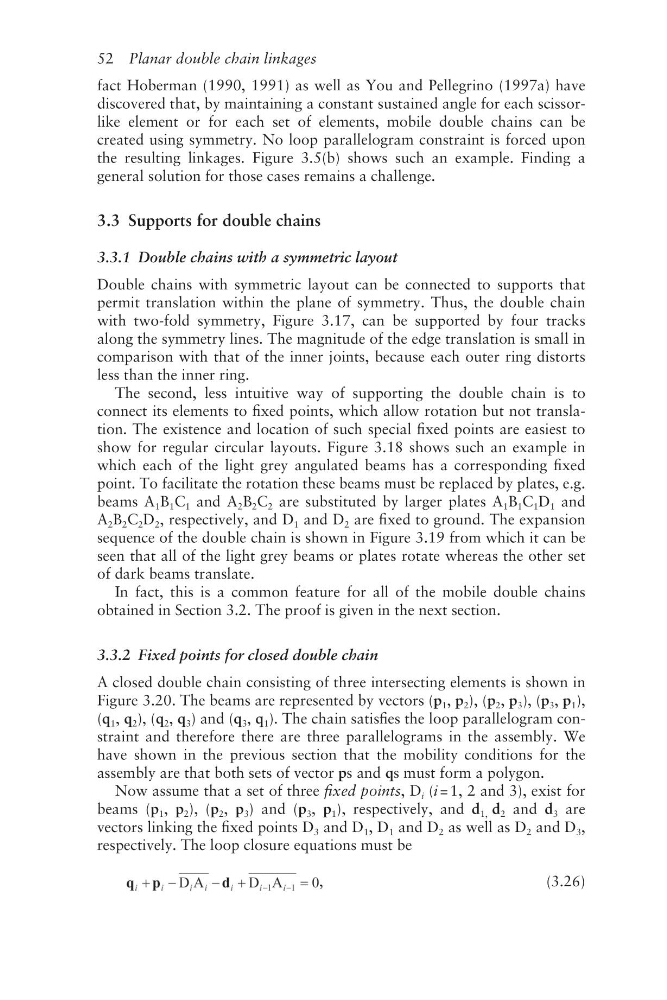
respectively. The loop closure equations must be
,
(3.26)
fact Hoberman (1990, 1991) as well as You and Pellegrino (1997a) have
discovered that, by maintaining a constant sustained angle for each scissorlike element or for each set of elements, mobile double chains can be
created using symmetry. No loop parallelogram constraint is forced upon
the resulting linkages. Figure 3.5(b) shows such an example. Finding a
general solution for those cases remains a challenge.
3.3 Supports for double chains
3.3.1 Double chains with a symmetric layout
Double chains with symmetric layout can be connected to supports that
permit translation within the plane of symmetry. Thus, the double chain
with two- fold symmetry, Figure 3.17, can be supported by four tracks
along the symmetry lines. The magnitude of the edge translation is small in
comparison with that of the inner joints, because each outer ring distorts
less than the inner ring.
The second, less intuitive way of supporting the double chain is to
connect its elements to fixed points, which allow rotation but not translation. The existence and location of such special fixed points are easiest to
show for regular circular layouts. Figure 3.18 shows such an example in
which each of the light grey angulated beams has a corresponding fixed
point. To facilitate the rotation these beams must be replaced by plates, e.g.
beams A 1 B 1 C 1 and A 2 B 2 C 2 are substituted by larger plates A 1 B 1 C 1 D 1 and
A 2 B 2 C 2 D 2 , respectively, and D 1 and D 2 are fixed to ground. The expansion
sequence of the double chain is shown in Figure 3.19 from which it can be
seen that all of the light grey beams or plates rotate whereas the other set
of dark beams translate.
In fact, this is a common feature for all of the mobile double chains
obtained in Section 3.2. The proof is given in the next section.
3.3.2 Fixed points for closed double chain
A closed double chain consisting of three intersecting elements is shown in
Figure 3.20. The beams are represented by vectors (p 1 , p 2 ), (p 2 , p 3 ), (p 3 , p 1 ),
(q 1 , q 2 ), (q 2 , q 3 ) and (q 3 , q 1 ). The chain satisfies the loop parallelogram constraint and therefore there are three parallelograms in the assembly. We
have shown in the previous section that the mobility conditions for the
assembly are that both sets of vector ps and qs must form a polygon.
Now assume that a set of three fixed points, D i (i = 1, 2 and 3), exist for
beams (p 1 , p 2 ), (p 2 , p 3 ) and (p 3 , p 1 ), respectively, and d 1, d 2 and d 3 are
vectors linking the fixed points D 3 and D 1 , D 1 and D 2 as well as D 2 and D 3 ,
respectively. The loop closure equations must be
,
(3.26)