

50 Planar double chain linkages
and
.
(3.25b)
Using the same argument for the immobile double chain assembly consisting of five non- intersecting elements, it can be concluded that this assembly
is also immobile.
For all of the double chain assemblies made from five pairs, we can
determine their mobility using the approach outlined above. The result is
given in Table 3.1. Note that for an immobile double chain the total
number of non- intersecting pairs is always odd regardless of the order of
these pairs in the chain.
The above proofs can be extended to double chains with any number of
intersecting and non- intersecting elements. To sum up, the mobility conditions of a closed double chain linkage constructed subjected to the loop
parallelogram constraint are as follows.
a the number of non- intersecting pairs must be even; and
b the sum of vectors p and q must be zero, respectively.
Based on the derivation, we are able to produce mobile double chains with
both an even and odd number of intersecting scissor- like elements. It is
particularly interesting to note that we are able to produce a mobile double
chain consisting of three intersecting elements, see Figure 3.16.
The limitation of the above derivation is the imposition of the loop parallelogram constraint on all of the double chains. Other mobile closed
double chains also exist, which have been briefly outlined in Section 3.1. In
(a)
(b)
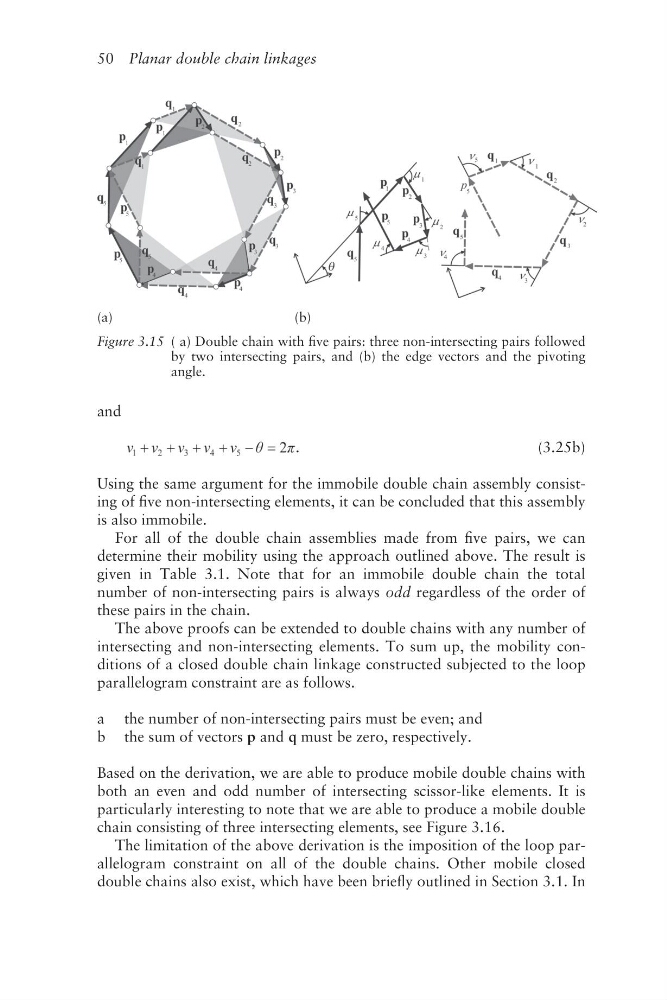
Figure 3.15 ( a) Double chain with five pairs: three non-intersecting pairs followed
by two intersecting pairs, and (b) the edge vectors and the pivoting
angle.
and
.
(3.25b)
Using the same argument for the immobile double chain assembly consisting of five non- intersecting elements, it can be concluded that this assembly
is also immobile.
For all of the double chain assemblies made from five pairs, we can
determine their mobility using the approach outlined above. The result is
given in Table 3.1. Note that for an immobile double chain the total
number of non- intersecting pairs is always odd regardless of the order of
these pairs in the chain.
The above proofs can be extended to double chains with any number of
intersecting and non- intersecting elements. To sum up, the mobility conditions of a closed double chain linkage constructed subjected to the loop
parallelogram constraint are as follows.
a the number of non- intersecting pairs must be even; and
b the sum of vectors p and q must be zero, respectively.
Based on the derivation, we are able to produce mobile double chains with
both an even and odd number of intersecting scissor- like elements. It is
particularly interesting to note that we are able to produce a mobile double
chain consisting of three intersecting elements, see Figure 3.16.
The limitation of the above derivation is the imposition of the loop parallelogram constraint on all of the double chains. Other mobile closed
double chains also exist, which have been briefly outlined in Section 3.1. In
(a)
(b)
Figure 3.15 ( a) Double chain with five pairs: three non-intersecting pairs followed
by two intersecting pairs, and (b) the edge vectors and the pivoting
angle.