

48 Planar double chain linkages
and
,
(3.21b)
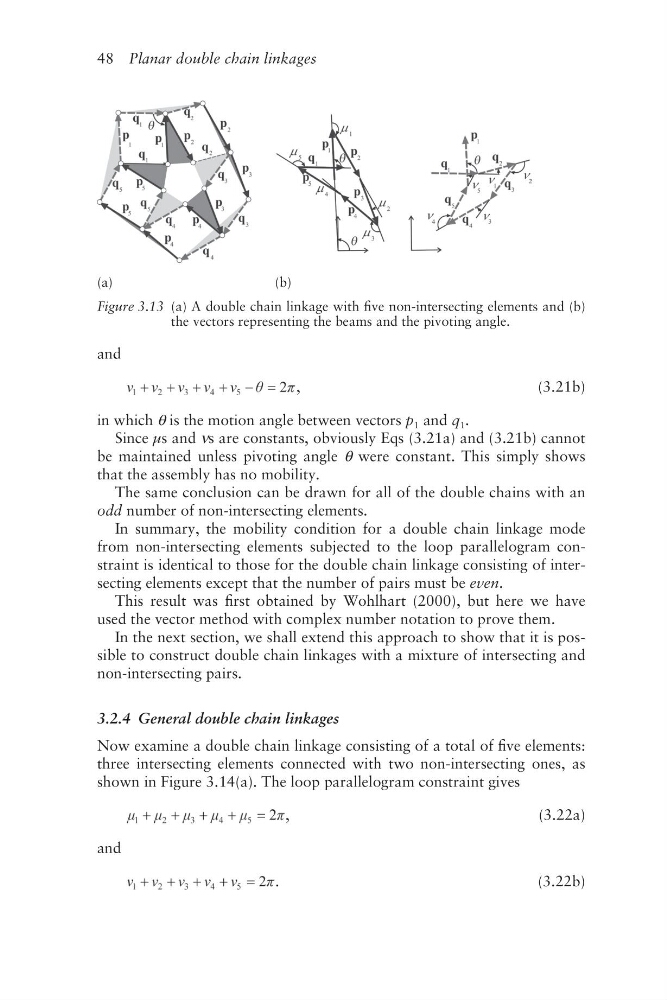
in which θ is the motion angle between vectors p 1 and q 1 .
Since μs and νs are constants, obviously Eqs (3.21a) and (3.21b) cannot
be maintained unless pivoting angle θ were constant. This simply shows
that the assembly has no mobility.
The same conclusion can be drawn for all of the double chains with an
odd number of non- intersecting elements.
In summary, the mobility condition for a double chain linkage mode
from non- intersecting elements subjected to the loop parallelogram constraint is identical to those for the double chain linkage consisting of intersecting elements except that the number of pairs must be even.
This result was first obtained by Wohlhart (2000), but here we have
used the vector method with complex number notation to prove them.
In the next section, we shall extend this approach to show that it is possible to construct double chain linkages with a mixture of intersecting and
non- intersecting pairs.
3.2.4 General double chain linkages
Now examine a double chain linkage consisting of a total of five elements:
three intersecting elements connected with two non- intersecting ones, as
shown in Figure 3.14(a). The loop parallelogram constraint gives
,
(3.22a)
and
.
(3.22b)
(a)
(b)
Figure 3.13 (a) A double chain linkage with five non-intersecting elements and (b)
the vectors representing the beams and the pivoting angle.
and
,
(3.21b)
in which θ is the motion angle between vectors p 1 and q 1 .
Since μs and νs are constants, obviously Eqs (3.21a) and (3.21b) cannot
be maintained unless pivoting angle θ were constant. This simply shows
that the assembly has no mobility.
The same conclusion can be drawn for all of the double chains with an
odd number of non- intersecting elements.
In summary, the mobility condition for a double chain linkage mode
from non- intersecting elements subjected to the loop parallelogram constraint is identical to those for the double chain linkage consisting of intersecting elements except that the number of pairs must be even.
This result was first obtained by Wohlhart (2000), but here we have
used the vector method with complex number notation to prove them.
In the next section, we shall extend this approach to show that it is possible to construct double chain linkages with a mixture of intersecting and
non- intersecting pairs.
3.2.4 General double chain linkages
Now examine a double chain linkage consisting of a total of five elements:
three intersecting elements connected with two non- intersecting ones, as
shown in Figure 3.14(a). The loop parallelogram constraint gives
,
(3.22a)
and
.
(3.22b)
(a)
(b)
Figure 3.13 (a) A double chain linkage with five non-intersecting elements and (b)
the vectors representing the beams and the pivoting angle.