

Planar double chain linkages 41
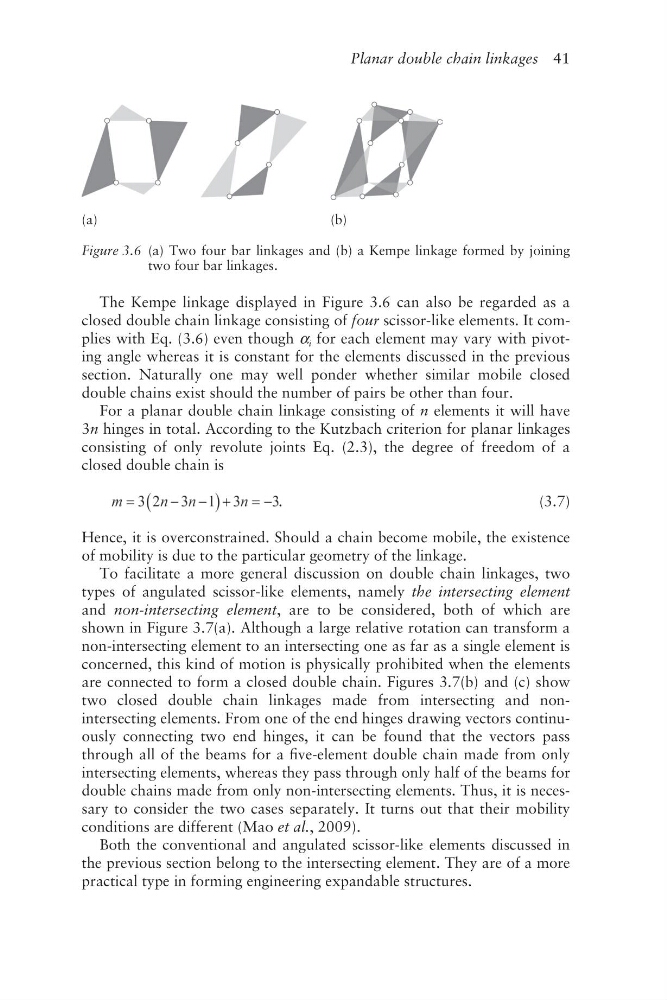
The Kempe linkage displayed in Figure 3.6 can also be regarded as a
closed double chain linkage consisting of four scissor- like elements. It complies with Eq. (3.6) even though α i for each element may vary with pivoting angle whereas it is constant for the elements discussed in the previous
section. Naturally one may well ponder whether similar mobile closed
double chains exist should the number of pairs be other than four.
For a planar double chain linkage consisting of n elements it will have
3n hinges in total. According to the Kutzbach criterion for planar linkages
consisting of only revolute joints Eq. (2.3), the degree of freedom of a
closed double chain is
.
(3.7)
Hence, it is overconstrained. Should a chain become mobile, the existence
of mobility is due to the particular geometry of the linkage.
To facilitate a more general discussion on double chain linkages, two
types of angulated scissor- like elements, namely the intersecting element
and non- intersecting element, are to be considered, both of which are
shown in Figure 3.7(a). Although a large relative rotation can transform a
non- intersecting element to an intersecting one as far as a single element is
concerned, this kind of motion is physically prohibited when the elements
are connected to form a closed double chain. Figures 3.7(b) and (c) show
two closed double chain linkages made from intersecting and nonintersecting elements. From one of the end hinges drawing vectors continuously connecting two end hinges, it can be found that the vectors pass
through all of the beams for a five- element double chain made from only
intersecting elements, whereas they pass through only half of the beams for
double chains made from only non- intersecting elements. Thus, it is necessary to consider the two cases separately. It turns out that their mobility
conditions are different (Mao et al., 2009).
Both the conventional and angulated scissor- like elements discussed in
the previous section belong to the intersecting element. They are of a more
practical type in forming engineering expandable structures.
(a)
(b)
Figure 3.6 (a) Two four bar linkages and (b) a Kempe linkage formed by joining
two four bar linkages.
The Kempe linkage displayed in Figure 3.6 can also be regarded as a
closed double chain linkage consisting of four scissor- like elements. It complies with Eq. (3.6) even though α i for each element may vary with pivoting angle whereas it is constant for the elements discussed in the previous
section. Naturally one may well ponder whether similar mobile closed
double chains exist should the number of pairs be other than four.
For a planar double chain linkage consisting of n elements it will have
3n hinges in total. According to the Kutzbach criterion for planar linkages
consisting of only revolute joints Eq. (2.3), the degree of freedom of a
closed double chain is
.
(3.7)
Hence, it is overconstrained. Should a chain become mobile, the existence
of mobility is due to the particular geometry of the linkage.
To facilitate a more general discussion on double chain linkages, two
types of angulated scissor- like elements, namely the intersecting element
and non- intersecting element, are to be considered, both of which are
shown in Figure 3.7(a). Although a large relative rotation can transform a
non- intersecting element to an intersecting one as far as a single element is
concerned, this kind of motion is physically prohibited when the elements
are connected to form a closed double chain. Figures 3.7(b) and (c) show
two closed double chain linkages made from intersecting and nonintersecting elements. From one of the end hinges drawing vectors continuously connecting two end hinges, it can be found that the vectors pass
through all of the beams for a five- element double chain made from only
intersecting elements, whereas they pass through only half of the beams for
double chains made from only non- intersecting elements. Thus, it is necessary to consider the two cases separately. It turns out that their mobility
conditions are different (Mao et al., 2009).
Both the conventional and angulated scissor- like elements discussed in
the previous section belong to the intersecting element. They are of a more
practical type in forming engineering expandable structures.
(a)
(b)
Figure 3.6 (a) Two four bar linkages and (b) a Kempe linkage formed by joining
two four bar linkages.