

152 Layouts of spatial motion structures
Note that some of the motion structures with layouts based on tilings
exhibit three dimensional motion and have curved profiles despite that
tilings are essentially two dimensional. This is due to the fact that the
building blocks are based on three dimensional mechanisms. A truly three
dimensional layout may be obtained using the uniform polyhedra. In the
past, Kovács et al. (2004) proposed a class of expandable polyhedral structures transforming between dodecahedron and truncated icosahedrons.
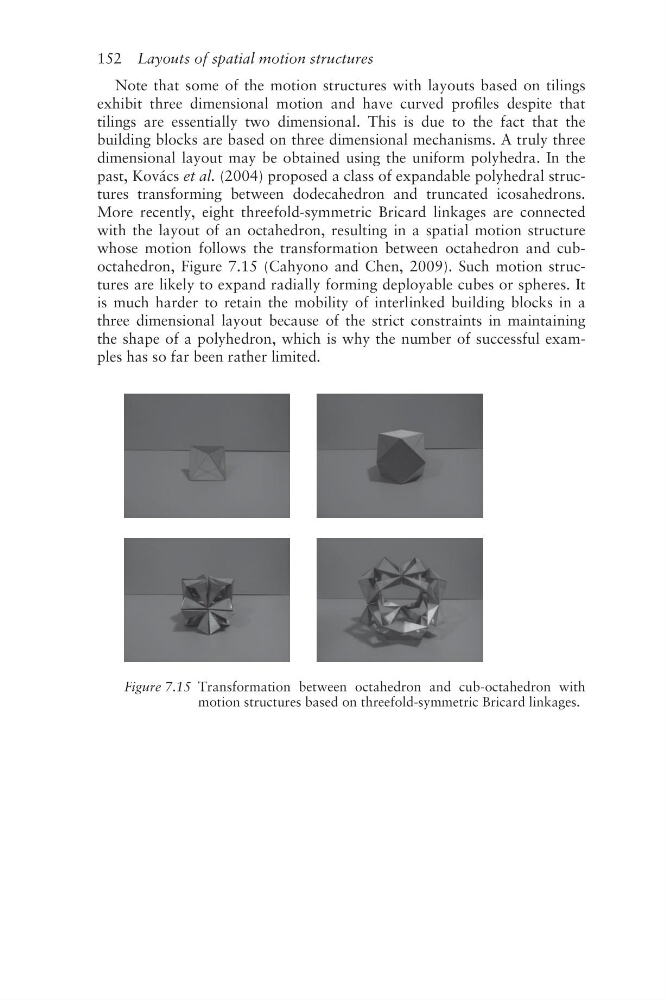
More recently, eight threefold- symmetric Bricard linkages are connected
with the layout of an octahedron, resulting in a spatial motion structure
whose motion follows the transformation between octahedron and cuboctahedron, Figure 7.15 (Cahyono and Chen, 2009). Such motion structures are likely to expand radially forming deployable cubes or spheres. It
is much harder to retain the mobility of interlinked building blocks in a
three dimensional layout because of the strict constraints in maintaining
the shape of a polyhedron, which is why the number of successful examples has so far been rather limited.
Figure 7.15 Transformation between octahedron and cub-octahedron with
motion structures based on threefold-symmetric Bricard linkages.
Note that some of the motion structures with layouts based on tilings
exhibit three dimensional motion and have curved profiles despite that
tilings are essentially two dimensional. This is due to the fact that the
building blocks are based on three dimensional mechanisms. A truly three
dimensional layout may be obtained using the uniform polyhedra. In the
past, Kovács et al. (2004) proposed a class of expandable polyhedral structures transforming between dodecahedron and truncated icosahedrons.
More recently, eight threefold- symmetric Bricard linkages are connected
with the layout of an octahedron, resulting in a spatial motion structure
whose motion follows the transformation between octahedron and cuboctahedron, Figure 7.15 (Cahyono and Chen, 2009). Such motion structures are likely to expand radially forming deployable cubes or spheres. It
is much harder to retain the mobility of interlinked building blocks in a
three dimensional layout because of the strict constraints in maintaining
the shape of a polyhedron, which is why the number of successful examples has so far been rather limited.
Figure 7.15 Transformation between octahedron and cub-octahedron with
motion structures based on threefold-symmetric Bricard linkages.