

150 Layouts of spatial motion structures
motion. The kinematic motion requirement can now be met. However, the
entire assembly no longer exhibits the synchronised motion common for
assemblies of mobility one.
7.4.2 Case II
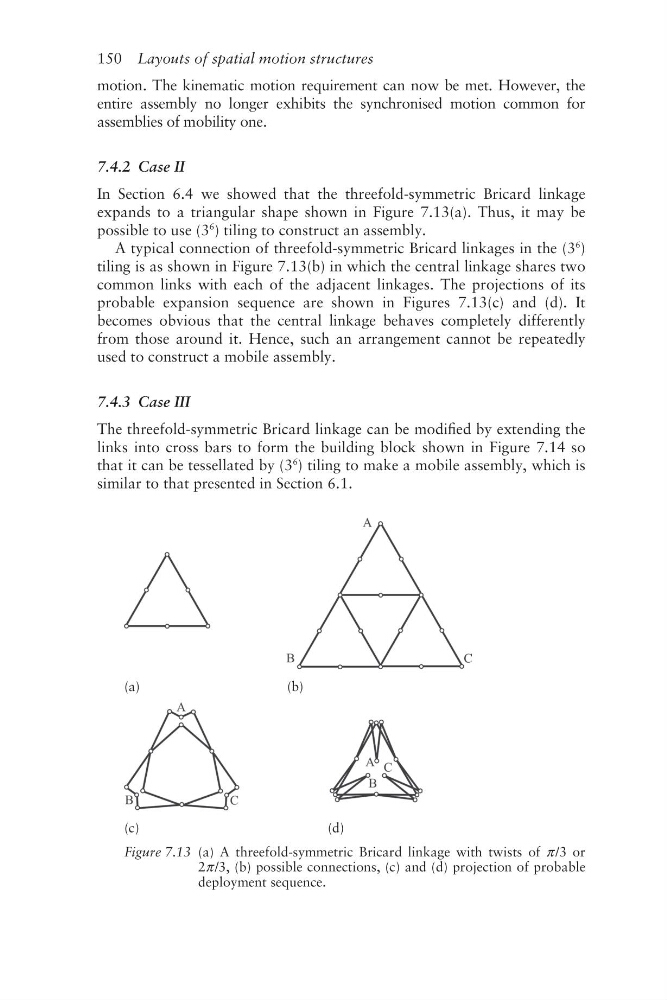
In Section 6.4 we showed that the threefold- symmetric Bricard linkage
expands to a triangular shape shown in Figure 7.13(a). Thus, it may be
possible to use (3
6
) tiling to construct an assembly.
A typical connection of threefold- symmetric Bricard linkages in the (3
6
)
tiling is as shown in Figure 7.13(b) in which the central linkage shares two
common links with each of the adjacent linkages. The projections of its
probable expansion sequence are shown in Figures 7.13(c) and (d). It
becomes obvious that the central linkage behaves completely differently
from those around it. Hence, such an arrangement cannot be repeatedly
used to construct a mobile assembly.
7.4.3 Case III
The threefold- symmetric Bricard linkage can be modified by extending the
links into cross bars to form the building block shown in Figure 7.14 so
that it can be tessellated by (3
6
) tiling to make a mobile assembly, which is
similar to that presented in Section 6.1.
(a)
(b)
(c)
(d)
Figure 7.13 (a) A threefold-symmetric Bricard linkage with twists of π /3 or
2π /3, (b) possible connections, (c) and (d) projection of probable
deployment sequence.
motion. The kinematic motion requirement can now be met. However, the
entire assembly no longer exhibits the synchronised motion common for
assemblies of mobility one.
7.4.2 Case II
In Section 6.4 we showed that the threefold- symmetric Bricard linkage
expands to a triangular shape shown in Figure 7.13(a). Thus, it may be
possible to use (3
6
) tiling to construct an assembly.
A typical connection of threefold- symmetric Bricard linkages in the (3
6
)
tiling is as shown in Figure 7.13(b) in which the central linkage shares two
common links with each of the adjacent linkages. The projections of its
probable expansion sequence are shown in Figures 7.13(c) and (d). It
becomes obvious that the central linkage behaves completely differently
from those around it. Hence, such an arrangement cannot be repeatedly
used to construct a mobile assembly.
7.4.3 Case III
The threefold- symmetric Bricard linkage can be modified by extending the
links into cross bars to form the building block shown in Figure 7.14 so
that it can be tessellated by (3
6
) tiling to make a mobile assembly, which is
similar to that presented in Section 6.1.
(a)
(b)
(c)
(d)
Figure 7.13 (a) A threefold-symmetric Bricard linkage with twists of π /3 or
2π /3, (b) possible connections, (c) and (d) projection of probable
deployment sequence.