

Layouts of spatial motion structures 137
k- uniform tilings, equitransitive and edge- transitive tilings, and tilings that
are not edge- to-edge (Grünbaum and Shephard, 1986).
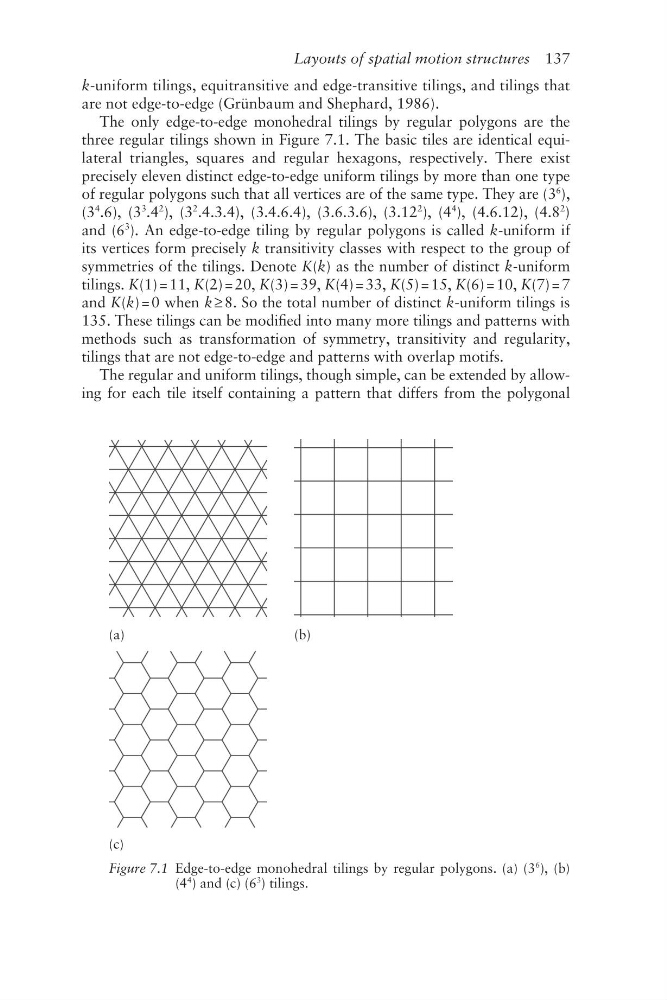
The only edge- to-edge monohedral tilings by regular polygons are the
three regular tilings shown in Figure 7.1. The basic tiles are identical equilateral triangles, squares and regular hexagons, respectively. There exist
precisely eleven distinct edge- to-edge uniform tilings by more than one type
of regular polygons such that all vertices are of the same type. They are (3
6
),
(3
4
.6), (3
3
.4
2
), (3
2
.4.3.4), (3.4.6.4), (3.6.3.6), (3.12
2
), (4
4
), (4.6.12), (4.8
2
)
and (6
3
). An edge- to-edge tiling by regular polygons is called k- uniform if
its vertices form precisely k transitivity classes with respect to the group of
symmetries of the tilings. Denote K(k) as the number of distinct k- uniform
tilings. K(1) = 11, K(2) = 20, K(3) = 39, K(4) = 33, K(5) = 15, K(6) = 10, K(7) = 7
and K(k) = 0 when k ≥ 8. So the total number of distinct k- uniform tilings is
135. These tilings can be modified into many more tilings and patterns with
methods such as transformation of symmetry, transitivity and regularity,
tilings that are not edge- to-edge and patterns with overlap motifs.
The regular and uniform tilings, though simple, can be extended by allowing for each tile itself containing a pattern that differs from the polygonal
(a)
(b)
(c)
Figure 7.1 Edge-to-edge monohedral tilings by regular polygons. (a) (3
6
), (b)
(4
4
) and (c) (6
3
) tilings.
k- uniform tilings, equitransitive and edge- transitive tilings, and tilings that
are not edge- to-edge (Grünbaum and Shephard, 1986).
The only edge- to-edge monohedral tilings by regular polygons are the
three regular tilings shown in Figure 7.1. The basic tiles are identical equilateral triangles, squares and regular hexagons, respectively. There exist
precisely eleven distinct edge- to-edge uniform tilings by more than one type
of regular polygons such that all vertices are of the same type. They are (3
6
),
(3
4
.6), (3
3
.4
2
), (3
2
.4.3.4), (3.4.6.4), (3.6.3.6), (3.12
2
), (4
4
), (4.6.12), (4.8
2
)
and (6
3
). An edge- to-edge tiling by regular polygons is called k- uniform if
its vertices form precisely k transitivity classes with respect to the group of
symmetries of the tilings. Denote K(k) as the number of distinct k- uniform
tilings. K(1) = 11, K(2) = 20, K(3) = 39, K(4) = 33, K(5) = 15, K(6) = 10, K(7) = 7
and K(k) = 0 when k ≥ 8. So the total number of distinct k- uniform tilings is
135. These tilings can be modified into many more tilings and patterns with
methods such as transformation of symmetry, transitivity and regularity,
tilings that are not edge- to-edge and patterns with overlap motifs.
The regular and uniform tilings, though simple, can be extended by allowing for each tile itself containing a pattern that differs from the polygonal
(a)
(b)
(c)
Figure 7.1 Edge-to-edge monohedral tilings by regular polygons. (a) (3
6
), (b)
(4
4
) and (c) (6
3
) tilings.