

130 The Bricard linkages
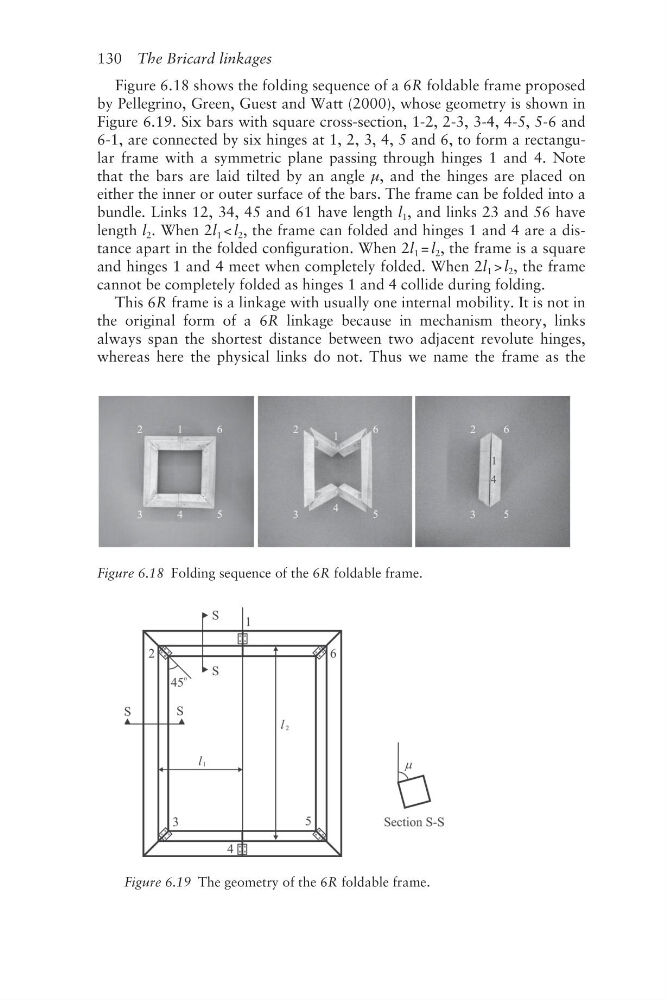
Figure 6.18 shows the folding sequence of a 6R foldable frame proposed
by Pellegrino, Green, Guest and Watt (2000), whose geometry is shown in
Figure 6.19. Six bars with square cross- section, 1-2, 2-3, 3-4, 4-5, 5-6 and
6-1, are connected by six hinges at 1, 2, 3, 4, 5 and 6, to form a rectangular frame with a symmetric plane passing through hinges 1 and 4. Note
that the bars are laid tilted by an angle μ, and the hinges are placed on
either the inner or outer surface of the bars. The frame can be folded into a
bundle. Links 12, 34, 45 and 61 have length l 1 , and links 23 and 56 have
length l 2 . When 2l 1 < l 2 , the frame can folded and hinges 1 and 4 are a distance apart in the folded configuration. When 2l 1 = l 2 , the frame is a square
and hinges 1 and 4 meet when completely folded. When 2l 1 > l 2 , the frame
cannot be completely folded as hinges 1 and 4 collide during folding.
This 6R frame is a linkage with usually one internal mobility. It is not in
the original form of a 6R linkage because in mechanism theory, links
always span the shortest distance between two adjacent revolute hinges,
whereas here the physical links do not. Thus we name the frame as the
Figure 6.18 Folding sequence of the 6R foldable frame.
Figure 6.19 The geometry of the 6R foldable frame.
Figure 6.18 shows the folding sequence of a 6R foldable frame proposed
by Pellegrino, Green, Guest and Watt (2000), whose geometry is shown in
Figure 6.19. Six bars with square cross- section, 1-2, 2-3, 3-4, 4-5, 5-6 and
6-1, are connected by six hinges at 1, 2, 3, 4, 5 and 6, to form a rectangular frame with a symmetric plane passing through hinges 1 and 4. Note
that the bars are laid tilted by an angle μ, and the hinges are placed on
either the inner or outer surface of the bars. The frame can be folded into a
bundle. Links 12, 34, 45 and 61 have length l 1 , and links 23 and 56 have
length l 2 . When 2l 1 < l 2 , the frame can folded and hinges 1 and 4 are a distance apart in the folded configuration. When 2l 1 = l 2 , the frame is a square
and hinges 1 and 4 meet when completely folded. When 2l 1 > l 2 , the frame
cannot be completely folded as hinges 1 and 4 collide during folding.
This 6R frame is a linkage with usually one internal mobility. It is not in
the original form of a 6R linkage because in mechanism theory, links
always span the shortest distance between two adjacent revolute hinges,
whereas here the physical links do not. Thus we name the frame as the
Figure 6.18 Folding sequence of the 6R foldable frame.
Figure 6.19 The geometry of the 6R foldable frame.