

128 The Bricard linkages
,
,
,
,
,
(6.8)
,
,
.
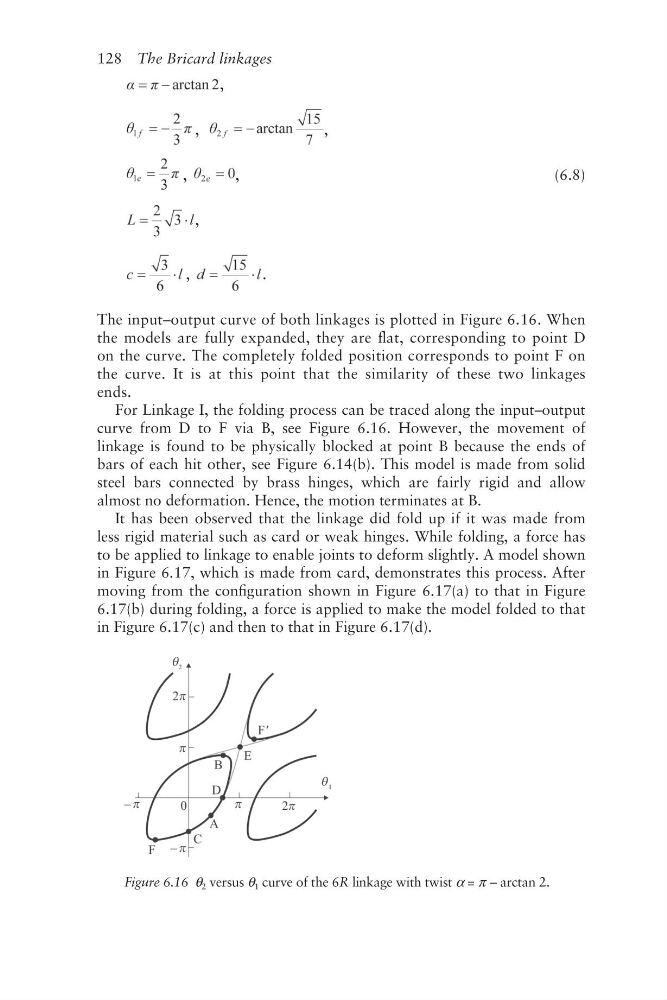
The input–output curve of both linkages is plotted in Figure 6.16. When
the models are fully expanded, they are flat, corresponding to point D
on the curve. The completely folded position corresponds to point F on
the curve. It is at this point that the similarity of these two linkages
ends.
For Linkage I, the folding process can be traced along the input–output
curve from D to F via B, see Figure 6.16. However, the movement of
linkage is found to be physically blocked at point B because the ends of
bars of each hit other, see Figure 6.14(b). This model is made from solid
steel bars connected by brass hinges, which are fairly rigid and allow
almost no deformation. Hence, the motion terminates at B.
It has been observed that the linkage did fold up if it was made from
less rigid material such as card or weak hinges. While folding, a force has
to be applied to linkage to enable joints to deform slightly. A model shown
in Figure 6.17, which is made from card, demonstrates this process. After
moving from the configuration shown in Figure 6.17(a) to that in Figure
6.17(b) during folding, a force is applied to make the model folded to that
in Figure 6.17(c) and then to that in Figure 6.17(d).
Figure 6.16 θ 2 versus θ 1 curve of the 6R linkage with twist α = π – arctan 2.
,
,
,
,
,
(6.8)
,
,
.
The input–output curve of both linkages is plotted in Figure 6.16. When
the models are fully expanded, they are flat, corresponding to point D
on the curve. The completely folded position corresponds to point F on
the curve. It is at this point that the similarity of these two linkages
ends.
For Linkage I, the folding process can be traced along the input–output
curve from D to F via B, see Figure 6.16. However, the movement of
linkage is found to be physically blocked at point B because the ends of
bars of each hit other, see Figure 6.14(b). This model is made from solid
steel bars connected by brass hinges, which are fairly rigid and allow
almost no deformation. Hence, the motion terminates at B.
It has been observed that the linkage did fold up if it was made from
less rigid material such as card or weak hinges. While folding, a force has
to be applied to linkage to enable joints to deform slightly. A model shown
in Figure 6.17, which is made from card, demonstrates this process. After
moving from the configuration shown in Figure 6.17(a) to that in Figure
6.17(b) during folding, a force is applied to make the model folded to that
in Figure 6.17(c) and then to that in Figure 6.17(d).
Figure 6.16 θ 2 versus θ 1 curve of the 6R linkage with twist α = π – arctan 2.