

The Bennett linkage 91
The solutions given in Eqs (5.34) and (5.35) indicate that, in order to
connect the top right 4R loop PVND and the bottom left 4R loop JBKS,
they must have either zero twists or twists identical to those of larger 4R
loop. Both possibilities are shown in Figure 5.9(c) where twists are marked
alongside corresponding links.
The connectivity of the top left 4R loop AIQE and the bottom right 4R
loop GLCM along the other diagonal direction by an additional 4R loop
EFGH, Figure 5.9(d), can also be examined using the similar analysis. It is
found that connectivity is possible only in two cases. The first case is when
loops AIQE and GLCM have the same twists as those of 4R loop ABCD,
which are α and β. The twists of the connection 4R loop EFGH are –α and
–β. The second case is when loops AIQE and GLCM have zero twists, i.e.
both are planar 4R loops, and the twists of the connection 4R loop EFGH
are α and β.
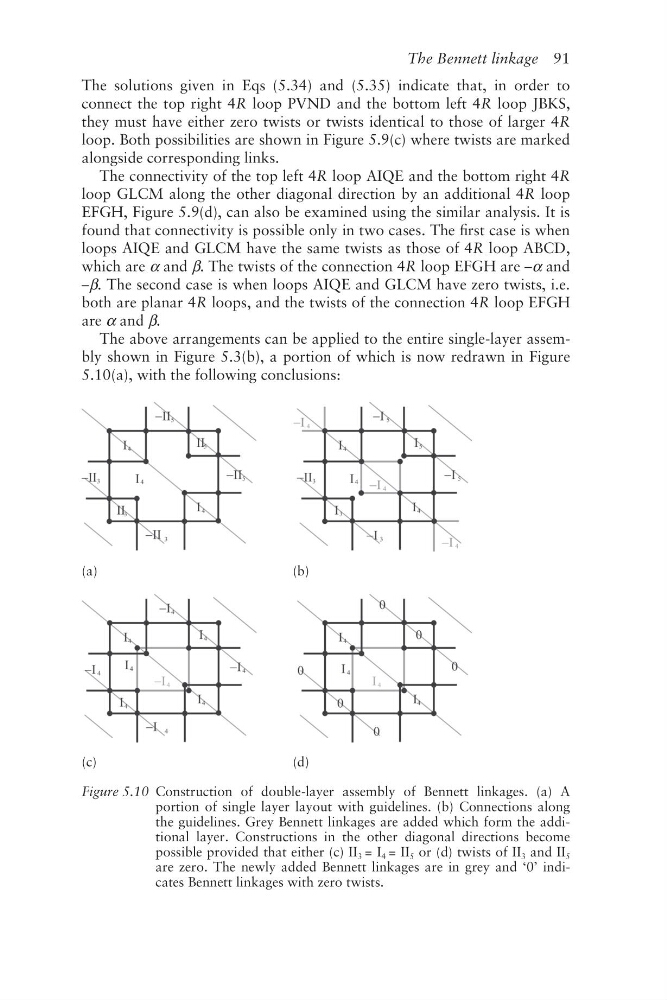
The above arrangements can be applied to the entire single- layer assembly shown in Figure 5.3(b), a portion of which is now redrawn in Figure
5.10(a), with the following conclusions:
(a)
(b)
(c)
(d)
Figure 5.10 Construction of double-layer assembly of Bennett linkages. (a) A
portion of single layer layout with guidelines. (b) Connections along
the guidelines. Grey Bennett linkages are added which form the additional layer. Constructions in the other diagonal directions become
possible provided that either (c) II 3 = I 4 = II 5 or (d) twists of II 3 and II 5
are zero. The newly added Bennett linkages are in grey and ‘0’ indicates Bennett linkages with zero twists.
The solutions given in Eqs (5.34) and (5.35) indicate that, in order to
connect the top right 4R loop PVND and the bottom left 4R loop JBKS,
they must have either zero twists or twists identical to those of larger 4R
loop. Both possibilities are shown in Figure 5.9(c) where twists are marked
alongside corresponding links.
The connectivity of the top left 4R loop AIQE and the bottom right 4R
loop GLCM along the other diagonal direction by an additional 4R loop
EFGH, Figure 5.9(d), can also be examined using the similar analysis. It is
found that connectivity is possible only in two cases. The first case is when
loops AIQE and GLCM have the same twists as those of 4R loop ABCD,
which are α and β. The twists of the connection 4R loop EFGH are –α and
–β. The second case is when loops AIQE and GLCM have zero twists, i.e.
both are planar 4R loops, and the twists of the connection 4R loop EFGH
are α and β.
The above arrangements can be applied to the entire single- layer assembly shown in Figure 5.3(b), a portion of which is now redrawn in Figure
5.10(a), with the following conclusions:
(a)
(b)
(c)
(d)
Figure 5.10 Construction of double-layer assembly of Bennett linkages. (a) A
portion of single layer layout with guidelines. (b) Connections along
the guidelines. Grey Bennett linkages are added which form the additional layer. Constructions in the other diagonal directions become
possible provided that either (c) II 3 = I 4 = II 5 or (d) twists of II 3 and II 5
are zero. The newly added Bennett linkages are in grey and ‘0’ indicates Bennett linkages with zero twists.