

5.3 Positions and Parallaxes of Stars
73
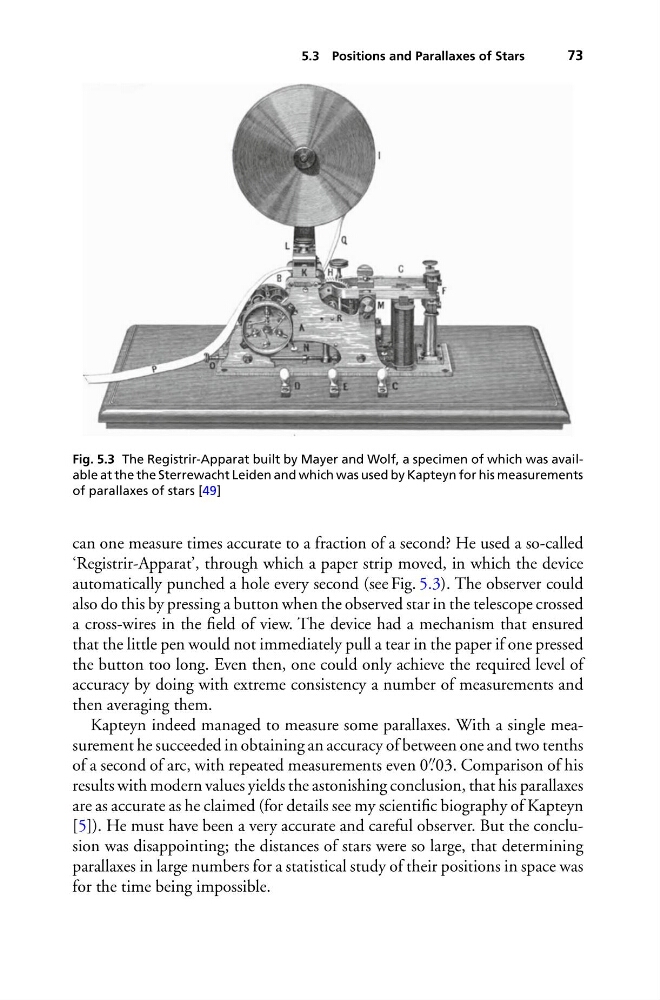
Fig. 5.3 The Registrir-Apparat built by Mayer and Wolf, a specimen of which was available at the the Sterrewacht Leiden and which was used by Kapteyn for his measurements
of parallaxes of stars [49]
can one measure times accurate to a fraction of a second? He used a so-called
‘Registrir-Apparat’, through which a paper strip moved, in which the device
automatically punched a hole every second (see Fig. 5.3). The observer could
also do this by pressing a button when the observed star in the telescope crossed
a cross-wires in the field of view. The device had a mechanism that ensured
that the little pen would not immediately pull a tear in the paper if one pressed
the button too long. Even then, one could only achieve the required level of
accuracy by doing with extreme consistency a number of measurements and
then averaging them.
Kapteyn indeed managed to measure some parallaxes. With a single measurement he succeeded in obtaining an accuracy of between one and two tenths
of a second of arc, with repeated measurements even 0 .03. Comparison of his
results with modern values yields the astonishing conclusion, that his parallaxes
are as accurate as he claimed (for details see my scientific biography of Kapteyn
[5]). He must have been a very accurate and careful observer. But the conclusion was disappointing; the distances of stars were so large, that determining
parallaxes in large numbers for a statistical study of their positions in space was
for the time being impossible.
73
Fig. 5.3 The Registrir-Apparat built by Mayer and Wolf, a specimen of which was available at the the Sterrewacht Leiden and which was used by Kapteyn for his measurements
of parallaxes of stars [49]
can one measure times accurate to a fraction of a second? He used a so-called
‘Registrir-Apparat’, through which a paper strip moved, in which the device
automatically punched a hole every second (see Fig. 5.3). The observer could
also do this by pressing a button when the observed star in the telescope crossed
a cross-wires in the field of view. The device had a mechanism that ensured
that the little pen would not immediately pull a tear in the paper if one pressed
the button too long. Even then, one could only achieve the required level of
accuracy by doing with extreme consistency a number of measurements and
then averaging them.
Kapteyn indeed managed to measure some parallaxes. With a single measurement he succeeded in obtaining an accuracy of between one and two tenths
of a second of arc, with repeated measurements even 0 .03. Comparison of his
results with modern values yields the astonishing conclusion, that his parallaxes
are as accurate as he claimed (for details see my scientific biography of Kapteyn
[5]). He must have been a very accurate and careful observer. But the conclusion was disappointing; the distances of stars were so large, that determining
parallaxes in large numbers for a statistical study of their positions in space was
for the time being impossible.