

5.3 Positions and Parallaxes of Stars
71
refraction do not play a role, because again differences in altitude were used
and then these effects cancel in the subtraction. Kapteyn showed that with his
technique is was possible to determine the absolute altitude of the pole above
the horizon. These conditions were so specific that in practice no such combination of three stars was available, but Kapteyn showed that one could still
get good results when observations of a large number of similar approximate
combinations of stars, scattered all over the sky, were used.
Kapteyn did not stop with merely presenting a method. In the summer
vacation of 1882 he was allowed to test his method with an instrument in
Leiden (because of bad weather he partly used measurements he had taken for
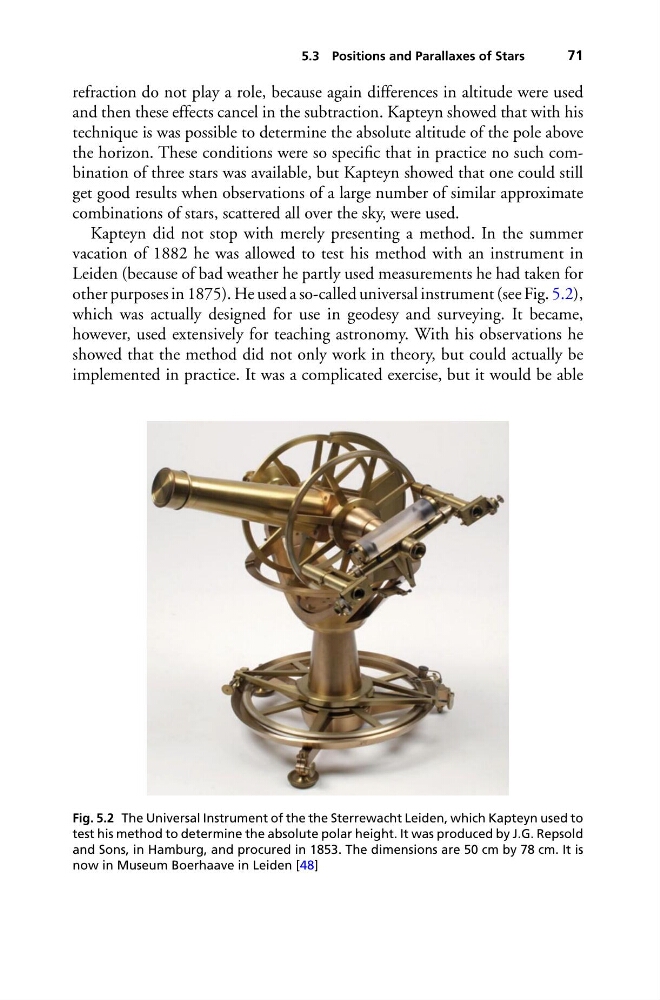
other purposes in 1875). He used a so-called universal instrument (see Fig. 5.2),
which was actually designed for use in geodesy and surveying. It became,
however, used extensively for teaching astronomy. With his observations he
showed that the method did not only work in theory, but could actually be
implemented in practice. It was a complicated exercise, but it would be able
Fig. 5.2 The Universal Instrument of the the Sterrewacht Leiden, which Kapteyn used to
test his method to determine the absolute polar height. It was produced by J.G. Repsold
and Sons, in Hamburg, and procured in 1853. The dimensions are 50 cm by 78 cm. It is
now in Museum Boerhaave in Leiden [48]
71
refraction do not play a role, because again differences in altitude were used
and then these effects cancel in the subtraction. Kapteyn showed that with his
technique is was possible to determine the absolute altitude of the pole above
the horizon. These conditions were so specific that in practice no such combination of three stars was available, but Kapteyn showed that one could still
get good results when observations of a large number of similar approximate
combinations of stars, scattered all over the sky, were used.
Kapteyn did not stop with merely presenting a method. In the summer
vacation of 1882 he was allowed to test his method with an instrument in
Leiden (because of bad weather he partly used measurements he had taken for
other purposes in 1875). He used a so-called universal instrument (see Fig. 5.2),
which was actually designed for use in geodesy and surveying. It became,
however, used extensively for teaching astronomy. With his observations he
showed that the method did not only work in theory, but could actually be
implemented in practice. It was a complicated exercise, but it would be able
Fig. 5.2 The Universal Instrument of the the Sterrewacht Leiden, which Kapteyn used to
test his method to determine the absolute polar height. It was produced by J.G. Repsold
and Sons, in Hamburg, and procured in 1853. The dimensions are 50 cm by 78 cm. It is
now in Museum Boerhaave in Leiden [48]