

3.3 The Construction of the Heavens
41
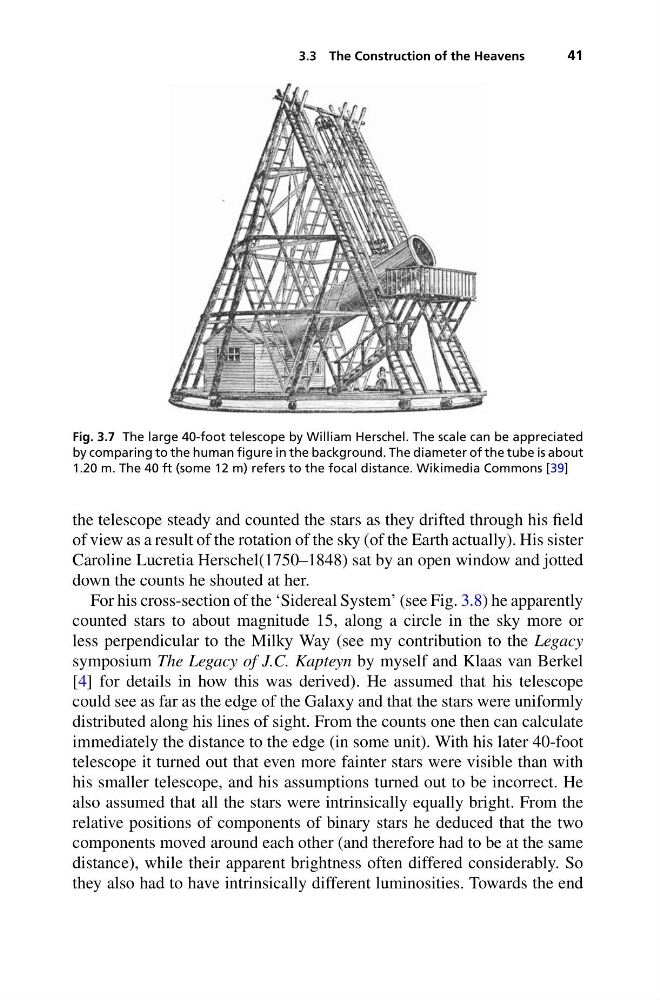
Fig. 3.7 The large 40-foot telescope by William Herschel. The scale can be appreciated
by comparing to the human figure in the background. The diameter of the tube is about
1.20 m. The 40 ft (some 12 m) refers to the focal distance. Wikimedia Commons [39]
the telescope steady and counted the stars as they drifted through his field
of view as a result of the rotation of the sky (of the Earth actually). His sister
Caroline Lucretia Herschel(1750–1848) sat by an open window and jotted
down the counts he shouted at her.
For his cross-section of the ‘Sidereal System’ (see Fig. 3.8) he apparently
counted stars to about magnitude 15, along a circle in the sky more or
less perpendicular to the Milky Way (see my contribution to the Legacy
symposium The Legacy of J.C. Kapteyn by myself and Klaas van Berkel
[4] for details in how this was derived). He assumed that his telescope
could see as far as the edge of the Galaxy and that the stars were uniformly
distributed along his lines of sight. From the counts one then can calculate
immediately the distance to the edge (in some unit). With his later 40-foot
telescope it turned out that even more fainter stars were visible than with
his smaller telescope, and his assumptions turned out to be incorrect. He
also assumed that all the stars were intrinsically equally bright. From the
relative positions of components of binary stars he deduced that the two
components moved around each other (and therefore had to be at the same
distance), while their apparent brightness often differed considerably. So
they also had to have intrinsically different luminosities. Towards the end
41
Fig. 3.7 The large 40-foot telescope by William Herschel. The scale can be appreciated
by comparing to the human figure in the background. The diameter of the tube is about
1.20 m. The 40 ft (some 12 m) refers to the focal distance. Wikimedia Commons [39]
the telescope steady and counted the stars as they drifted through his field
of view as a result of the rotation of the sky (of the Earth actually). His sister
Caroline Lucretia Herschel(1750–1848) sat by an open window and jotted
down the counts he shouted at her.
For his cross-section of the ‘Sidereal System’ (see Fig. 3.8) he apparently
counted stars to about magnitude 15, along a circle in the sky more or
less perpendicular to the Milky Way (see my contribution to the Legacy
symposium The Legacy of J.C. Kapteyn by myself and Klaas van Berkel
[4] for details in how this was derived). He assumed that his telescope
could see as far as the edge of the Galaxy and that the stars were uniformly
distributed along his lines of sight. From the counts one then can calculate
immediately the distance to the edge (in some unit). With his later 40-foot
telescope it turned out that even more fainter stars were visible than with
his smaller telescope, and his assumptions turned out to be incorrect. He
also assumed that all the stars were intrinsically equally bright. From the
relative positions of components of binary stars he deduced that the two
components moved around each other (and therefore had to be at the same
distance), while their apparent brightness often differed considerably. So
they also had to have intrinsically different luminosities. Towards the end