

34
3 Astronomy Around 1875
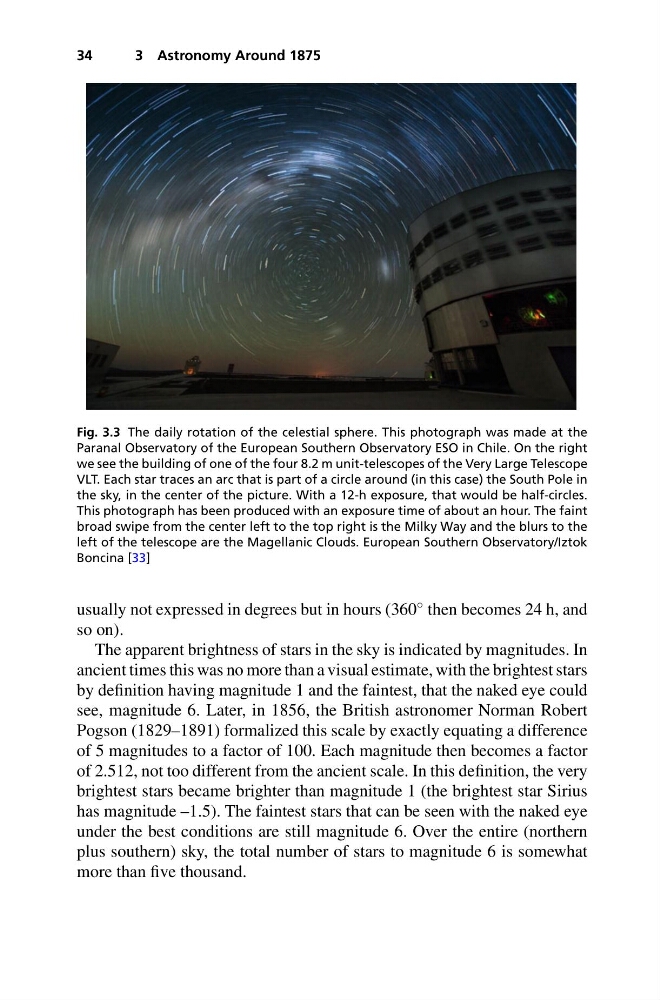
Fig. 3.3 The daily rotation of the celestial sphere. This photograph was made at the
Paranal Observatory of the European Southern Observatory ESO in Chile. On the right
we see the building of one of the four 8.2 m unit-telescopes of the Very Large Telescope
VLT. Each star traces an arc that is part of a circle around (in this case) the South Pole in
the sky, in the center of the picture. With a 12-h exposure, that would be half-circles.
This photograph has been produced with an exposure time of about an hour. The faint
broad swipe from the center left to the top right is the Milky Way and the blurs to the
left of the telescope are the Magellanic Clouds. European Southern Observatory/Iztok
Boncina [33]
usually not expressed in degrees but in hours (360 ◦ then becomes 24 h, and
so on).
The apparent brightness of stars in the sky is indicated by magnitudes. In
ancient times this was no more than a visual estimate, with the brightest stars
by definition having magnitude 1 and the faintest, that the naked eye could
see, magnitude 6. Later, in 1856, the British astronomer Norman Robert
Pogson (1829–1891) formalized this scale by exactly equating a difference
of 5 magnitudes to a factor of 100. Each magnitude then becomes a factor
of 2.512, not too different from the ancient scale. In this definition, the very
brightest stars became brighter than magnitude 1 (the brightest star Sirius
has magnitude –1.5). The faintest stars that can be seen with the naked eye
under the best conditions are still magnitude 6. Over the entire (northern
plus southern) sky, the total number of stars to magnitude 6 is somewhat
more than five thousand.
3 Astronomy Around 1875
Fig. 3.3 The daily rotation of the celestial sphere. This photograph was made at the
Paranal Observatory of the European Southern Observatory ESO in Chile. On the right
we see the building of one of the four 8.2 m unit-telescopes of the Very Large Telescope
VLT. Each star traces an arc that is part of a circle around (in this case) the South Pole in
the sky, in the center of the picture. With a 12-h exposure, that would be half-circles.
This photograph has been produced with an exposure time of about an hour. The faint
broad swipe from the center left to the top right is the Milky Way and the blurs to the
left of the telescope are the Magellanic Clouds. European Southern Observatory/Iztok
Boncina [33]
usually not expressed in degrees but in hours (360 ◦ then becomes 24 h, and
so on).
The apparent brightness of stars in the sky is indicated by magnitudes. In
ancient times this was no more than a visual estimate, with the brightest stars
by definition having magnitude 1 and the faintest, that the naked eye could
see, magnitude 6. Later, in 1856, the British astronomer Norman Robert
Pogson (1829–1891) formalized this scale by exactly equating a difference
of 5 magnitudes to a factor of 100. Each magnitude then becomes a factor
of 2.512, not too different from the ancient scale. In this definition, the very
brightest stars became brighter than magnitude 1 (the brightest star Sirius
has magnitude –1.5). The faintest stars that can be seen with the naked eye
under the best conditions are still magnitude 6. Over the entire (northern
plus southern) sky, the total number of stars to magnitude 6 is somewhat
more than five thousand.